Constraint Management Tools: Software, Methods, and an Executive Operating Loop

Constraint management tools help leaders identify the limiting factor, inspect evidence, coordinate action, and verify whether company throughput improved.

Constraint management command center showing company goals, performance signals, revenue, and the current limiting factor in Commandix for constraint management tools
Constraint management command centerConstraint work begins with the business outcome and the evidence that deserves executive attention.
On this page

Key takeaways

  • Constraint management requires more than an analysis diagram: leaders need connected evidence, action ownership, and a throughput feedback loop.
  • The right toolset starts with the goal, distinguishes symptoms from the limiting factor, and makes exploit, subordinate, and elevate decisions visible.
  • Software should support judgment and coordination; it should not declare a person the bottleneck from one workload metric.

Constraint management tools range from a whiteboard and a queue report to flow analytics, workload models, root-cause methods, and enterprise execution software. The variety creates a buying problem. Teams collect tools that describe parts of the system, but leadership still cannot answer what limits the goal and what should happen next.

A useful toolkit must support the complete management loop. It begins with the business outcome, identifies the current constraint, tests the diagnosis with evidence, assigns action, and measures whether throughput improved. Any tool that covers one step can help. A connected platform reduces the handoffs and interpretation gaps between the steps.

This guide explains which methods and software capabilities belong in that toolkit, where each is useful, and how Commandix makes the Theory of Constraints operational across goals, teams, projects, tasks, revenue, workload, and flow.

What are constraint management tools?#

Constraint management tools are methods and software used to find, understand, improve, and monitor the factor that limits a system from achieving more of its goal. The constraint may be physical capacity, a person, a team, a policy, a market condition, a decision queue, a project dependency, or a revenue handoff.

Methods provide thinking structure. Current reality trees, process maps, buffer management, five focusing steps, queue analysis, and cause-and-effect review help teams reason about the system. Software provides current evidence, traceability, access, action ownership, and trend measurement.

The strongest operating model uses both. Software without a method can produce alerts without priority. A method without reliable evidence can become a workshop that is not connected to daily execution.

Tooling principle

Use methods to improve the quality of the question and software to keep the evidence, ownership, and feedback loop alive.

The five tool categories in a complete toolkit#

A complete constraint toolkit covers visibility, diagnosis, prioritization, action, and verification. Many companies own several visibility tools and almost no action or verification system. That is why the same bottleneck returns to the meeting without changing.

The categories do not need five separate products. They do need five explicit capabilities and a shared operating model.

Tool categoryPurposeExamples of evidence
Outcome visibilityDefine the goal and affected business valueGoal progress, revenue, project commitment
Constraint diagnosisFind the repeated limiting patternQueue depth, wait time, blocked value, ownership concentration
Flow and capacityTest whether demand exceeds effective capacityCycle time, lead time, WIP, flow efficiency, workload
Action managementCoordinate exploit, subordinate, and elevate decisionsOwner, action type, due date, status, affected work
VerificationDetermine whether throughput improvedCompletion trend, queue age, throughput change, moved constraint
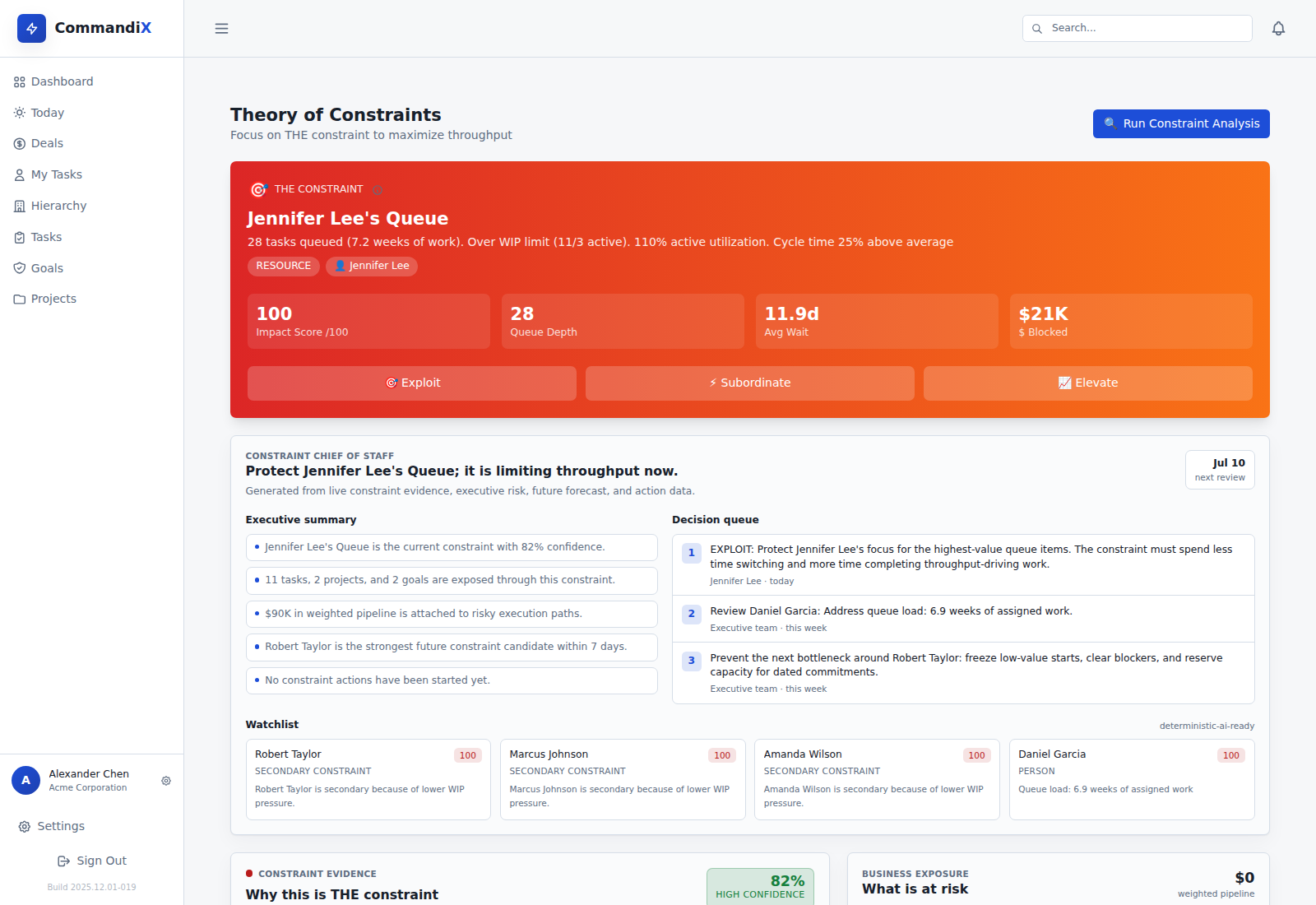
Constraint analysis tool identifying the current bottleneck, owner, queue depth, impact, blocked value, and confidence in Commandix for constraint management tools, showing.
Constraint analysis toolAnalysis tools turn scattered delay signals into a named candidate constraint.

Start every analysis from the system goal#

A constraint only exists relative to a goal. The busiest team is not automatically the constraint. The slowest process is not automatically the constraint. Ask which outcome the company is trying to increase or protect, then identify what limits that outcome now.

This keeps analysis from becoming local optimization. Improving a non-constraint can create more work for the constraint and make the total system slower. Automating task creation may increase intake while completion remains fixed. Increasing sales activity may enlarge a proposal queue that already limits revenue.

The tool should connect the candidate constraint to a goal, project, customer, revenue amount, or strategic commitment. Business context turns a technical delay signal into an executive priority.

Use constraint analysis tools to test the diagnosis#

Constraint analysis combines several weak signals into a defensible pattern. Queue depth shows accumulated demand. Wait time shows friction. Workload shows concentration. Blocked value shows economic impact. Repeated ownership or stage pressure shows persistence. Flow trend shows whether the condition is worsening.

No single metric should name a human bottleneck automatically. A high workload can reflect valuable output and healthy flow. A low completion count can reflect difficult work or external waiting. The tool should expose evidence and confidence, then let leaders inspect responsible work before deciding.

Commandix connects the identified constraint to task, project, team, goal, revenue, and flow context. That traceability makes the diagnosis explainable and correctable.

Diagnosis quality check

  • The affected business goal or throughput measure is explicit.
  • The pattern repeats across enough work to be systemic.
  • Queue, waiting, workload, and blocked-value evidence agree.
  • Alternative explanations such as priority, data quality, or one-time events were tested.
  • The responsible work can be inspected without a custom report.
  • Leadership can explain why this constraint matters more than other delays.
Constraint workload analysis dashboard showing active load, queue pressure, work in progress, and team capacity in Commandix for constraint management tools
Constraint workload analysis dashboardWorkload helps test the diagnosis but must be interpreted against goal impact and flow.

Combine flow analytics with workload carefully#

Workload answers how much work is assigned or active. Flow answers how work moves. The two can disagree. A person may have a heavy load and still process work quickly. Another queue may appear moderate but contain old, high-value items that wait most of their elapsed time.

Cycle time, lead time, aging WIP, cumulative flow, and flow efficiency help leadership understand waiting. Compare those measures with workload and completion. The likely constraint is where pressure persists and limits the outcome, not simply where the dashboard contains the largest number.

This combined view also guides the action. If interruption and poor inputs consume constraint time, exploit it. If excessive upstream work feeds the queue, subordinate intake. If protected capacity remains insufficient, elevate.

Turn analysis into exploit, subordinate, and elevate actions#

Constraint management fails when the diagnosis ends in a slide. The action tool should record what changes, who owns it, which work is affected, when the decision will be reviewed, and which throughput measure should move.

Exploit actions remove avoidable waste from the constraint: incomplete inputs, unnecessary meetings, context switching, low-value requests, defects, or unclear sequence. Subordinate actions change behavior elsewhere: limit WIP, pause lower-value projects, prepare work before handoff, and sequence demand by business value. Elevate actions add skill, automation, authority, supplier capacity, or headcount.

Keep the categories visible because they clarify the management logic. Adding capacity before exploitation and subordination can hide an operating problem inside a larger budget.

Exploit action

Change how the existing constraint capacity is used.

Subordinate action

Change how the wider system feeds and supports the constraint.

Elevate action

Increase or redesign capacity after lower-cost changes are tested.

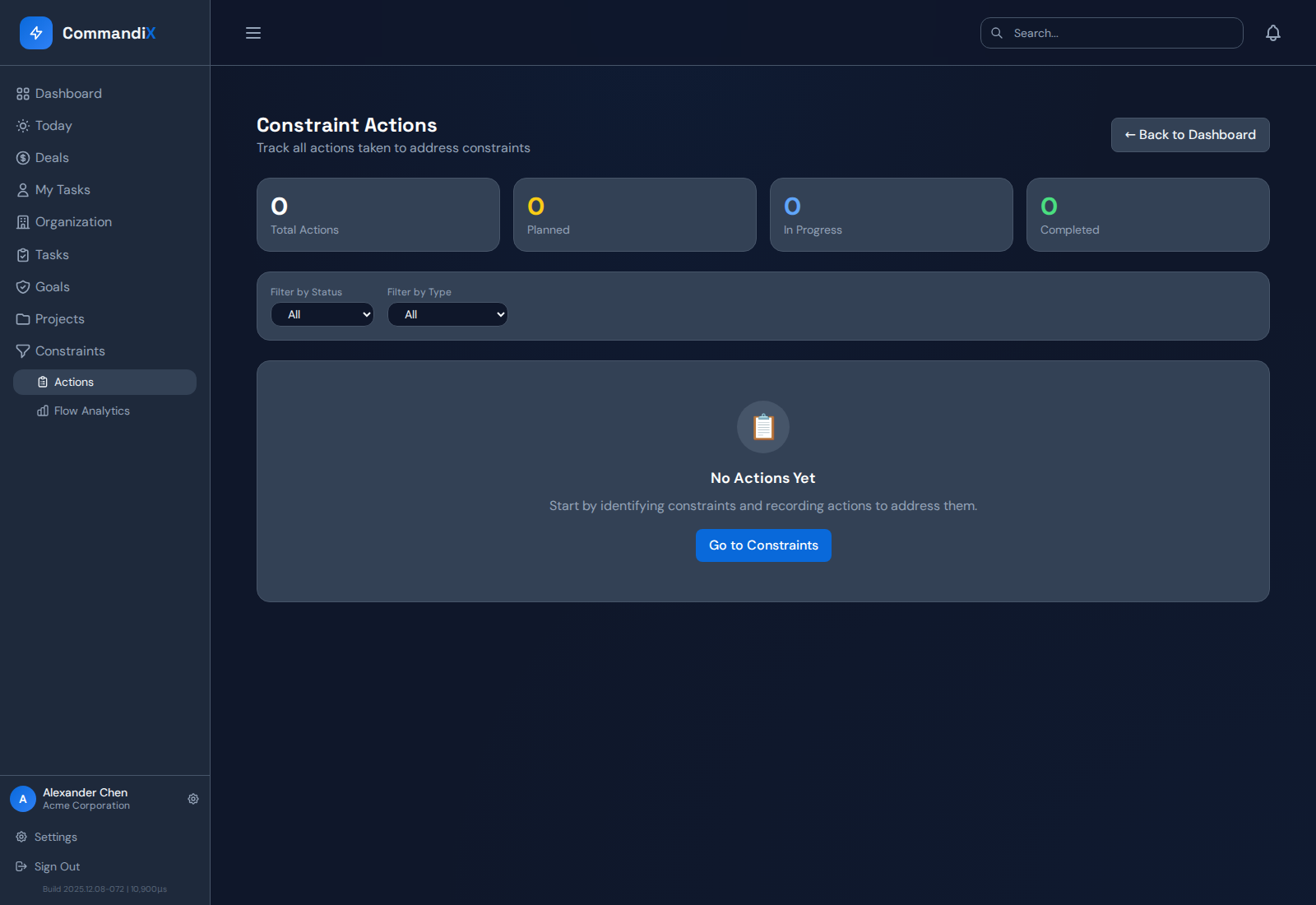
Constraint action management tool organizing exploit, subordinate, and elevate actions with owners and status in Commandix for constraint management tools, showing Owned action.
Constraint action management toolOwned action is the bridge between identifying a constraint and improving the system.

Build the weekly executive constraint loop#

The weekly loop can be concise. Confirm the goal. Review changed flow and outcome signals. Name the current constraint and evidence. Check the previous action. Assign the next action and owner. Decide which work must be subordinated. Set the throughput check for the next review.

The system should preserve that sequence. A leader opening the command center should not need to reconstruct last week from meeting notes. The constraint, action, owner, evidence, and expected result should remain connected.

When throughput improves, identify the next constraint. This prevents inertia. A successful intervention changes the system, so the limiting point may move to another team, policy, stage, or market condition.

Evaluate constraint management software#

Ask a vendor to demonstrate the entire loop with real product behavior. Start from an at-risk outcome. Show the candidate constraint. Open the queue and responsible work. Compare workload and flow. Create an action. Return to the executive view and show how improvement will be verified.

Check whether the platform works across departments and objects. Constraints often cross sales, projects, tasks, approvals, and teams. A point solution that sees only one board may miss the system boundary that matters.

Evaluate security and governance as well. Constraint data can reveal employee performance, strategic weakness, revenue risk, and sensitive operating dependencies. Role-based access, tenant isolation, audit logs, secure authentication, and privacy documentation belong in the selection criteria.

Constraint flow analytics showing cycle time, lead time, flow efficiency, WIP, blocked work, and cumulative flow in Commandix for constraint management tools
Constraint flow analytics toolFlow evidence verifies whether intervention reduced waiting and increased throughput.

Avoid tool sprawl and analysis theater#

Tool sprawl appears when every team brings a different chart to the constraint review. Data definitions conflict, screenshots age, and ownership moves into meeting notes. Integrations can help, but only if the company agrees on the goal, constraint method, action model, and feedback measure.

Analysis theater appears when teams produce increasingly sophisticated explanations without changing work. Set a rule: every confirmed constraint review ends with an owned intervention and a date for checking throughput. If evidence is insufficient, the action is to gather the specific missing evidence, not to debate indefinitely.

A connected platform reduces coordination cost, but discipline remains necessary. The software cannot make leadership protect the constraint or stop lower-value work. It can make the decision and consequences visible.

Operating rule

A constraint review without an owner, action, and throughput check is analysis, not management.

Choose tools that make the constraint actionable#

The right constraint management tools create continuity from strategy to evidence to action. They help executives focus on the limiting factor, help managers inspect the underlying work, and help teams understand why priorities and WIP limits changed.

For a software-specific buyer framework, read the constraint management software guide. For practical examples of queue, workload, and blocked-work diagnosis, use the bottleneck analysis tool guide.

Commandix brings the goal, constraint, owner, next action, and throughput check into one operating system. That is the point of the toolkit: not more diagrams, but a company that can see its limit and move it deliberately.

Move from bottleneck evidence to an owned action.

Explore constraint analysis, workload, flow analytics, action management, and executive review in Commandix.

Open live workspace
Executive constraint operating brief showing the goal, named constraint, owner, next action, and throughput check in Commandix for constraint management tools
Executive constraint operating briefThe executive brief keeps the constraint, action, and verification loop inside the weekly operating cadence.

Frequently asked questions#

What are constraint management tools?#

Constraint management tools are methods and software used to identify the factor limiting a system goal, inspect supporting evidence, coordinate improvement actions, and verify throughput change.

Which metrics help identify a constraint?#

Useful evidence includes queue depth, wait time, aging WIP, workload concentration, blocked value, cycle time, lead time, flow efficiency, repeated dependencies, and outcome impact.

What is the difference between constraint analysis and constraint management?#

Constraint analysis identifies and explains the limiting factor. Constraint management adds action ownership, system subordination, capacity decisions, and throughput verification.

Can software automatically identify a business constraint?#

Software can rank candidate constraints and expose evidence, but leaders should inspect context and alternative explanations before making a system or people decision.

See it in Commandix

Ask the operating system what leadership should inspect first.

Explore the AI Analyst with goals, work, revenue, teams, and constraint evidence in context.
Review one delayed result
Back to all Commandix articles