Project Bottlenecks in Project Management: Find the Constraint Before Dates Slip

Project bottlenecks in project management become manageable when leaders connect queues, dependencies, owners, portfolio load, blocked value, and flow evidence.

Project bottleneck portfolio dashboard showing initiatives, owners, priorities, dates, progress, and delivery risk in Commandix
Project bottleneck portfolio dashboardPortfolio visibility reveals when several apparently healthy projects depend on the same constrained capacity.
On this page

Key takeaways

  • A blocked task affects one item; a project bottleneck repeatedly limits completion across a workflow or portfolio.
  • The earliest evidence is usually queue age, repeated dependency pressure, workload concentration, blocked value, and rising WIP.
  • The correct response is to protect and subordinate work around the constraint before adding capacity or pushing every project harder.

A project bottleneck rarely announces itself as the project bottleneck. It appears as a late review, a missed handoff, an overloaded specialist, an approval that keeps moving, or a milestone that remains almost complete. Each symptom looks local. The delivery impact spreads across the project and often across the entire portfolio.

This is why bottlenecks in project management survive weekly status meetings. Project managers report their own dates and blockers. Department leaders defend their own capacity. Executives see red, amber, and green initiatives but cannot see the shared queue underneath them. By the time the pattern is obvious, several dates have already slipped.

Project bottleneck management changes the unit of analysis. Instead of asking which project is late, leadership asks what resource, policy, dependency, handoff, or decision limits the rate at which valuable projects finish. That question reveals the intervention with the highest leverage.

What is a project bottleneck?#

A project bottleneck is the point in a project system where demand persistently exceeds the capacity or decision speed available, limiting overall throughput. It can be a person, team, skill, approval, vendor, environment, policy, dependency, or sequencing rule. The defining feature is not that work is blocked once. The same point repeatedly governs how quickly the project or portfolio can finish.

A bottleneck may be visible inside one project, but enterprise portfolios make it harder. A security reviewer, data engineer, legal approver, product executive, or deployment environment can serve many initiatives. Every project plan assumes partial access to that capacity. Collectively, the plans demand more than exists.

The project dashboard must therefore connect local work to shared resources and outcomes. Otherwise each initiative looks manageable while the combined system is impossible.

Project rule

A bottleneck is not the loudest delay. It is the recurring limitation that controls the rate at which valuable work finishes.

Distinguish a blocker, risk, dependency, and bottleneck#

Project language often treats every impediment as a bottleneck. That makes prioritization impossible. A blocker stops a specific item. A dependency establishes an order between items. A risk may cause future impact. A bottleneck limits throughput across repeated work. One object can become another, but the management response differs.

A missing file can block one task and require a local fix. A specialist who must prepare that file for twenty tasks is a bottleneck and requires a system response. A vendor delay is a risk until it affects committed work. A shared environment is a dependency until its queue controls release flow.

ConditionScopeBest first response
BlockerOne work item cannot moveRemove or escalate the immediate obstacle
DependencyWork must occur in a defined sequenceClarify handoff, readiness, and owner
RiskA possible event threatens future deliveryReduce probability or prepare mitigation
BottleneckRepeated demand exceeds the limiting pointProtect, subordinate, and improve the constraint
Portfolio constraintSeveral projects depend on the same limitSequence the portfolio around scarce capacity
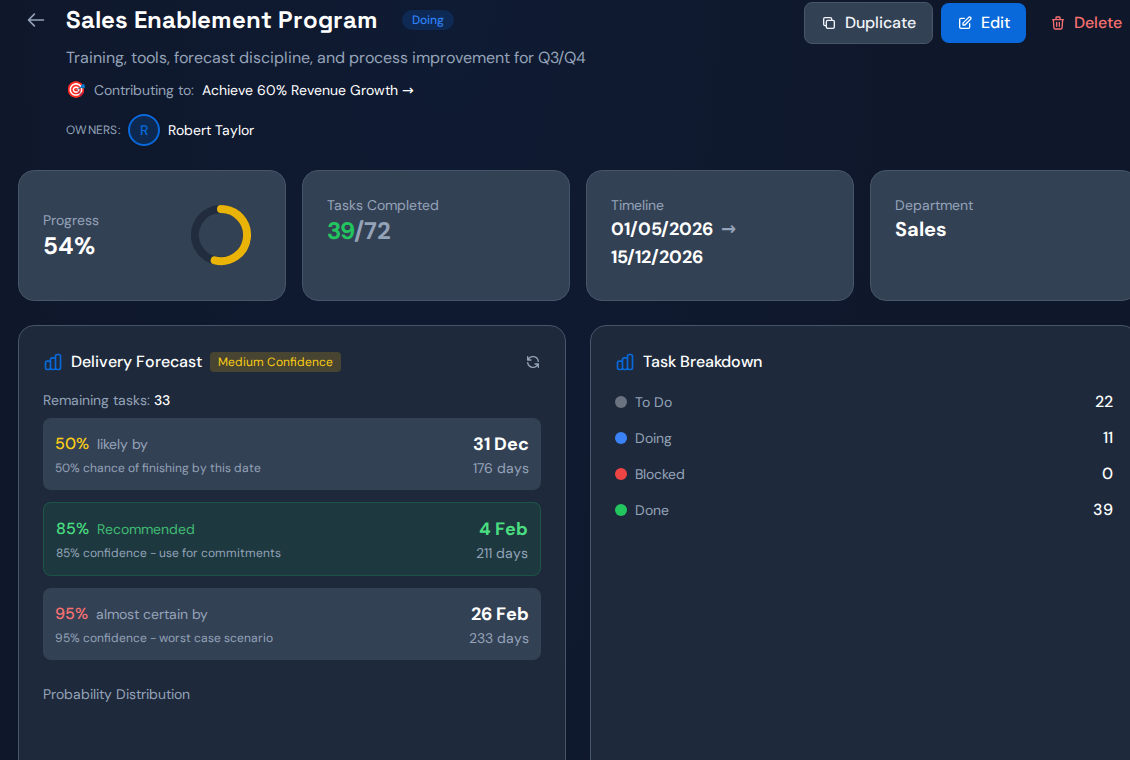
Project bottleneck detail showing project owner, collaborators, goal linkage, status, and execution context in Commandix
Project bottleneck detail and ownershipProject context identifies whether the delay is local or part of a repeated ownership and dependency pattern.

Recognize the early signals of project bottlenecks#

Late milestones are lagging evidence. Earlier signals appear in the work system. Queue depth grows behind one owner or stage. Work waits longer than it is actively processed. The same dependency appears in several status updates. Work in progress rises while completed work remains flat. Projects are repeatedly ninety percent complete.

Blocked value adds business priority. Ten routine tasks waiting may matter less than one approval blocking a strategic launch or a material deal. Connect every candidate bottleneck to the goal, revenue, customer, or portfolio result it affects.

Trend matters more than a snapshot. One difficult week may be noise. A widening queue, rising cycle time, and repeated owner pressure across several reviews is a pattern leadership should investigate.

Project bottleneck evidence

  • Work repeatedly waits at the same owner, team, stage, or dependency.
  • Queue age increases faster than completed work.
  • Several projects require the same constrained capacity in the same period.
  • Blocked items carry strategic, customer, or revenue value.
  • Starting additional work increases WIP without increasing completion.
  • Cycle time or lead time worsens around the suspected constraint.
  • The pattern persists after isolated blockers are removed.

Why project status reports hide shared constraints#

Status reports are organized by initiative. Constraints are often organized by resource or flow. That mismatch means every project can report a reasonable local plan while the portfolio makes conflicting promises about the same person, team, or environment.

Percentage complete makes the problem worse. Work can progress rapidly until it reaches the shared bottleneck. Several projects then appear nearly finished, even though the limited final step determines every delivery date. Leadership sees reassuring percentages and an increasingly dangerous queue.

A portfolio view should show ownership concentration, cross-project dependencies, active WIP, blocked work, and goal priority. The point is not to centralize every task. It is to make shared pressure visible before local plans collide.

Project task flow dashboard showing planned, active, blocked, overdue, and completed work by owner in Commandix for project bottleneck
Project task flow bottleneck evidenceTask state and age expose where project work is waiting rather than moving.

Apply Theory of Constraints to project management#

The Theory of Constraints provides a disciplined response. First, identify the constraint relative to the project or portfolio goal. Second, exploit it by protecting productive time and removing preventable waste. Third, subordinate other work by changing sequence, intake, and priority around the constraint. Fourth, elevate capacity only when protection and subordination are insufficient. Fifth, repeat because the constraint will move.

For a specialist review queue, exploitation may mean complete inputs, fewer meetings, and fixed review windows. Subordination may mean teams stop sending partially ready work and sequence requests by business value. Elevation may mean training another reviewer or adding capacity.

The sequence prevents a common mistake: hiring or escalating before leadership stops feeding avoidable demand into the bottleneck. Capacity is expensive. Focus and sequencing often create improvement first.

Exploit

Protect the constraint from interruption, defects, and low-value demand.

Subordinate

Align project intake and sequence to the pace of the constraint.

Elevate

Add skill, automation, authority, or capacity when evidence justifies it.

Choose PM software that prevents execution bottlenecks#

PM software cannot prevent every bottleneck. It can prevent leadership from discovering one too late. Look for connected project, task, owner, goal, workload, flow, and constraint views. A product that shows only dates and status will report symptoms without exposing the shared system.

Ask the vendor to demonstrate a complete investigation. Start with a portfolio risk, open the project, inspect blocked and aging tasks, identify repeated owners or dependencies, compare workload and flow, record a constraint action, and verify the effect. The path should work without exports or a custom analyst.

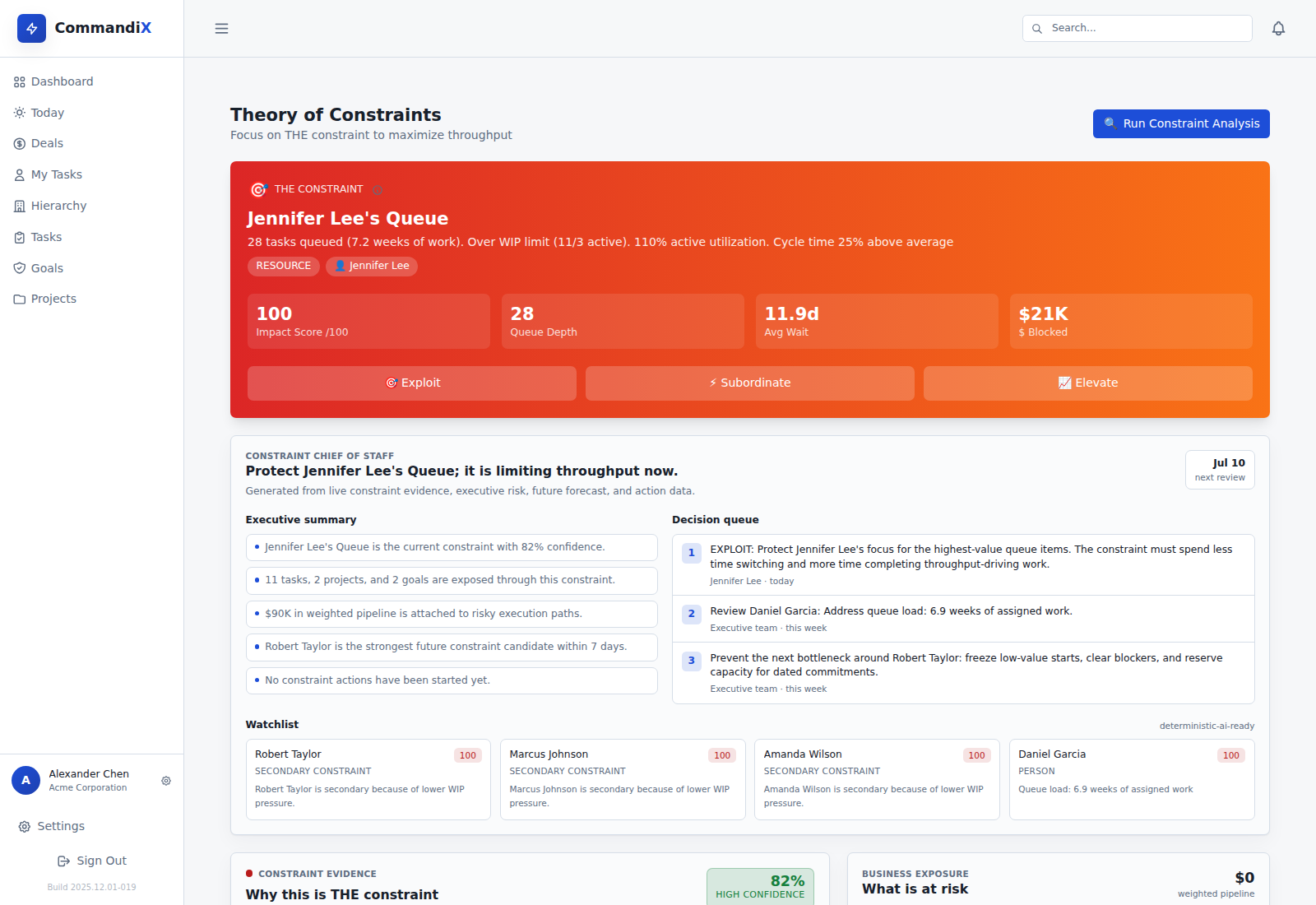
Commandix supports this operating path. Projects remain linked to goals and work. Flow analytics shows cycle time, lead time, WIP, and waiting. Constraint analysis names the limiting point and action. Executives can stay at portfolio level until evidence requires a drill-down.

Project constraint analysis identifying the shared bottleneck, queue depth, business impact, and responsible owner in Commandix for project bottleneck, showing Constraint.
Project portfolio constraint analysisConstraint analysis connects project delay to the shared limiting factor across the portfolio.

Run a weekly project constraint review#

A useful review begins with the portfolio outcome, not a tour of every project. Which committed result is at risk? Which flow or project changed materially? Where is work accumulating? Which owner or dependency appears repeatedly? What business value is blocked?

Select one constraint action. Name one accountable owner and due date. Decide which lower-value work must wait so the action has room. At the next review, compare queue age, blocked work, cycle time, and completion. If throughput did not improve, refine the diagnosis.

This cadence makes status reporting secondary. Projects that are stable require little executive time. The meeting concentrates attention where a decision can protect the most portfolio value.

Avoid the most common bottleneck mistakes#

The first mistake is pushing every project equally. More pressure at non-constraints creates additional inventory for the constraint. The second is confusing the busiest team with the constraint. Workload matters only when it limits the goal. The third is fixing one blocked item and declaring the bottleneck solved.

The fourth mistake is adding capacity without changing intake or sequence. New capacity can be consumed immediately by uncontrolled demand. The fifth is failing to measure after the intervention. Without a throughput check, leadership cannot tell whether it improved the system or moved the queue.

The final mistake is treating the bottleneck owner as the problem. The company designed the routing, priorities, policies, and portfolio. Diagnose the system before assigning blame.

Project workload dashboard showing constrained owners, active assignments, queue pressure, and capacity risk in Commandix for project bottleneck
Project resource workload risk dashboardWorkload evidence shows whether project demand has exceeded the attention available from a critical owner or team.

Measure whether the project system improved#

Use a small before-and-after set: queue depth, oldest waiting item, cycle time, lead time, blocked value, completed work, and project milestone movement. Measure the constraint itself and the project outcome. A local improvement that does not change completion may have shifted work downstream.

Also measure portfolio behavior. Did active WIP decline? Did projects stop competing for the same window? Did teams send more complete inputs? Did decision latency fall? These changes show whether the operating rule improved, not just one task.

The executive project portfolio dashboard guide explains portfolio evidence in detail. The bottleneck identification software guide covers the broader diagnostic signals across teams, work, and revenue.

Turn project bottlenecks into owned decisions#

Project bottlenecks become expensive when they remain distributed across status updates. A connected system makes the pattern visible: the goal affected, projects competing, work waiting, owner or dependency involved, blocked value, and change in flow.

Commandix brings those relationships into one execution command center. Leadership can identify the constraint, protect it, subordinate lower-value demand, assign the next action, and verify throughput without turning the PMO into a reporting factory.

The objective is not a portfolio with no problems. It is a portfolio that detects its limiting point early and changes behavior before dates slip.

Find the shared constraint before the portfolio slips.

Inspect projects, tasks, owners, workload, blocked value, flow analytics, and constraint actions in Commandix.

Open live workspace
Project flow analytics dashboard showing cycle time, lead time, flow efficiency, WIP, blocked work, and cumulative flow in Commandix for project bottleneck
Project bottleneck flow analyticsFlow analytics verifies whether the bottleneck action reduced waiting and improved completion.

Frequently asked questions#

What is a project bottleneck?#

A project bottleneck is a person, team, dependency, policy, stage, environment, or decision point whose limited capacity repeatedly controls the rate at which project work finishes.

How do you identify bottlenecks in project management?#

Look for repeated queues, aging work, shared dependency pressure, ownership concentration, blocked value, rising WIP, longer cycle time, and several projects waiting at the same point.

What is the difference between a blocker and a bottleneck?#

A blocker stops one work item. A bottleneck repeatedly limits throughput across a workflow or portfolio and requires a system-level response.

Can project management software prevent bottlenecks?#

It cannot eliminate all constraints, but connected project, task, workload, flow, and constraint evidence can reveal bottlenecks early enough for leadership to protect capacity and change sequence.

See it in Commandix

See where the portfolio is consuming constrained capacity.

Review projects, goals, task flow, owners, and constraint evidence in the live Commandix workspace.
Review one delayed result
Back to all Commandix articles