Key takeaways
- Constraint management software should answer one executive question: what is limiting throughput right now?
- The best systems connect the constraint to goals, owners, projects, tasks, revenue, workload, and flow evidence.
- Commandix turns constraint management into a weekly operating loop: see the goal, identify the constraint, assign the owner, move the next action, and verify throughput improved.
Constraint management software is not software for people who want another dashboard. It is software for leaders who are tired of watching activity rise while the business result stays stuck. The best constraint management software gives executives the answer hidden underneath all the reports: what is limiting execution, who owns the next move, and how will we know if throughput improved?
That is the difference between managing work and managing the system. Work management asks whether tasks exist, who owns them, and whether they are done. Constraint management asks a harder question: if the company can improve only one part of the system this week, which part creates the most business leverage?
That question matters because every company has a constraint. It may be a person, team, approval policy, project portfolio, handoff, market motion, sales follow-up pattern, implementation queue, executive decision queue, or shared specialist. The constraint is the point that limits output. Improve the wrong point and the company gets locally cleaner while the quarter still slips. Improve the constraint and the entire system can move.
What is constraint management software?#
Constraint management software is an operating system for finding, acting on, and measuring the constraint that limits business throughput. In the Theory of Constraints, a system is only as productive as its constraint. That idea sounds simple, but most companies do not operate that way. They operate from status updates, department dashboards, project plans, and team rituals. Those tools can be useful, but they often bury the most important answer under too much local information.
A real constraint management system has to connect the whole picture. It needs goals because constraints only matter in relation to an outcome. It needs work because the constraint shows up in tasks, projects, dependencies, blocked work, and queues. It needs people and teams because capacity is uneven. It needs revenue because the business consequence of a constraint is often financial. It needs flow analytics because the only honest proof is whether work moved better after leadership acted.
Most importantly, constraint management software needs to produce a decision. A pretty constraint report is not enough. The leadership team needs a named constraint, a named owner, a recommended next action, and a throughput check. Without those four pieces, the software may create awareness, but it will not change the operating rhythm.
If the system cannot answer "what should we fix first?", it is not constraint management software. It is another place to look at activity.
Why ordinary tools miss the constraint#
Most companies already own plenty of software. They have task boards, project tools, spreadsheets, BI dashboards, CRM pipelines, OKR trackers, chat, docs, and meeting notes. The problem is not that executives lack information. The problem is that the information is fragmented and usually organized around local ownership rather than system throughput.
A task board can show that Marketing has many active tasks. It may not show that Legal review is the real constraint. A project dashboard can show that Product Launch is yellow. It may not show that three projects are fighting for the same senior engineer. A CRM can show pipeline risk. It may not show that seller follow-up work is blocked by implementation uncertainty or internal proposal dependencies.
This is why leaders often feel like they are chasing ghosts. Everyone is working. Everyone has evidence. Every department has a reasonable explanation. But the business result does not move. Constraint management software has to cut through that pattern by connecting the symptom to the limiting point underneath it.
| Tool type | What it usually shows | What constraint management software must add |
|---|---|---|
| Task management | Tasks, owners, statuses, due dates. | Which task queues are limiting throughput and why. |
| Project management | Plans, milestones, risks, dependencies. | Which dependency, owner, or capacity point is constraining the portfolio. |
| OKR software | Goals, progress, confidence, check-ins. | The execution constraint preventing the goal from moving. |
| CRM | Deals, stages, owners, pipeline value. | Revenue execution work, seller load, blocked deals, and follow-up constraints. |
| BI dashboard | Metrics, charts, trends, slices. | The next action and owner that should improve the limiting metric. |
The five questions the software must answer#
The first question is the goal. What outcome is the business trying to protect or improve? Without the goal, every constraint discussion becomes vague. A constraint is not simply something busy or late. It is the limiting point relative to a desired outcome.
The second question is the constraint. Where is throughput limited? That may come from queue depth, aging work, blocked value, wait time, overdue work, handoff delay, owner load, sales task execution, or portfolio conflict. A good system does not pretend that one signal is perfect. It combines evidence until a practical answer emerges.
The third question is the owner. Who is accountable for changing the system? This does not mean blaming the bottleneck. Often the person named by the constraint is overloaded because the organization trusts them with too much critical work. Ownership means someone must protect the constraint, remove low-value demand, improve inputs, or elevate capacity.
The fourth question is the next action. Theory of Constraints gives leaders a clean action language: exploit, subordinate, elevate. Exploit means get the most from the current constraint by protecting its time and inputs. Subordinate means align the rest of the system around it. Elevate means add capacity or change the system when evidence proves that protection and alignment are not enough.
The fifth question is the throughput check. Did anything improve? Did cycle time fall? Did blocked work shrink? Did the project move? Did the sales queue clear? Did the goal progress? The software should force this question because it turns leadership from opinion into learning.
How Commandix implements constraint management software#
Commandix is built around the operating loop that executives need: goal, constraint, owner, next action, throughput. It starts from the command center, where leadership can see strategic goals, teams, projects, tasks, revenue, and operating signals in one place. This matters because constraints rarely stay inside a single department. The thing limiting a revenue target may live in sales tasks, implementation capacity, proposal support, or leadership approvals.
The constraint analysis card is the signature moment. It names the current constraint and shows the evidence behind it: confidence, impact, queue depth, wait time, blocked value, and recommended action paths. This is where the conversation changes. Instead of asking every leader for a status tour, the executive team can ask whether the identified constraint is the point of highest leverage.
From there, Commandix connects the constraint to responsible work. Leaders can move from a dashboard signal into the department, person, task, project, or deal behind it. For example, a CEO can identify the lowest performer in a team for the month in two clicks from the dashboard: open the department, then open tasks. A CRO can identify who drives the most sales and who drives the least by moving from the revenue signal into the sales unit. The value is not surveillance. The value is fast context, so leaders can tell the difference between underperformance, overload, poor prioritization, blocked work, and high-complexity work.
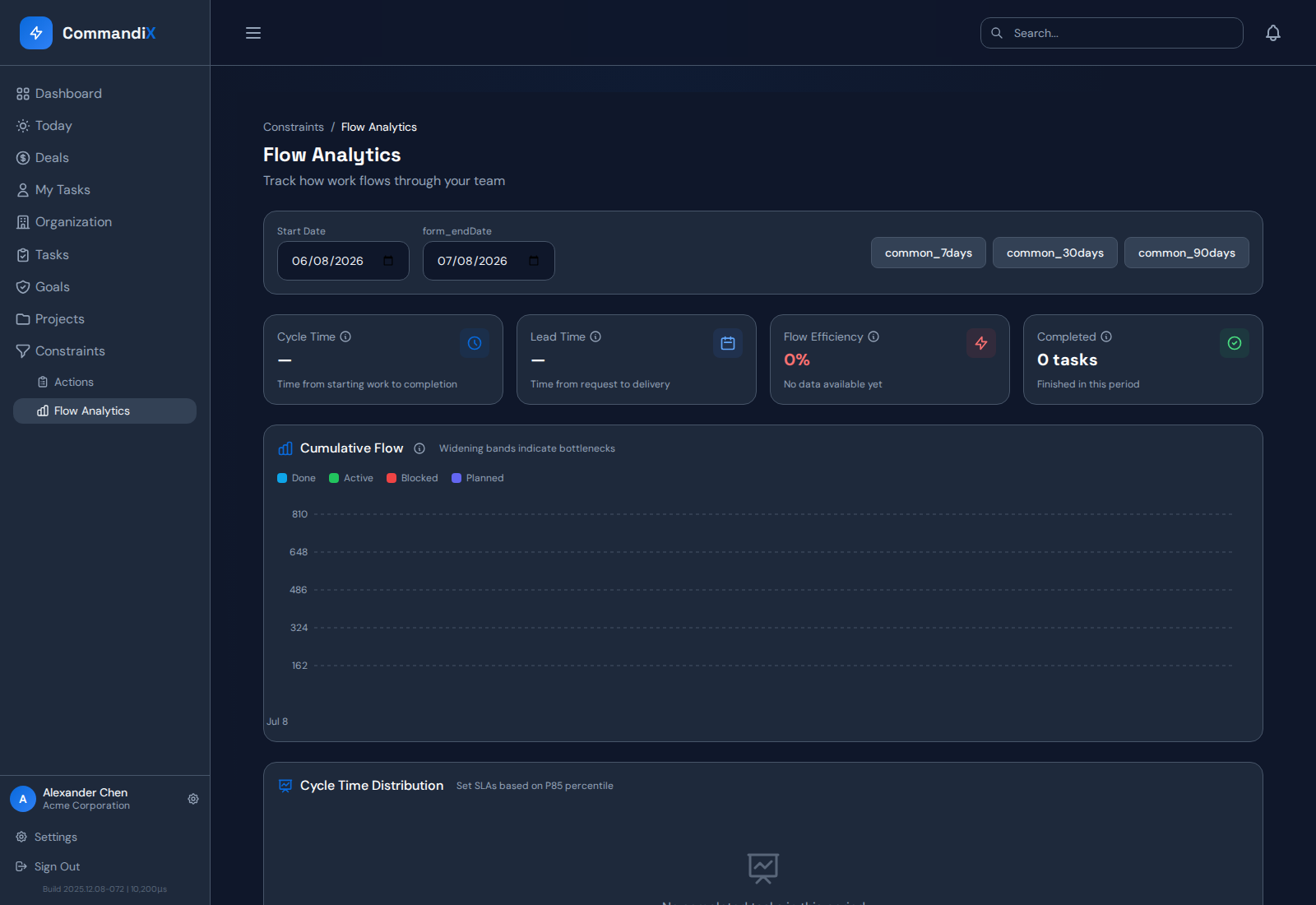
Commandix also includes flow analytics. This matters because workload and throughput are not the same thing. A person can be overloaded while completed work is still moving. A flow chart can look quiet while a live workload dashboard shows a current pileup. A mature constraint management system needs both views, so leaders do not overreact to one chart or ignore the current bottleneck.
The emotional value is speed with evidence. The CEO no longer has to wait for a report to know what to inspect first.
The operating loop leaders actually use#
Constraint management software should not become another analytics hobby. It should change the weekly rhythm. A practical cadence starts with the leadership team opening the command center before the meeting. They confirm the goal, inspect the current constraint, look at the owner and action, and review the throughput check from last week.
Then the team decides what to exploit, subordinate, or elevate. If the constraint is a shared specialist, the move may be to stop feeding low-value work into that person. If the constraint is a sales follow-up queue, the move may be to protect seller time and remove internal tasks. If the constraint is an approval policy, the move may be to redesign the decision packet. If the constraint is project portfolio overload, the move may be to pause projects competing for the same scarce capacity.
The best weekly operating review is not longer. It is sharper. The room should leave with fewer vague follow-ups and more clear decisions. One owner. One action. One proof point. That is how constraint management becomes behavior instead of theory.
Protect the constraint and make sure it never waits on avoidable inputs or decisions.
Align the rest of the work system around the constraint instead of maximizing local activity.
Add capacity, automation, authority, or process redesign only when evidence supports it.
What buyers should demand from constraint management software#
Buyers should demand more than a bottleneck chart. A constraint chart without action ownership is a warning light, not an operating system. The software should connect goals to work. It should show the current constraint and explain confidence. It should connect the constraint to teams, people, tasks, projects, and revenue. It should suggest action categories. It should preserve enough history to show whether throughput improved.
Security and governance also matter. Constraint management software touches leadership execution data, team performance, sales work, and strategic priorities. It should respect tenant boundaries, roles, sessions, OAuth or SSO paths, audit logs, secure headers, HTTPS, privacy pages, and procurement expectations. Enterprise buyers should treat execution data like serious operating data, not a casual productivity feed.
Evaluation checklist
- Can the system name the active constraint, not just show late work?
- Can it connect the constraint to the company goal?
- Can leaders drill into the owner, team, task, project, or deal behind the signal?
- Can it distinguish workload, blocked work, cycle time, wait time, and throughput?
- Can it turn the diagnosis into an exploit, subordinate, or elevate action?
- Can the next review prove whether the action improved throughput?
- Can enterprise teams control access, audit activity, and support privacy requirements?
The business value of getting this right#
The value of constraint management software is not that it makes work look organized. The value is that it helps leadership aim. A company can waste a quarter improving non-constraints. It can hire in the wrong place, automate the wrong process, push the wrong team, or start the wrong projects. Those mistakes feel productive while they happen because everyone is working hard. The damage appears later, when the business result still has not moved.
When the constraint is visible, leadership can create leverage. The CEO knows what limits the company goal. The COO can run a cleaner weekly operating cadence. The CRO can connect pipeline risk to seller work and blocked deal tasks. The PMO can see portfolio bottlenecks before dates slip. Department leaders can coach with context. RevOps and Ops can keep the execution system honest.
That is why the phrase constraint management software should mean more than Theory of Constraints vocabulary inside a product. It should mean a practical, evidence-driven command center for increasing throughput. It should help the business move from "we are busy" to "this is what limits us, this is who owns the action, and this is the proof we expect next week."
How to start this week#
Choose one goal that matters. Open the work behind it. Look for waiting, blocked, overloaded, or repeatedly dependent work. Identify the person, team, policy, or queue that appears most often. Name it as a candidate constraint. Then decide one action for one week: protect the constraint, subordinate lower-value work, or elevate capacity. At the next review, check whether throughput improved.
That small loop is the heart of constraint management. It is simple, but it is not easy. It requires leaders to stop spreading attention equally across everything and start treating executive focus as a scarce resource. That is why the right software matters. It makes the constraint visible before the quarter becomes a post-mortem.
Commandix exists for that moment. The moment a CEO or COO opens the system and can see the goal, the constraint, the owner, the next action, and whether throughput improved. Not another task board. Not another OKR tracker. Not another dashboard. Constraint management software for leaders who want to know what to fix first.
Inspect the current constraint, owner, next action, flow analytics, team workload, revenue execution, and weekly throughput brief in the Commandix live demo.
Open live demo
Frequently asked questions#
What is constraint management software?#
Constraint management software helps leaders identify the limiting constraint in a business system, connect it to goals and work, assign the next action, and verify whether throughput improved.
How is constraint management software different from project management software?#
Project management software organizes tasks and timelines. Constraint management software shows which person, team, policy, queue, or revenue motion is limiting the system and what leadership should fix first.
Who uses constraint management software?#
CEOs, COOs, CROs, PMOs, RevOps leaders, department heads, and operating teams use constraint management software when they need to improve execution throughput instead of simply tracking activity.
What should constraint management software include?#
It should include goal traceability, constraint identification, owner and action assignment, workload evidence, flow analytics, revenue context, auditability, and a recurring operating cadence.