Key takeaways
- A stalled deal may be waiting on the seller, the customer, or another internal team.
- Pipeline fields alone rarely explain the operating delay.
- Choose coaching, unblocking, resequencing, or capacity action only after tracing the next required work.
When revenue is behind, the first instinct is often to ask sales for more activity. Sometimes that is correct. Sometimes the seller has already completed the useful next step and the deal is waiting for pricing approval, legal language, technical validation, product input, security answers, or confidence in delivery capacity.
A useful revenue review connects the commercial result to the work the wider company must complete. It does not remove seller accountability. It makes accountability specific enough to act on.
Start with deals that have a decision attached#
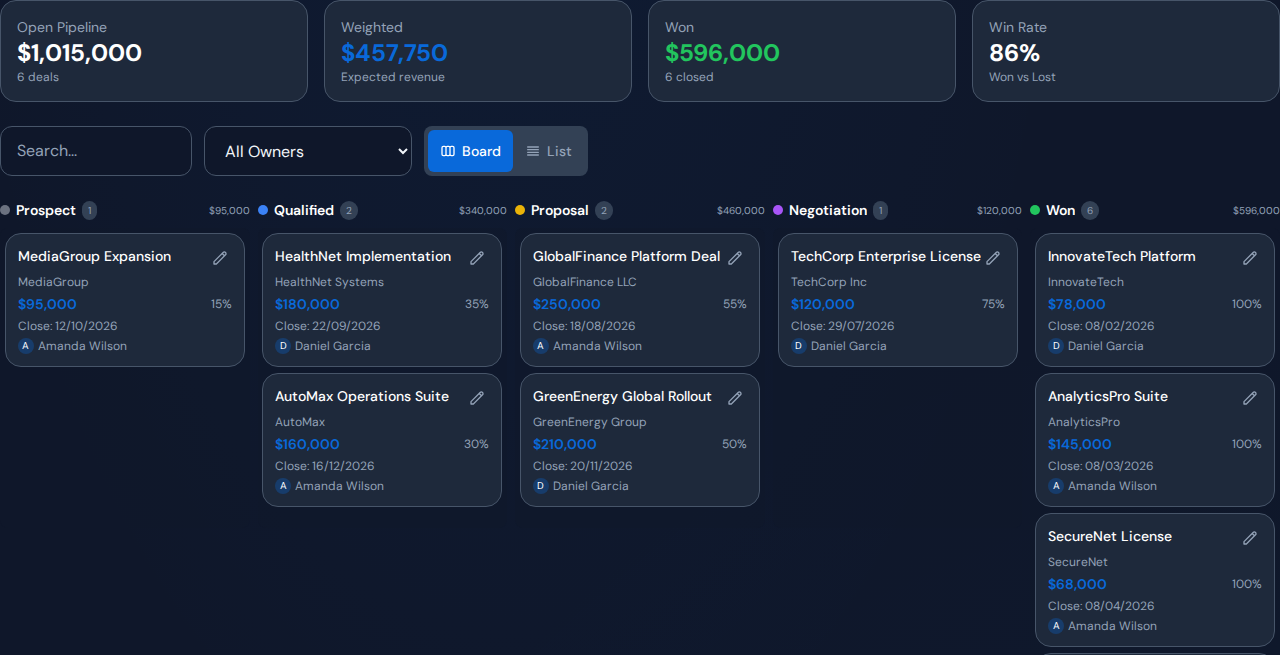
Select a small group of material deals with a clear next customer or internal decision. Record stage, owner, value, expected date, last meaningful movement, and the next action required. A deal with no defined next action is already telling leadership something useful.
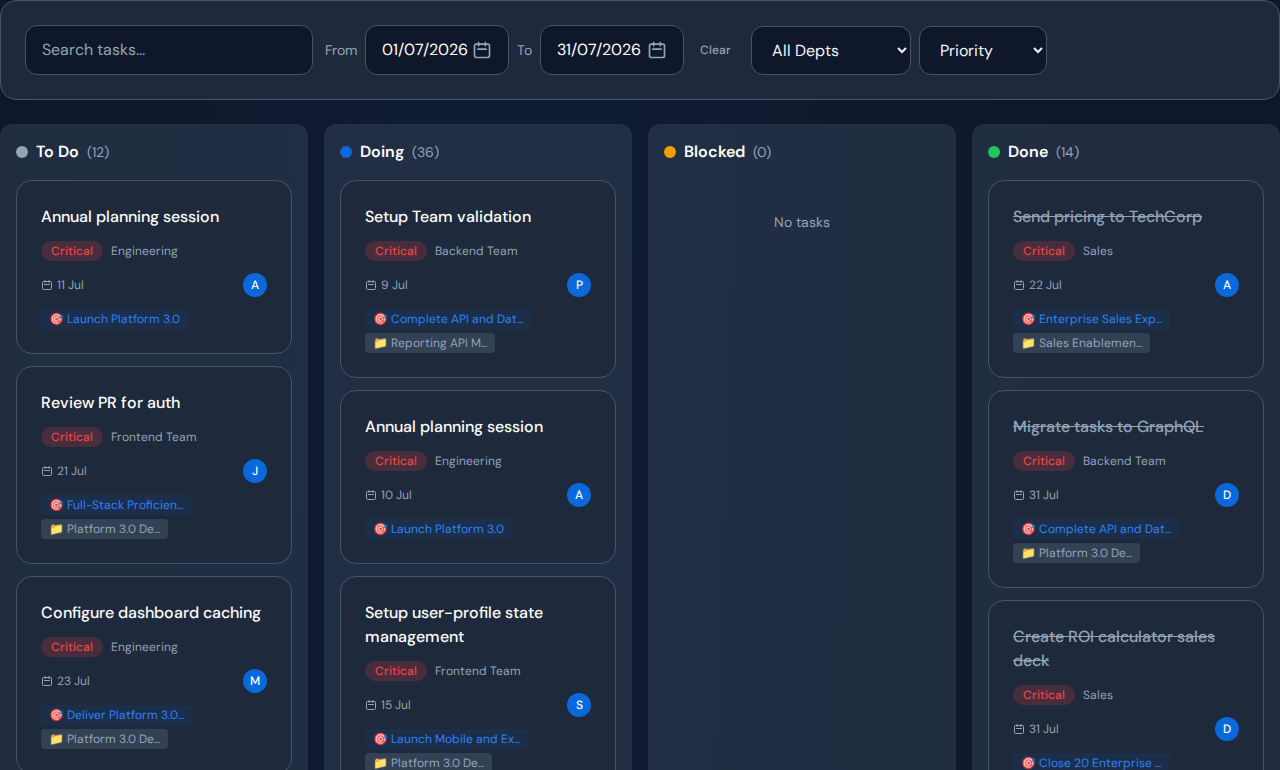
For each deal, identify whether the next action belongs to the seller, the customer, or another team. Link the tasks, approvals, documents, dependencies, and owners around it. This is where a CRM stage becomes an execution record.
Separate four kinds of delay#
| Delay | Evidence | Possible response |
|---|---|---|
| Seller follow-through | Owned next actions are late without an external dependency | Coach, clarify priority, or rebalance workload |
| Customer decision | The customer owns the next event and the follow-up plan is current | Change qualification, mutual plan, or forecast confidence |
| Internal handoff | Proposal, legal, security, product, or approval work waits internally | Unblock, change service rule, or protect shared capacity |
| Delivery constraint | The company cannot credibly promise onboarding or implementation | Resequence demand, change promise, or add delivery capacity |
Keep people context intact#
Do not use a single sales result as an employment conclusion. Compare results beside territory, deal mix, customer timing, workload, overdue work, internal dependencies, and the quality of the underlying records. The software can expose a pattern; a manager remains responsible for interpretation and action.
This also prevents a common operating error: praising local sales activity while important customer work waits elsewhere. A wider-company queue can limit revenue even when the sales team’s own tasks are current.
Choose one intervention and signal#
If the evidence points to internal approval, assign one owner to change the queue and review approval wait. If it points to seller workload, rebalance or reduce competing work and review next-action age. If it points to delivery capacity, adjust commitments and measure onboarding queue and cycle time.
The review should end with a decision record: result at risk, current explanation, alternative explanations still possible, action, owner, baseline, and next check. Revenue execution improves when the company can see where a deal is waiting and changes the specific condition responsible for that wait.
Build a deal-to-work trace#
For each material deal, record the next customer decision and every internal deliverable required before it can happen. Examples include pricing approval, security answers, architecture validation, a statement of work, contract review, product commitment, implementation estimate, or executive sponsorship. Give each deliverable an owner and a needed-by date tied to the customer event.
This trace should be small enough to maintain. It is not a duplicate project plan for every opportunity. Use it where the value, complexity, or cross-functional risk justifies operating attention. Link back to the system that owns the source record instead of copying status into a slide.
Define meaningful movement#
A changed CRM stage is not always meaningful movement, and an unchanged stage is not always inactivity. Define the event that reduces uncertainty or advances the buying process: validated need, access to authority, agreed success criteria, completed technical validation, accepted commercial terms, or scheduled implementation capacity.
Review the age of the next action and the age of the internal dependency. This prevents teams from rewarding high activity that does not change the decision. It also gives internal service teams a measurable queue rather than a collection of urgent messages.
Use evidence appropriate to the response#
| Response considered | Evidence to inspect | Follow-up signal |
|---|---|---|
| Seller coaching | Next actions, qualification, workload, deal plan, customer engagement | Meaningful next events and action age |
| Internal unblocking | Approval queue, owner, input quality, wait, return reason | Approval or deliverable turnaround |
| Reassign support | Deal complexity, specialist load, timing, expected value | Dependency age and stage evidence |
| Change forecast | Customer-owned event, mutual plan, unresolved risk | Forecast accuracy and slippage reason |
| Add delivery capacity | Ready sold demand, onboarding queue, qualified capacity | Time to start and onboarding cycle time |
Create service rules for recurring handoffs#
If legal, security, finance, or product review appears repeatedly, define what a ready request contains, how priority is assigned, who may expedite, and the expected response. Do not promise identical turnaround for every deal; use classes that reflect materiality and customer timing. Make an expedite consume an explicit tradeoff rather than silently displacing another request.
Measure returns caused by incomplete submissions. A long queue may require capacity, but it may also be filled with work that cannot be completed. Sales and the service team should jointly own the quality of the handoff.
Keep the forecast and operating review connected#
The forecast should reflect unresolved execution dependencies. If the company cannot complete a necessary action before the customer date, the probability or timing should change unless leadership explicitly resolves the constraint. This is more credible than carrying an optimistic close date while the required work remains invisible.
Conversely, do not reduce forecast confidence merely because an internal task exists. Inspect its readiness, service expectation, owner, and history. The purpose is to represent real execution risk, not add another subjective penalty.
Questions for the revenue delay review#
- What exact customer decision is next?
- Which seller, customer, or internal action must happen before it?
- Is the required input complete and prioritized?
- Which team owns the current wait, and can leadership change the condition?
- What signal next week would show the intervention worked?
End with one response, not a general instruction to “push harder.” Coaching, unblocking, changing the promise, resequencing support, and adding capacity are different decisions. The deal-to-work trace helps leadership choose the one that matches the observed delay.
Model the revenue dependency in Commandix#
Select the material deal or revenue result, then connect its next required work. Retain the seller, customer event, internal owners, dates, tasks, approvals, and dependencies. Review seller workload and deal activity beside the wider company queue. This keeps a stalled commercial result from becoming an unsupported conclusion about an individual.
Use the action record for the specific response: coaching, internal unblocking, support reassignment, promise change, forecast adjustment, or capacity review. Choose a baseline that fits. A legal handoff might use ready-request wait; a seller action might use meaningful next-event age; a delivery concern might use onboarding queue and time to start.
Access to sales and people information should follow the workspace role model. Commandix can help compare results with tasks, workload, deal mix, and dependencies; managers remain responsible for employment and coaching decisions. Public screenshots and the sample workspace contain sample data and should be evaluated as product navigation, not performance evidence.
Review the action on the promised date. If the internal deliverable completed and the customer event still did not move, the explanation may be incomplete. If the action was never completed, address the barrier before inferring that it failed. Preserve the outcome so forecast and operating reviews can learn which cross-functional conditions repeatedly affect revenue.
How to use this guide responsibly#
Treat the guide as a decision structure, not as proof that one cause applies in every company. Begin with a named result and current records. Separate observations from explanations, keep plausible alternatives visible, and scale the response to the confidence of the evidence. A short reversible test is often more informative than a broad rollout based on an attractive story.
Commandix organizes operating evidence and the action history; it does not guarantee a root cause or business outcome. Source data may be incomplete, stale, or shaped by different workflow definitions. Validate important records with the people doing the work. Keep personal, customer, commercial, and security information within the access and retention rules appropriate to the organization.
Use sample screenshots and the public sample workspace to inspect the interface only. They contain illustrative data. A live review should state its evidence period, included systems, gaps, baseline, action owner, expected signal, and next decision date. If the records cannot support the decision, stop with a data-readiness action. That is a useful management outcome, not a failed analysis.
Frequently asked questions#
How do you distinguish a seller issue from a company handoff issue?#
Trace stalled deals into their next actions, owners, internal tasks, approvals, wait states, and promised customer dates.
Should seller rankings decide the intervention?#
No. Results should be reviewed beside territory, deal mix, workload, dependencies, task context, and human judgment.
Which measure should the review use?#
Use the signal relevant to the chosen action, such as next-action age, approval wait, proposal turnaround, implementation capacity, or stage movement.