Bottleneck analysis
Bottleneck Identification Software: Find Execution Delays Before They Become Missed Targets
Bottleneck identification software helps leaders detect blocked work, overloaded teams, delayed projects, and weak handoffs before goals slip.
Bottleneck identification software exists for the moment every operator knows too well: the plan looks reasonable, the team looks busy, the dashboards look alive, and yet the result is not moving. Somewhere in the system, work is piling up. Somewhere, a decision is waiting. Somewhere, a person or team has become the narrow gate through which too much work must pass. If leadership cannot see that gate early, the business pays later.
The best bottleneck tools do not merely shout "something is late." Everyone already knows when something is late. The value is earlier and sharper: where is work accumulating, why is it waiting, which goal is affected, who owns the next action, and what will happen if nothing changes this week?
Bottlenecks are not always dramatic
Some bottlenecks look obvious. A task column is full of blocked work. A key engineer has twenty active assignments. A sales team has qualified deals waiting for follow-up. But the dangerous bottlenecks are often quieter. They hide inside approval loops, shared specialists, unclear priorities, or projects started faster than they can be finished. They are not explosions. They are friction.
That is why ordinary dashboards miss them. A department completion rate may drop, but the department is not the bottleneck. It may be suffering from a dependency in another team. A project may be late, but the project is not the bottleneck. It may be one overloaded reviewer. A sales pipeline may stall, but the issue may be execution work after the demo, not prospecting volume.
The evidence that matters
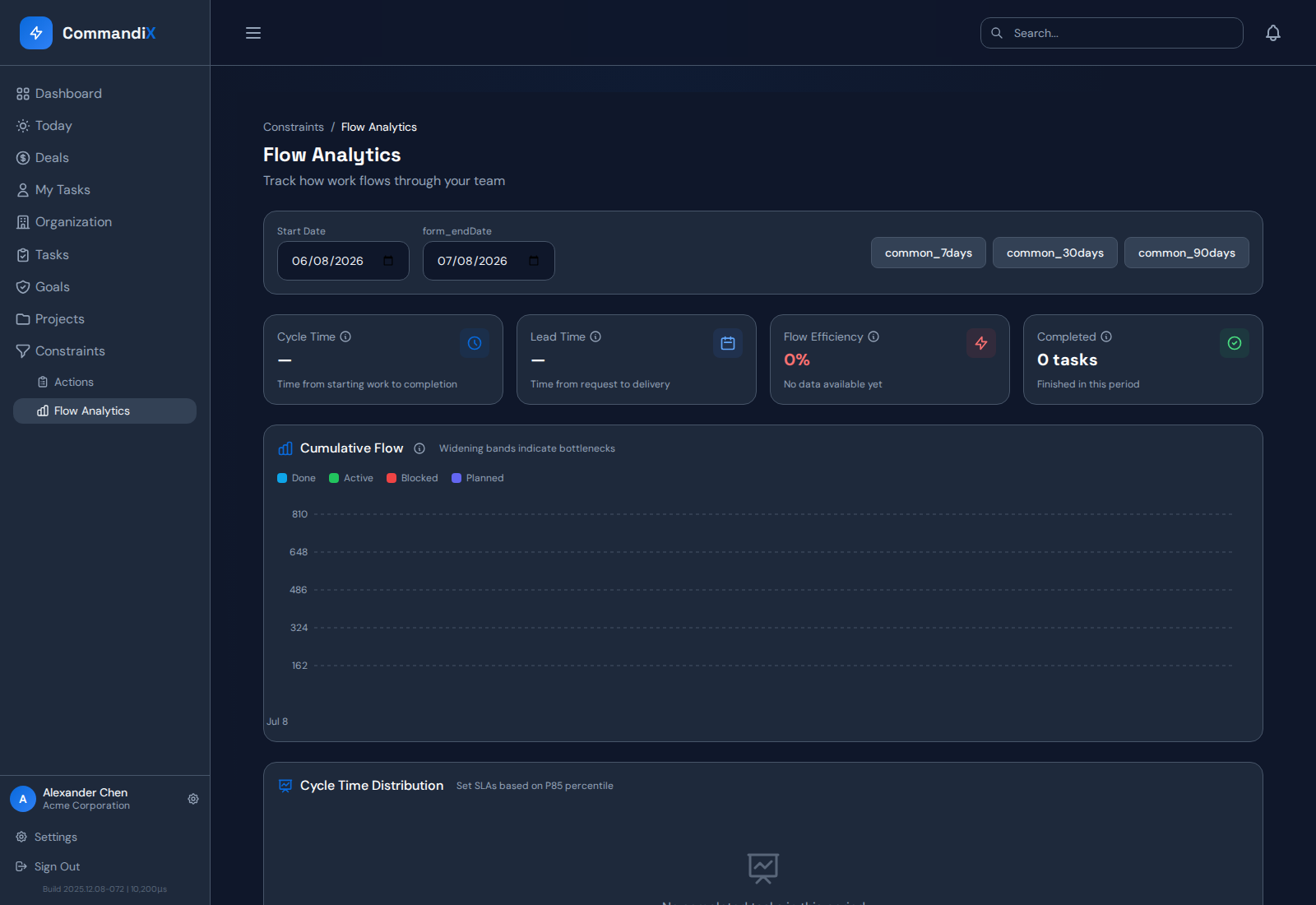
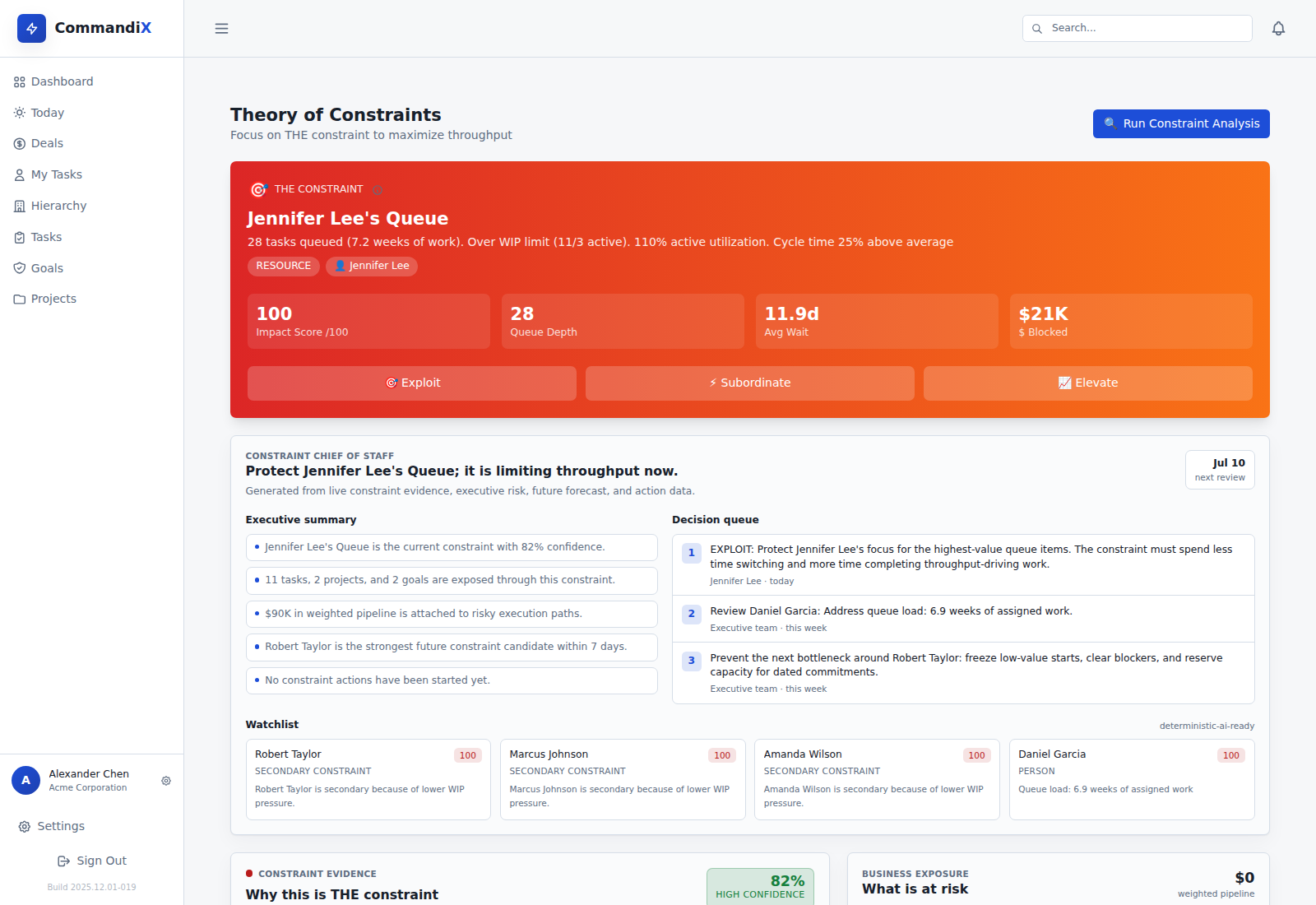
Good bottleneck identification combines several signals. Queue depth tells you how much work is waiting behind a person, team, or stage. Average wait time tells you how painful that wait has become. Blocked value tells you the business weight of the delay. Cycle time tells you whether completed work is slowing down. Workload shows whether capacity is being abused right now.
Individually, each signal can mislead. Together, they begin to tell the truth. A large queue with low business value may be noise. A small queue behind a critical specialist may be the real constraint. A busy team may be healthy if throughput is strong. A quiet team may be dangerous if its work is waiting for decisions. The point is not to worship one metric. The point is to build a diagnosis strong enough for leadership action.
Why Commandix starts from the business system
Commandix treats bottlenecks as operating problems, not just workflow problems. That means the analysis does not stop at the board. It connects the bottleneck to goals, departments, people, projects, tasks, and revenue. This matters because the executive question is never merely "where are cards stuck?" The executive question is "what result is now at risk because this work is stuck?"
From the company dashboard, leadership can move into department performance, then into the team or person behind the number. If Sales is underperforming, the system does not leave the CEO staring at a red metric. It opens the sales unit, sales team performance, sales tasks, and pipeline context. If Engineering is overloaded, the system can expose active work, overdue work, blocked tasks, and project pressure.
The bottleneck taxonomy
There are at least five bottleneck types worth naming. A capacity bottleneck happens when more work is assigned than a person or team can process. A dependency bottleneck happens when work waits on another role, decision, system, or vendor. A priority bottleneck happens when everything is declared important and the constraint is forced to context-switch. A policy bottleneck happens when the process itself creates unnecessary waiting. A market or revenue bottleneck happens when the operating system is ready to deliver but pipeline quality, sales follow-up, or customer decision velocity is limiting output.
Naming the type matters because each one demands a different action. You do not solve a policy bottleneck with heroic overtime. You do not solve a priority bottleneck by hiring randomly. You do not solve a revenue execution bottleneck by improving a product team dashboard. Once the bottleneck type is clear, the next action becomes far less political.
What leaders should do when the bottleneck is found
First, exploit it. Protect the bottleneck from low-value work. Remove interruptions. Make sure it always has the right input and never waits on avoidable decisions. Second, subordinate the system. Align upstream and downstream teams around the constraint. Stop feeding it work it cannot process. Third, elevate only when evidence says capacity must increase. Elevation might mean hiring, automation, delegation, process redesign, or executive intervention.
This is where the energy comes from. A team that has been grinding for months suddenly sees a practical path. The goal is no longer "work harder." The goal is "change the system so the constraint can produce more." That distinction is the difference between exhaustion and momentum.
A 10-minute bottleneck review
Start with the goal most at risk. Identify the department, project, or revenue line behind it. Open the active work. Look for waiting, blocked, overdue, or overloaded patterns. Ask which person, team, or stage appears repeatedly. Check whether the queue is large, old, or business-critical. Then decide one action for the week. If the action does not reduce waiting or improve throughput, the diagnosis gets refined.
Bottleneck identification is not a one-time report. It is a leadership rhythm. The constraint moves. The system adapts. Yesterday's bottleneck becomes tomorrow's solved problem. The companies that win are not the ones that never get stuck. They are the ones that can find the stuck point fast and act before the delay becomes a missed target.
Why early detection creates money
Bottlenecks are expensive because they delay value that the business has already paid to create. Salaries are spent while work waits. Sales conversations cool while follow-up tasks age. Project teams keep context switching while a decision queue grows. A launch slips, then support, marketing, finance, and sales all absorb the cost. The delay rarely stays local.
Early detection changes that economics. If leaders can see the bottleneck while it is still a queue, they can act before it becomes a missed revenue target. Protect the constrained specialist. Reduce active work. Escalate a customer decision. Stop feeding the overloaded review step. One good intervention can recover weeks of execution time and prevent a large amount of frustration.
What makes Commandix practical
Commandix is practical because it puts bottleneck evidence near the work. Leaders are not forced to export data, hire an analyst, and wait for a post-mortem. They can start at the company signal, drill into a unit, inspect people and tasks, compare flow, and assign action. That makes bottleneck identification part of management rhythm instead of a special investigation after damage is already done.
The emotional benefit is momentum. Teams are much more willing to engage when the system shows the problem clearly and fairly. The conversation becomes less about blame and more about relief: this is why work is waiting, this is what we will stop, and this is the action that should make tomorrow better than today.
The bottleneck review agenda
Run the review like an operator, not like a spectator. Start with the most important goal or revenue line at risk. Open the work behind it. Sort for blocked, overdue, waiting, and overloaded items. Look for repetition. One person, one team, one approval step, one dependency, or one policy will usually appear more often than the room expected. That pattern is the candidate bottleneck.
Then ask three questions that create action. What valuable work is trapped behind this bottleneck? What can we stop, pause, or simplify so the bottleneck produces more? What number should improve next week if we are right? The answer might be fewer overdue follow-ups, lower queue age, faster review completion, reduced blocked value, or more completed work from the constrained team.
The value of this agenda is speed. It keeps leaders from wandering through opinions. It keeps managers from defending local metrics that do not increase throughput. It gives everyone a clean standard: if the bottleneck is real and the action is good, the system should show movement. Commandix makes that standard visible because the bottleneck is tied to work, people, goals, and flow instead of living in a one-off spreadsheet.
The payoff leaders should expect
The payoff is not merely a cleaner dashboard. The payoff is recovered execution capacity. When bottlenecks are found early, leadership can stop wasting energy on broad pressure and start making precise moves. A company can protect a constrained expert, stop flooding a review queue, reassign follow-up work, or pause a project before the entire quarter bends around the delay.
That precision creates trust. Teams see that management is not asking everyone to run faster without understanding the system. Executives see which intervention should create measurable movement. The business gets a more honest route to speed: remove the right friction, then watch throughput improve.
Frequently asked questions
What does bottleneck identification software do?
It helps teams find where work is piling up, waiting, blocked, overloaded, or constrained so leaders can act before targets slip.
What is the difference between a blocker and a bottleneck?
A blocker stops one item. A bottleneck limits the flow of many items through the system.
Can bottlenecks be people?
Yes. A person, role, team, process, policy, dependency, or approval path can become the bottleneck.