Business operating system
Operating System for Company Execution: Build the Rhythm That Makes Strategy Move
A company execution operating system connects goals, teams, projects, tasks, constraints, and revenue into one rhythm for leadership action.
An operating system for company execution is the rhythm that makes strategy move after the leadership offsite ends. Every company has some kind of operating system, whether it admits it or not. It may be a disciplined cadence of goals, reviews, dashboards, and ownership. Or it may be a messy blend of meetings, Slack threads, spreadsheets, task boards, CRM reports, and heroic memory.
The difference shows up under pressure. When the quarter gets hard, a weak operating system produces confusion. A strong one produces focus. Leaders know the goals. Teams know the work. Constraints are visible. Revenue signals are connected. The next action is not hidden inside a meeting transcript.
The six parts of company execution
The first part is goals. The company must know what outcomes matter. The second is structure. Departments, teams, and people need clear ownership. The third is projects. Strategic work needs a place to live beyond the slide. The fourth is tasks. Daily execution must be visible and connected to objectives. The fifth is revenue. Sales execution must sit beside the rest of the operating system. The sixth is constraints. Leadership must know what is limiting throughput now.
If one part is disconnected, the system leaks. Goals without projects become aspiration. Projects without tasks become vague. Tasks without goals become busywork. Revenue without execution becomes theater. Structure without performance data becomes an org chart. Metrics without constraints become noise.
Why Commandix starts with a command center
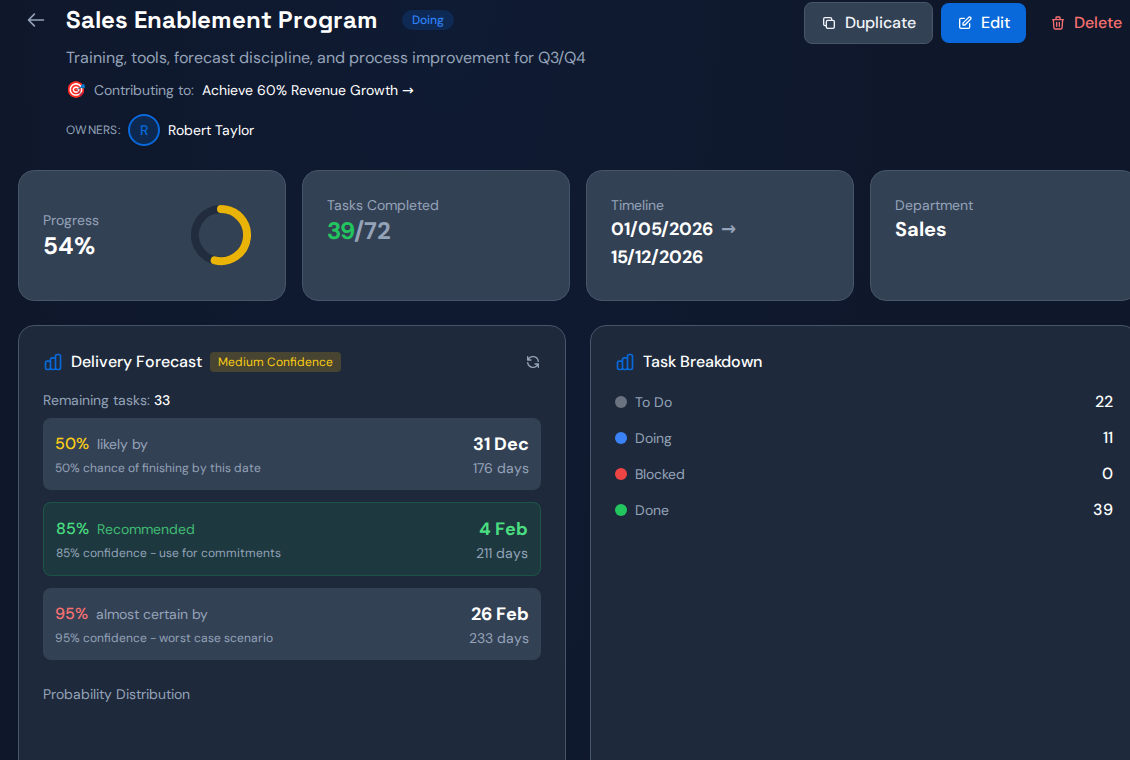
Commandix starts with the command center because leaders need to see the system before they dive into the parts. The first question is not "which task is late?" The first question is "what is happening to the business?" Goals, departments, throughput, workload, sales performance, and constraints belong in one executive view.
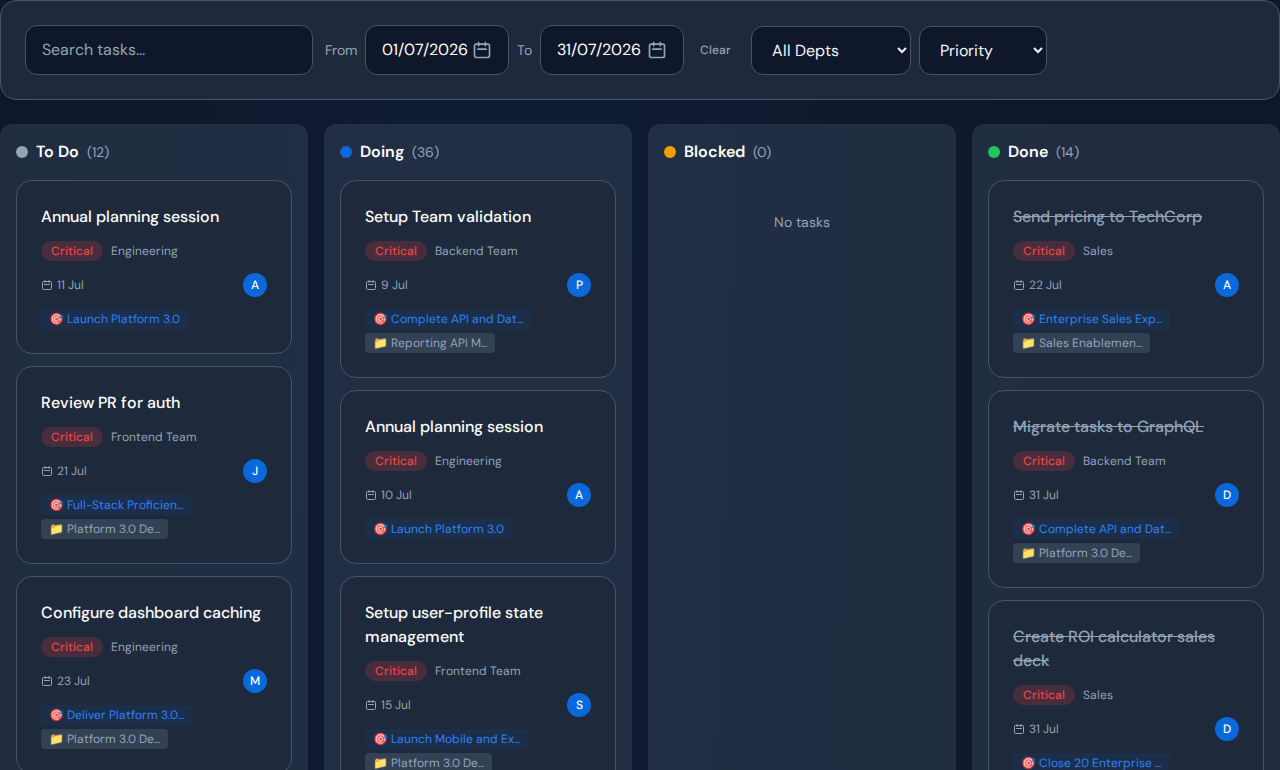
From there, the system must allow fast drill-down. A leader should be able to open a department, inspect team work, view people performance, open projects, trace goals, and see sales execution. That movement from signal to evidence is what makes the system useful.
The constraint is the operating focus
A company execution operating system becomes much more powerful when it adopts Theory of Constraints thinking. Instead of spreading attention across every problem, leadership asks what is limiting the system. The answer may be a team, person, policy, dependency, or revenue process. Once the constraint is named, the organization can align around it.
This is not a small design choice. It changes the emotional state of the business. Teams stop drowning in equal-priority requests. Executives stop confusing urgency with leverage. Managers get a stronger reason to say no. The company learns to finish the work that matters.
The value for leaders
The value is operating confidence. The CEO can see whether strategic goals are alive. The COO can see where execution is stuck. The CRO can see whether revenue work has follow-through. Department leaders can see workload and accountability. Everyone uses the same operating facts.
This creates speed because fewer conversations start from scratch. It creates accountability because ownership is visible. It creates trust because status is tied to work. It creates urgency because the constraint is no longer hiding.
How to implement it
Start small and serious. Put the top company goals in the system. Map departments and owners. Add strategic projects. Connect the tasks that move those projects. Bring sales work into view. Then run one weekly execution review from the command center. Ask what moved, what waited, what is blocked, where the constraint is, and what action will change throughput.
Do that for a month and the company will feel the difference. Not because software magically fixes execution, but because leadership finally has a rhythm that respects reality.
The standard to hold
A company execution operating system should make the business harder to fool. It should resist vague updates. It should expose disconnected work. It should help leaders identify leverage and follow through. It should make the company feel more awake.
That is the promise of Commandix: one operating system for the work, people, revenue, and constraints that decide whether strategy becomes reality.
The operating rhythm that compounds
The first week with a better execution operating system creates visibility. The first month creates better conversations. The first quarter creates a new management reflex. Leaders stop asking for custom status and start opening the system. Managers stop hiding capacity problems and start naming constraints. Teams stop wondering why priorities changed and start seeing the business logic.
That compound effect is the real prize. A company with a stronger operating rhythm does not need to be perfect. It needs to learn faster than the constraints that slow it down. It needs to see earlier, decide cleaner, and follow through harder.
Why Commandix is built for this moment
Modern companies are too complex for status meetings alone and too fast for quarterly retrospectives. They need a live operating surface that connects the business without flattening it into meaningless averages. Commandix brings goals, teams, projects, tasks, sales, flow, and constraints into one system so leaders can make decisions with context.
That is what makes the idea exciting. The company can become more precise without becoming colder. It can become more accountable without becoming political. It can become faster because it finally knows where to aim.
The leadership standard
A company execution operating system should hold leaders to a higher standard. No more goals with no work. No more work with no owner. No more projects that silently overload the same team. No more revenue targets disconnected from the tasks that move deals. No more leadership reviews where everyone debates versions of reality because the system is fragmented.
The standard is simple: if it matters, it must be visible; if it is visible, it must be owned; if it is owned, it must connect to the goal; if it is blocked, the constraint must be named; if the constraint is named, action must follow. This standard creates pressure, but it is productive pressure. It channels energy into the operating truth of the business.
That standard is especially powerful for enterprise teams because complexity tends to reward ambiguity. The bigger the organization, the easier it becomes for strategic work to hide between departments. A strong execution operating system cuts through that ambiguity and gives every leader a cleaner question: what outcome are you moving, what work proves it, and what constraint needs help?
Commandix is built for companies that want that standard. It gives leaders one place to see the business, drill into execution, understand constraints, and act. The value is not just software adoption. The value is a stronger company reflex: see sooner, decide cleaner, act harder, and learn faster.
The operating system as a competitive advantage
Two companies can have the same strategy and very different results because one has a stronger execution operating system. One company debates status. The other sees the work. One company discovers constraints after the miss. The other attacks constraints while there is still time. One company starts projects until capacity breaks. The other sequences work around throughput.
That is why this category matters so much. A company execution operating system is not administrative plumbing. It is how leadership attention becomes business movement. It is how the organization turns ambition into finished work.
Commandix is designed to make that advantage visible. The system brings strategy, people, work, revenue, and constraints into one rhythm so leaders can operate with more precision and more courage.
The strongest companies will treat that rhythm as part of their culture. They will expect goals to have work, work to have owners, owners to have capacity, and constraints to have actions. They will stop rewarding the performance of being busy and start rewarding the system behavior that creates throughput.
That cultural standard is hard to copy because it compounds through every review. The company sees sooner, learns faster, and wastes less leadership energy on avoidable confusion. Over time, the operating system becomes one of the quiet reasons the business keeps winning.
The company still needs judgment, courage, and leadership. The operating system simply gives those qualities a clearer target and a faster feedback loop.
That feedback loop is where execution gets stronger: one review, one constraint, one action, and one measurable improvement at a time.
That is how strategy stops drifting and starts becoming operational truth, visibly and repeatably.
Frequently asked questions
What is an operating system for company execution?
It is the management system that connects strategy, structure, work, revenue, constraints, and review cadence into one way of running the business.
Is this a methodology or software?
It is both. The methodology defines the rhythm and decisions; the software keeps the operating facts connected and visible.
Why does a scaling company need one?
Because growth creates more goals, teams, work, handoffs, and constraints than meetings and spreadsheets can reliably manage.