CommandiX Open demo

Execution management

Constraint-Based Execution Management: The Operating System for Leaders Who Refuse to Drift

Constraint-based execution management helps leaders identify the limiting constraint, assign the right action, and improve throughput across goals, teams, projects, and revenue.

Executive command center
Executive command centerGoals, departments, revenue, throughput, and operating signals in one leadership view.

Constraint-based execution management is the discipline of running the company around the few things that actually decide throughput. It is not another way to decorate a task board. It is not a prettier status report. It is the operating layer that asks the uncomfortable question every leadership team should be asking: what is stopping the system from producing more of the result we already agreed we want?

That question changes the room. Suddenly the meeting is not about who made the best slide, who has the most confident update, or which department can defend its local metrics. The conversation moves to leverage. What is the goal? What is the constraint? Who owns the next action? Did throughput improve after we acted? Those four questions are simple enough to remember and powerful enough to rewire how a company executes.

Why activity is not execution

Most companies are drowning in activity. There are tasks, comments, check-ins, decks, dashboards, and meetings. Everyone can prove they are busy. But busy is a weak form of comfort. A company can be extremely busy and still miss the quarter because the real constraint is ignored. The constraint might be one overloaded team, a policy that forces unnecessary approvals, a sales handoff that loses momentum, a project portfolio with too many active bets, or a senior specialist everyone quietly depends on.

The emotional cost is real. Leaders feel it when the same goals appear in review after review with only small movement. Managers feel it when they ask for more resources but cannot prove where the system is actually stuck. Teams feel it when they work harder and still watch the queue grow. Constraint-based execution management gives that frustration a target. It turns the fog into an object you can name, inspect, and attack.

The four-question operating loop

The first question is "what is the goal?" Not the vague ambition, but the measurable outcome that matters. Revenue growth. Platform launch. Brand awareness. Customer onboarding speed. Department completion rate. A goal only becomes operational when it is connected to the projects, tasks, owners, and teams doing the work.

The second question is "what is the constraint?" This is where most dashboards fail. They show the symptom, not the cause. A red department card may be telling you about a people bottleneck. A slipping project may be telling you about dependency waiting time. A sales miss may be telling you that deal work is not connected to the rest of execution. The constraint is the place where improvement has the highest leverage.

The third question is "who owns the action?" Without ownership, insight becomes theater. Commandix pushes the operating loop toward action by connecting constraints to exploit, subordinate, and elevate options. Protect the constraint. Align the system around it. Add capacity only when the evidence says elevation is needed.

The fourth question is "did throughput improve?" This is the discipline that keeps leaders honest. If the action did not reduce blocked work, improve flow, move a goal, or relieve the overloaded team, the system must learn. The point is not to be right on the first guess. The point is to stop pretending that updates are the same as improvement.

Constraint operating loop
Constraint operating loopA simple leadership loop: goal, constraint, action, throughput, repeat.

What this looks like inside Commandix

Commandix starts with the executive command center because leaders need the whole system in view. Strategy, departments, sales performance, throughput, and work type mix sit together. That matters because constraints rarely respect org charts. The thing hurting a revenue goal may live in operations. The thing slowing a project may live in a shared team. The dashboard gives leadership the surface area to see the system before drilling into it.

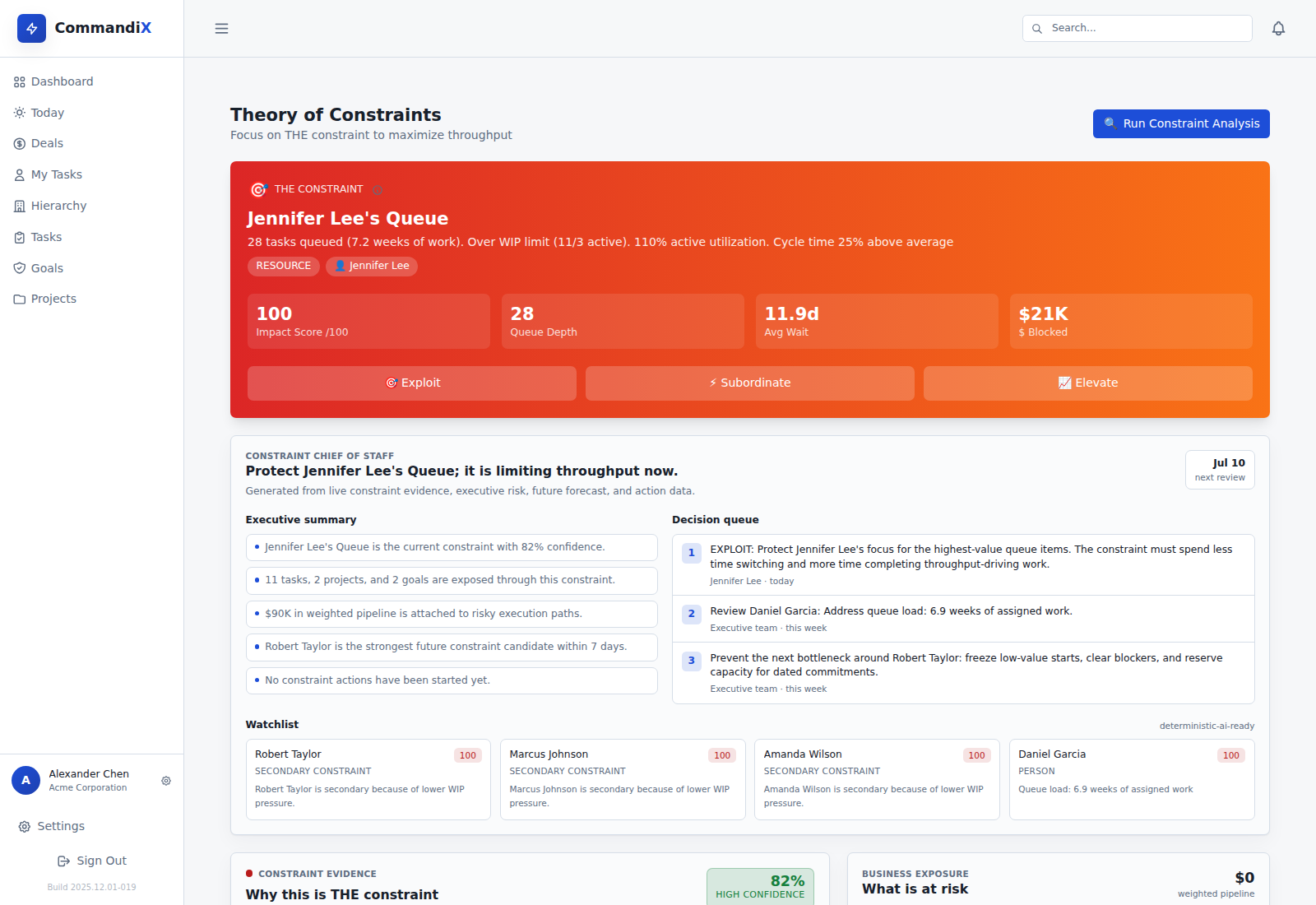
From there, constraint analysis makes the conversation sharper. The constraint card shows impact score, queue depth, average wait, and blocked value. Those numbers are not decoration. They are there to pull the leadership team away from opinion and toward evidence. When a person or team is named as the bottleneck, the next question becomes useful: what work is queued behind them, why is it waiting, and what should the organization stop doing so the constraint can produce?

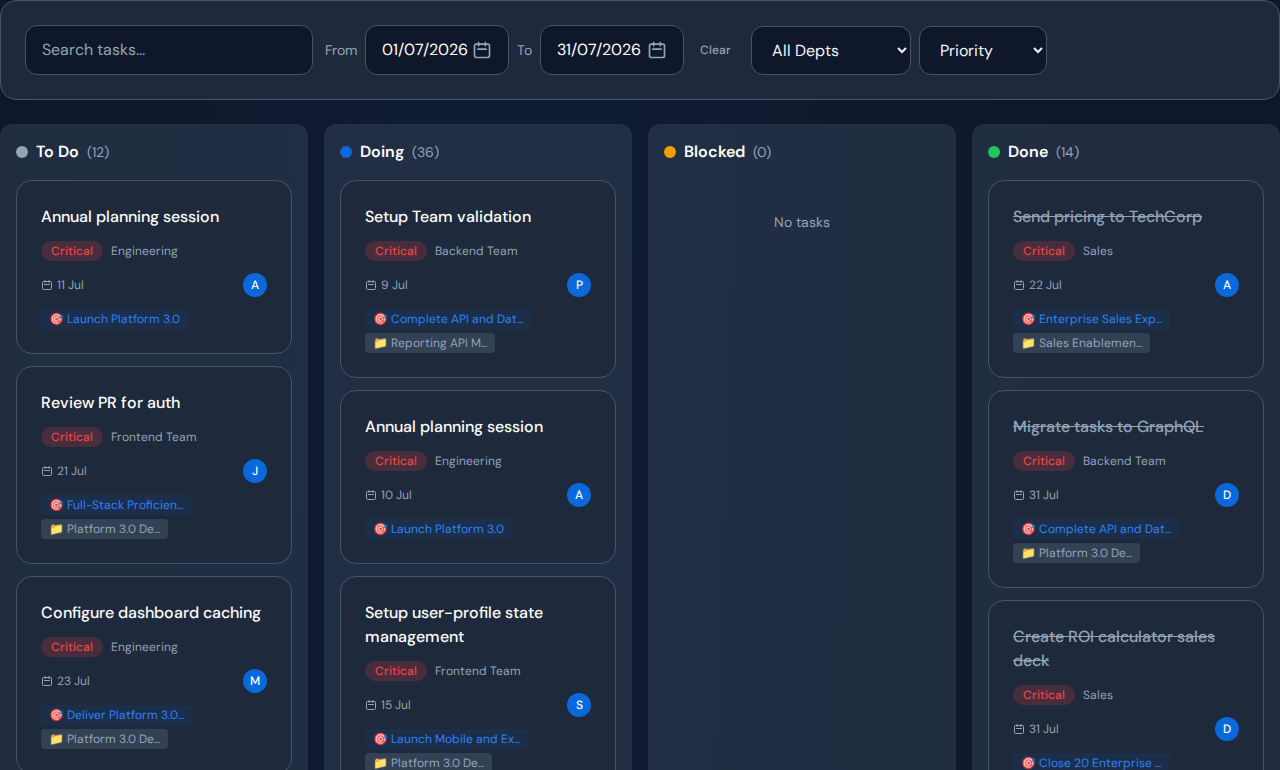
Flow analytics then protects the team from a common mistake: confusing workload with throughput. A person can be overloaded while completed work is still flowing. A CFD can show empty or thin history while the workload dashboard shows a current pileup. Good execution management explains the difference instead of hiding it. Leadership needs both the live load and the historical flow to make a good decision.

Constraint identified
Constraint identifiedImpact score, queue depth, wait time, blocked value, and exploit/subordinate/elevate actions.

The business value

The value is speed with judgment. Not panic speed. Not "everything is urgent" speed. Real speed comes from choosing the point where attention matters most. If the constraint is sales follow-up, then improving engineering velocity will not save the quarter. If the constraint is a backend lead approving every architectural decision, then adding more frontend tasks just creates more inventory. If the constraint is project intake, then hiring another project manager may only increase the number of active projects fighting for the same scarce capacity.

When a company works this way, meetings change. People stop bringing defensive updates and start bringing evidence. Teams stop optimizing their corner and start asking how to increase system throughput. Executives stop spreading attention like peanut butter over every initiative and start concentrating energy where it can actually move the business.

Constraint actions
Constraint actionsTurn diagnosis into focused action ownership and follow-through.

How to start this week

Pick one strategic goal that matters this quarter. Open the work behind it. Find the team, project, person, or policy that appears most often in waiting, blocked, overdue, or dependent work. Name that as a candidate constraint. Then run one action for a week: protect its time, subordinate lower-value work, or elevate capacity. At the next review, ask what moved.

That is the heartbeat of constraint-based execution management. It is practical. It is intense. It respects the business enough to stop pretending every improvement matters equally. And when leaders see the constraint clearly for the first time, the room usually gets quieter. Not because people are confused, but because the organization finally knows where to aim.

The board-level reason this matters

The executive value of constraint-based execution is that it turns management attention into a scarce asset. Boards do not reward motion. Markets do not reward internal effort. Customers do not reward how many projects were technically active. The business is rewarded when the system produces more value with the same or less friction. That is why the constraint deserves such a privileged place in the operating conversation.

When leadership knows the constraint, capital allocation improves. Hiring discussions become sharper. Project approvals become more honest. Sales promises become easier to defend because the company can see whether delivery capacity exists. Instead of asking for another generic update, the board can ask whether the limiting factor moved and what evidence proves it.

Flow analytics
Flow analyticsCycle time, lead time, flow efficiency, CFD, workload, and aging WIP for execution diagnosis.

The Commandix advantage for operators

Commandix makes the operating loop usable by busy leaders. It does not require the company to become academic about Theory of Constraints before it gets value. The system shows the signal, gives the drill-down, names the candidate constraint, and pushes the team toward action. That compression matters. A leader should be able to move from "the quarter is at risk" to "this is the queue we are going to protect" while the conversation is still hot.

That is how execution becomes exciting again. The company stops carrying a hundred low-grade anxieties and starts attacking one high-leverage problem at a time. People feel the difference because focus is humane. It removes noise, protects the work that matters, and gives the team a visible win to chase.

Goal traceability
Goal traceabilityFollow a strategic goal into projects, weighted tasks, owners, and real execution movement.

The 30-day adoption sprint

For the first 30 days, do not try to redesign the whole company. Pick one outcome that matters and use it as the proving ground. Week one is mapping: goal, projects, active work, owners, and current symptoms. Week two is diagnosis: where is work waiting, who is overloaded, which dependency keeps appearing, and what business value is trapped behind the queue. Week three is intervention: protect the constraint, stop feeding it low-value work, and assign one accountable action. Week four is proof: compare throughput, waiting time, blocked value, and leadership confidence.

This sprint gives executives a fast win because it avoids the classic transformation trap. The company does not need a year-long change program to feel the power of constraint-based execution. It needs one important goal, one honest constraint, and one measurable action. When that action moves the system, people feel it. The team gets relief. The leadership meeting gets sharper. The business sees that execution can be managed as a system, not as a collection of heroic favors.

That is where Commandix earns its place. It gives the sprint a home. The dashboard creates the starting signal. The constraint view gives the diagnosis. The action layer creates follow-through. The flow and workload views tell the team whether the fix is real. After one month, leaders are no longer debating whether the operating rhythm is useful. They are deciding which strategic goal to aim it at next.

Frequently asked questions

What is constraint-based execution management?

It is an operating method that connects strategy, work, people, revenue, and flow data so leaders can identify the constraint limiting throughput and act on it first.

How is it different from project management?

Project management organizes work. Constraint-based execution management asks which part of the system is limiting output and focuses leadership action there.

Who should use it?

CEOs, COOs, operating leaders, PMOs, and revenue leaders who need a live way to move from symptoms to action ownership.

See the operating system behind the article.Open Commandix demo