Key takeaways
- An executive command center is not a prettier dashboard. It is a decision surface.
- The highest-value answer for leadership is simple: goal, constraint, owner, next action, throughput check.
- Commandix helps leaders move from a weak number to accountable work, team performance, and revenue risk without waiting for custom reports.
Executive command center software should make the company harder to fool. That is the entire game. A leadership team can survive hard problems. It cannot survive a quarter where the real problem stays hidden until the forecast breaks, the strategic project slips, or the best people burn out under invisible queues.
Most executive dashboards show the surface. Revenue is up or down. Projects are green, yellow, or red. Tasks are open. Departments are busy. The room nods because the data looks official. But the CEO does not buy software because they want another official-looking screen. The CEO wants the answer underneath the screen: what is limiting execution, who owns it, what should we do next, and did throughput improve after we acted?
That is what separates a command center from a dashboard. A dashboard says, "Here is what happened." A command center says, "Here is what to fix first."
The executive problem: too many signals, not enough decision#
Scaling companies do not suffer from a shortage of data. They suffer from a shortage of clean operating judgment. Every department has a dashboard. Every project has a status. Every team has activity. Sales has pipeline. Operations has priorities. Product has roadmaps. Finance has forecasts. The leadership meeting becomes an exercise in translating all of that into one hard decision.
The problem is that most systems treat every metric as equally important. That feels fair, but it is operationally weak. The Theory of Constraints teaches a better principle: a system is limited by its constraint. If leaders spend the week optimizing a non-constraint, the company may get locally cleaner while the business result stays stuck. That is why Commandix puts the constraint inside the command center instead of hiding it on a technical analytics page.
If a dashboard does not tell the executive team what to fix first, it is still leaving the hardest work to the meeting.
What an executive command center must answer#
The operating answer needs five parts. First, the goal. Not a slogan. Not a direction. The real business result that matters this quarter. Second, the constraint. The person, team, process, queue, policy, or revenue motion limiting throughput. Third, the owner. Someone has to be accountable for changing the system, not just explaining it. Fourth, the next action. Exploit, subordinate, or elevate. Fifth, the throughput check. The proof that the action worked or failed.
| Leadership question | Weak dashboard answer | Command center answer |
|---|---|---|
| Are we on track? | A percentage, color, or trend. | The goal, linked work, risk, and constraint behind the movement. |
| What is broken? | A red department or late project. | The limiting point with queue, wait, confidence, and impact. |
| Who owns this? | A department name. | A named owner and accountable next action. |
| What should change this week? | More follow-up, more meetings, more pressure. | One exploit, subordinate, or elevate move. |
| Did it work? | Another update next week. | A throughput check tied to the action. |
The Commandix command center workflow#
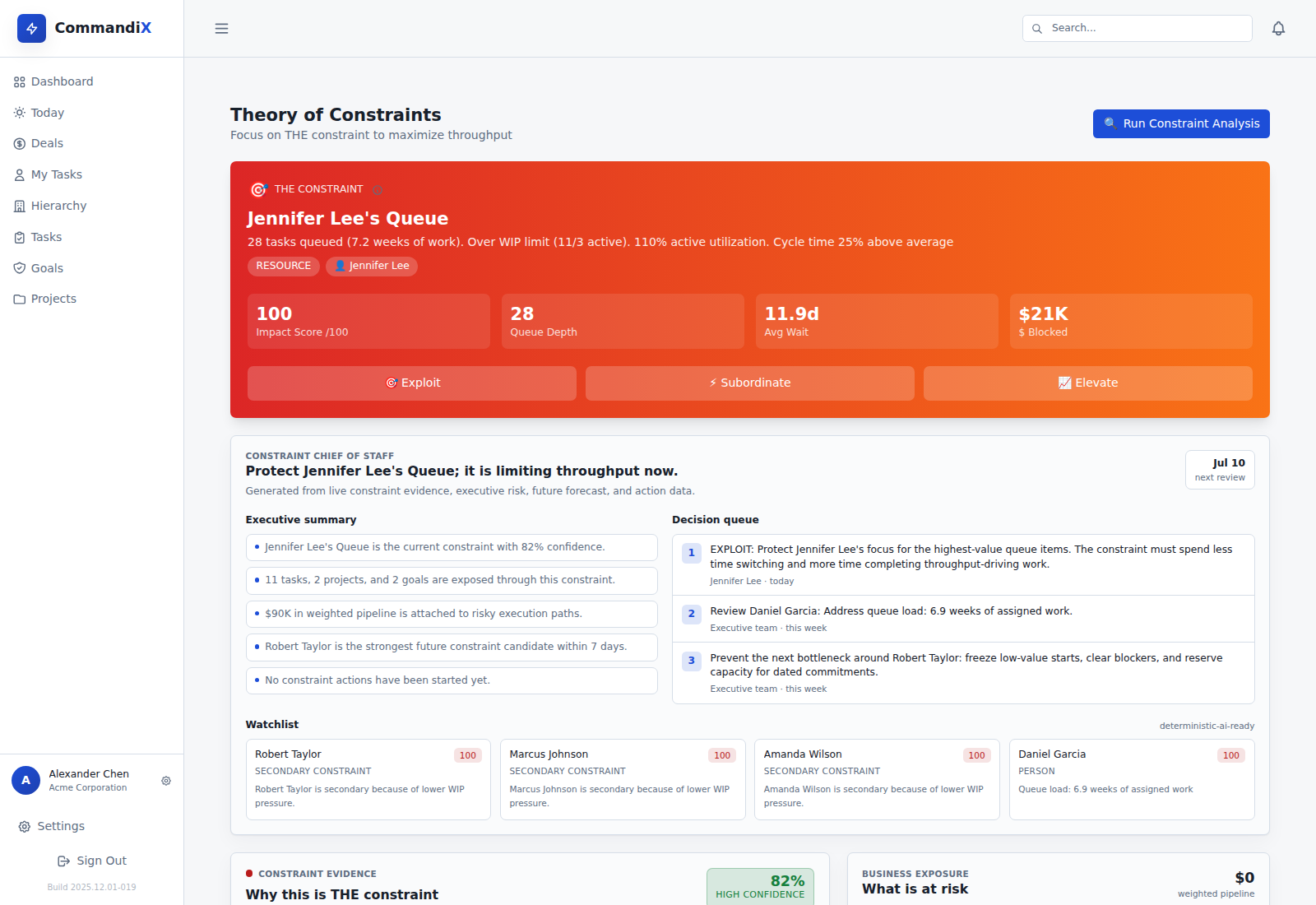
Commandix starts with the executive answer because that is where leadership attention belongs. The page shows the goal, the current constraint, the owner, the next action, and the measurement that proves whether throughput improved. Around that answer sit the business impact signals that make the decision urgent: revenue at risk, projects at risk, goals at risk, blocked work, overdue tasks, and deal execution.
This layout matters. A constraint without business impact can be dismissed as an operational detail. Business impact without a constraint creates anxiety. Put them together and the leadership team gets leverage. The room can stop asking for another report and start asking what needs to change in the system before the next review.
One of the most valuable parts of the view is the constraint signature. It combines confidence, impact score, queue depth, and wait time. Those numbers give executives a way to separate a noisy symptom from the current constraint. A busy person is not always the constraint. A red project is not always the constraint. A weak sales number is not always the constraint. The command center has to force the stronger question: where is throughput actually limited?
The business impact must be visible#
Executives do not act because a card is red. They act because the business consequence is obvious. If the constraint exposes revenue at risk, show it. If it threatens strategic projects, show them. If it blocks work across the company, show the count. If the delay is starving throughput, show the wait. This turns the constraint from a technical diagnosis into a management decision.
If the constraint card cannot survive the question "so what?", it is not ready for the executive meeting. Commandix ties the answer to money, projects, goals, and work so the business consequence is not vague.
That is why the command center does not isolate revenue from execution. Pipeline belongs in the operating system. Sales promises create tasks. Deal work creates dependencies. Proposal follow-up, security questions, implementation readiness, legal review, and internal approvals all affect revenue movement. A CRO may own the number, but the operating system often decides whether the number moves.
The two-click proof#
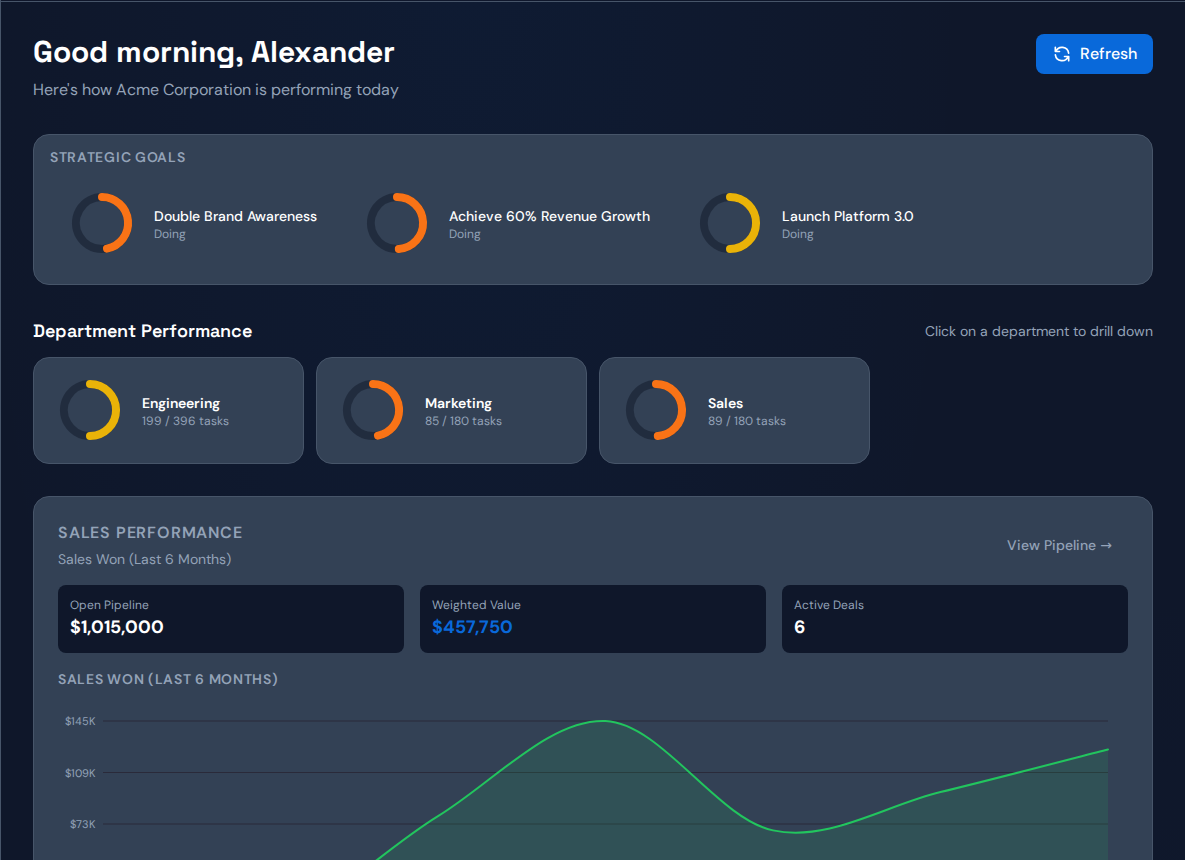
A command center earns trust when leaders can drill from a weak signal into evidence quickly. Commandix is designed for that. From the dashboard, a leader can open a department and then open tasks to see who is the lowest performer for the month. The point is not public shaming. The point is fast context. Is the person underperforming, overloaded, blocked, or holding complex high-value work?
The same logic applies to sales. In a few clicks, leadership can identify who drives the most weighted pipeline, who drives the least, where deal work is blocked, and which tasks are preventing revenue movement. This is the emotional moment for a CEO or COO. They can feel the difference between "I need to ask someone for a report" and "I can inspect the operating truth right now."
See the company constraint and the business consequence before the quarter becomes a post-mortem.
Run a cleaner weekly operating cadence around owner, action, and proof.
Connect pipeline risk to seller work, blocked tasks, and accountable follow-through.
Why this creates urgency instead of chaos#
Bad urgency says everything is on fire. Good urgency says this is the point of leverage. That difference changes how people feel at work. When every issue receives executive pressure, teams learn to protect themselves. They hide weakness, manage perception, and optimize for the loudest stakeholder. When leadership focuses on the constraint, teams get a clearer standard. The organization knows what matters this week.
This is why the command center includes the "stop doing" view. Sometimes the right action is not more work. It is less work aimed at the constraint. Stop feeding low-value items into the bottleneck. Stop context switching the constrained owner. Stop starting projects that fight for the same scarce capacity. Stop asking every department to optimize locally while the system constraint remains unchanged.
The operating meeting changes#
A normal executive meeting asks each leader to provide a status update. A stronger operating meeting starts from the command center. What is the goal? What is the constraint? Who owns the next action? What should we stop doing? What will prove throughput improved? The meeting becomes shorter because the conversation has a target.
| Old meeting pattern | Command center pattern | Result |
|---|---|---|
| Department status tour. | Constraint-first review. | Less theater, more leverage. |
| Many follow-ups. | One owner and one next action. | Clear accountability. |
| Late surprises. | Queue, wait, and blocked value early. | Earlier intervention. |
| Opinion debate. | Evidence from goals, tasks, teams, and revenue. | Sharper decisions. |
What buyers should demand#
If you are evaluating executive command center software, demand more than visual polish. Ask whether the system can connect goals to projects and tasks. Ask whether it can name the constraint. Ask whether it shows the owner and next action. Ask whether revenue execution lives beside operational work. Ask whether a leader can move from company signal to team, person, task, or deal evidence without a special analyst.
Also ask whether the software changes behavior. A command center should make leadership reviews calmer, sharper, and more action-oriented. If it only adds another screen to the meeting, it is not a command center. It is a dashboard with a bigger title.
The payoff#
The payoff is management speed. Not frantic speed. Executive speed. The company can see the limit earlier, make a cleaner decision, protect the right capacity, and check whether the system improved. That creates confidence because the leadership team is no longer guessing from scattered reports. They are operating from one connected view of goals, constraints, owners, actions, revenue, and throughput.
This is what Commandix is built to do. Give leaders the answer they wanted when they bought all the dashboards in the first place. What is limiting execution? Who owns it? What should we fix first? Did throughput improve?
When a CEO sees that answer in one place, the room changes. The conversation gets quieter, not weaker. Quieter because the signal is finally clear. Sharper because the next action is no longer hiding. That is the moment an executive command center becomes more than software. It becomes the weekly operating truth of the company.
Inspect the goal, current constraint, owner, next action, two-click performance proof, and revenue execution context in the Commandix demo.
Open live demo
Frequently asked questions#
What is executive command center software?#
Executive command center software gives leaders one operating view of goals, constraints, owners, next actions, teams, projects, tasks, revenue, and throughput.
How is it different from an executive dashboard?#
A dashboard shows status. A command center connects status to the constraint, owner, action, and throughput check so leaders can decide what to fix first.
Who should use Commandix as a command center?#
CEOs, COOs, CROs, PMOs, RevOps leaders, and department heads who need operating truth instead of scattered updates.