CommandiX

Weekly Operating Brief Software: Turn Execution Data Into a CEO Review That Creates Action

Weekly operating brief software should summarize the goal, constraint, owner, next action, stop-doing list, business impact, and throughput check for leadership.

Weekly operating brief panel in Commandix for weekly operating brief software, showing A copyable and printable brief turns live execution data into a leadership artifact.
Weekly operating brief panelA copyable and printable brief turns live execution data into a leadership artifact.
On this page

Key takeaways

  • A weekly operating brief should create a decision, not summarize every activity.
  • The strongest brief uses a simple structure: goal, constraint, owner, next action, stop-doing list, throughput check.
  • Commandix turns live execution data into a copyable and printable leadership brief for the weekly operating cadence.

Weekly operating brief software should make leadership reviews shorter, sharper, and more expensive in the right way. Expensive not because the tool costs more. Expensive because the meeting finally treats executive attention like the scarce asset it is. If the CEO, COO, CRO, PMO, and department leaders are in the room, the output cannot be "we discussed many updates." The output has to be a decision.

Most weekly reports fail because they are built around activity. Here is what we did. Here is what is in progress. Here is what is late. Here is what we plan next. That information can be useful, but it is not enough. Activity does not tell leadership where the system is constrained. It does not tell them what to stop. It does not tell them which action should improve throughput.

A strong weekly operating brief does exactly that. It turns execution data into a leadership artifact that answers: what is the goal, what is the constraint, who owns the action, what should move next, what should stop, and what will prove that throughput improved?

The status report trap#

Status reports are comfortable because they feel responsible. Everyone gets to show work. Every department gets airtime. Every project gets a line. The problem is that status reports often preserve complexity instead of reducing it. Leaders leave with more information but not more leverage.

This is dangerous because meetings can hide drift. A company can have disciplined weekly status reviews and still miss the quarter. The reports were sent. The dashboards were updated. The blockers were mentioned. But the leadership team never focused around the true constraint. The brief should prevent that failure by forcing the conversation toward the point of highest leverage.

Operating rule

If the weekly review does not produce a named action owned by a named person, it was probably a status ritual, not an operating cadence.

The six-part weekly brief#

The brief does not need to be long. It needs to be ruthless. The first part is the goal. Which outcome is this review protecting? The second is the constraint. What is limiting progress toward that outcome? The third is the owner. Who will change the system? The fourth is the next action. What move will exploit, subordinate, or elevate the constraint? The fifth is the stop-doing list. What low-value work should be paused so the constraint can produce? The sixth is the throughput check. How will the team know next week whether the action worked?

Brief sectionQuestion it answersWhy it matters
GoalWhat result are we protecting?Keeps the meeting tied to business value.
ConstraintWhat limits throughput now?Focuses leadership attention.
OwnerWho changes the system?Creates accountability.
Next actionWhat moves this week?Turns evidence into behavior.
Stop doingWhat should stop feeding the constraint?Creates capacity without panic.
Throughput checkWhat will prove improvement?Forces learning next week.
Brief decision card in Commandix for weekly operating brief software, showing The brief keeps the goal, constraint, owner, and next action in one concise view.
Brief decision cardThe brief keeps the goal, constraint, owner, and next action in one concise view.

Commandix turns the brief into a live artifact#

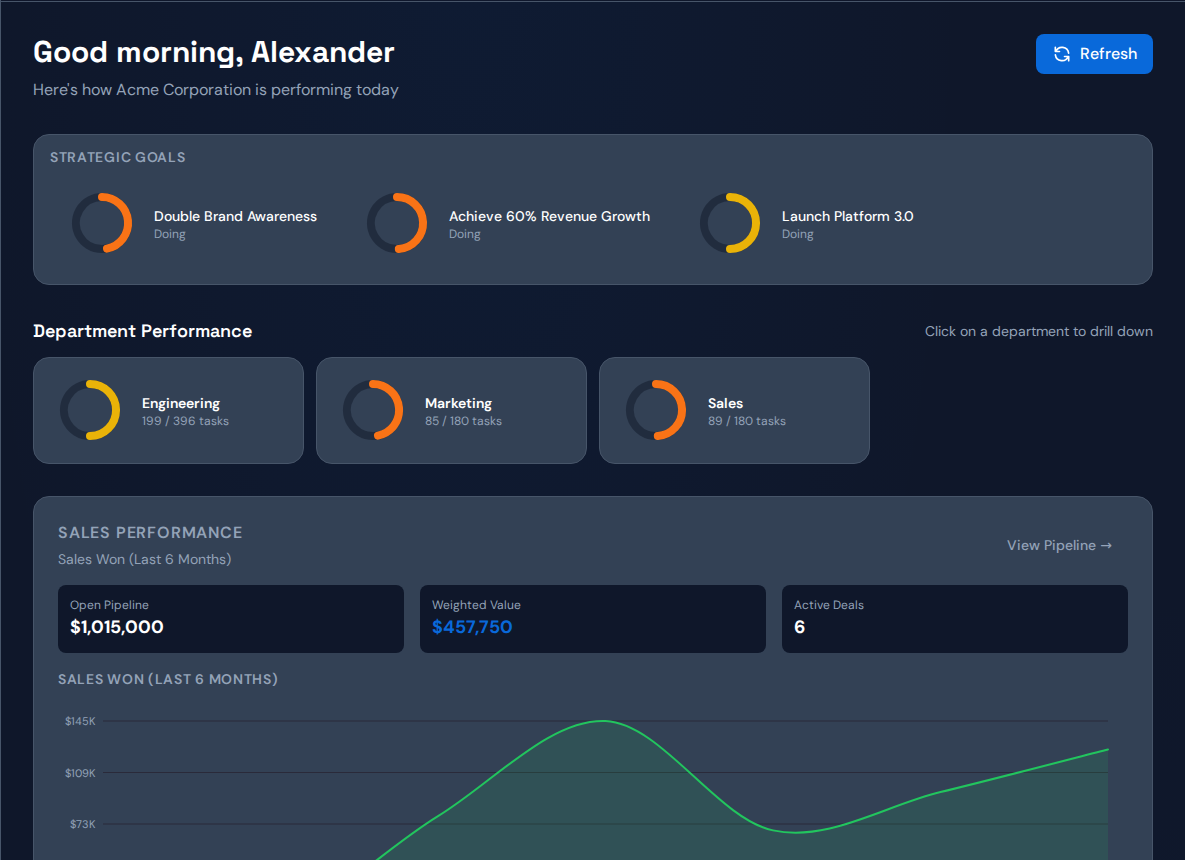
Commandix includes a weekly operating brief inside the command center. It is not a blank template. It is grounded in live execution data: the active goal, current constraint, owner, next action, business impact, and board-level questions. Leaders can copy it or print it because the brief is meant to travel. It can go into the weekly leadership agenda, board prep, executive notes, or a follow-up email.

That portability matters. A dashboard is something leaders look at. A brief is something leaders align around. It gives the team a shared language for the week. Instead of each leader remembering a different version of the discussion, the organization has one operating artifact.

The board questions change the meeting#

Good board questions create pressure without chaos. Did the goal move? Is the current constraint still the constraint? What should we stop doing? What proof will show throughput improved? These questions are simple, but they cut through a lot of noise. They force executives to connect ambition, work, capacity, and evidence.

Goal question

What outcome is at risk if nothing changes this week?

Constraint question

Where is work waiting, blocked, overloaded, or losing momentum?

Proof question

What number, queue, or throughput signal should improve next?

This is where the brief earns executive trust. It does not try to sound comprehensive. It tries to create the right pressure. When the right pressure exists, the team makes better tradeoffs. Lower-value work gets subordinated. Overloaded owners get protection. Important deal work gets attention. Projects that fight for the same constraint get sequenced.

Board questions card in Commandix for weekly operating brief software, showing Leadership questions keep the weekly review focused on proof, not theater.
Board questions cardLeadership questions keep the weekly review focused on proof, not theater.

Why the stop-doing list is the power move#

Most companies try to solve execution problems by adding more: more meetings, more tasks, more updates, more urgency, more people. Sometimes more is necessary. But the Theory of Constraints asks leaders to exploit and subordinate before they elevate. That means the weekly brief should identify what to stop, not only what to start.

A stop-doing list is not laziness. It is precision. If the constraint is a senior reviewer, stop sending low-value review items. If the constraint is sales follow-up, stop pulling sellers into non-selling internal tasks. If the constraint is executive approval, stop letting weak decision packets enter the queue. If the constraint is project portfolio overload, stop starting initiatives that fight for the same scarce capacity.

Fast leverage

The cheapest capacity you will ever create is the low-value work you stop feeding into the constraint.

The weekly cadence that works#

Run the review in four stages. First, open the command center and read the brief. Second, inspect the evidence behind the constraint. Third, decide the next action and stop-doing items. Fourth, commit to the throughput check for the next review. That is enough. If the meeting wanders, return to the brief.

TimeAgenda itemExpected output
0-10 minRead the brief and confirm the goal.Shared context.
10-25 minInspect constraint evidence.Agreement on the limiting point.
25-40 minChoose exploit, subordinate, or elevate.Owned next action.
40-50 minDecide what to stop doing.Protected capacity.
50-60 minSet throughput check.Next-week proof.
Operating meeting agenda in Commandix for weekly operating brief software, showing The weekly cadence turns signals into decisions the company can actually follow.
Operating meeting agendaThe weekly cadence turns signals into decisions the company can actually follow.

How this helps each executive role#

The CEO gets a simple answer to what limits the company goal. The COO gets a cleaner operating rhythm. The CRO gets revenue work connected to owners and blocked tasks. The PMO gets portfolio constraint evidence before dates slip. Department leaders get context for coaching and capacity. RevOps and Ops get a way to keep the operating system honest.

That role-level value matters because the weekly brief should not become the COO's private document. It should be the leadership team's shared operating language. Everyone should be able to read it and understand what the company is trying to improve this week.

What the brief should not become#

Do not let the brief become a miniature annual report. If it grows until nobody reads it, it has failed. Do not let every team add a section. Do not turn it into a gallery of charts. Do not include every metric just because it exists. The brief wins by being selective. Its job is to focus attention, not prove that the company owns data.

Also do not let the brief become a weapon. The purpose is to change the system, not humiliate the owner of the constraint. Sometimes the owner is the constraint because they are trusted with too much critical work. Sometimes the system is feeding them garbage inputs. Sometimes leadership created the overload. The brief should create clarity and responsibility, not fear.

Stop-doing list in Commandix for weekly operating brief software, showing Constraint-based leadership often creates throughput by stopping low-value work first.
Stop-doing listConstraint-based leadership often creates throughput by stopping low-value work first.

Signs your weekly review is improving#

Watch for these signals:

  • Meetings start with the constraint instead of department updates.
  • Fewer vague follow-ups leave the room.
  • Owners know exactly what to change this week.
  • Leaders pause or subordinate low-value work more quickly.
  • Revenue, project, and task risks are discussed in one operating context.
  • The team checks whether last week's action improved throughput.

The emotional payoff#

The emotional payoff is control. Not fake control where every tile is green. Real control, where leaders can see the problem early enough to make a move. A good weekly operating brief makes the business feel less foggy. The company may still have hard constraints, but the leadership team is no longer pretending that scattered activity equals execution.

This is the kind of artifact a CEO wants to forward. It is concise. It is grounded. It shows the decision. It names the owner. It shows what will prove improvement. It respects time.

Constraint proof in Commandix for weekly operating brief software, showing The brief is strongest when it is backed by the active constraint signature and expected result.
Constraint proofThe brief is strongest when it is backed by the active constraint signature and expected result.

How to start this week#

Pick one company goal. Identify the current constraint. Name one owner. Decide one next action. Decide what to stop doing. Decide what metric, queue, or throughput signal should improve by the next review. Write it in one page. That is your first weekly operating brief.

Commandix makes that easier because the brief is built from the operating system itself. Goals, constraints, owners, tasks, projects, revenue, and throughput are already connected. The brief simply turns that connected truth into a leadership artifact.

When the weekly review produces this kind of brief, the company feels different. Less drift. Less theater. Less "we will follow up." More ownership. More precision. More throughput. That is the point. The brief is not the work. It is the leadership mechanism that makes the right work harder to ignore.

Run the weekly operating brief.

Open Commandix and copy the goal, constraint, owner, next action, stop-doing list, and throughput check from the live command center.

Open live demo

Frequently asked questions#

What is a weekly operating brief?#

A weekly operating brief is a concise leadership artifact that names the goal, constraint, owner, next action, business impact, stop-doing items, and throughput check.

How is it different from a weekly status report?#

A status report summarizes activity. A weekly operating brief forces a decision around the constraint and the next action that should improve throughput.

Can Commandix create a weekly operating brief?#

Yes. Commandix includes a command center brief that can be copied or printed from live execution data.

See it in Commandix

Run the weekly review from one operating picture.

Inspect goals, constraints, owners, projects, tasks, revenue, and throughput in the live Commandix workspace.
Open live demo
Back to all Commandix articles