CommandiX

AI Executive Analyst Software: Ask Your Operating System What Is Limiting Execution

AI executive analyst software can turn goals, constraints, owners, tasks, projects, teams, revenue, and throughput into sharper leadership questions and next actions.

AI Analyst in light theme in Commandix for AI executive analyst software, showing The AI Analyst reads execution signals from goals, constraints, owners, work, revenue, and.
AI Analyst in light themeThe AI Analyst reads execution signals from goals, constraints, owners, work, revenue, and throughput.
On this page

Key takeaways

  • Executive AI is only valuable when it is grounded in the operating system, not generic advice.
  • The best AI analyst should explain the constraint, evidence, owner, next action, and throughput check.
  • Commandix lets leaders connect OpenAI, Claude, or DeepSeek and ask questions about real execution data.

AI executive analyst software should not be a chatbot wearing a suit. That is the low-value version. A CEO does not need generic advice about focus, alignment, and accountability. They have heard those words a thousand times. What they need is an analyst that can read the operating system and say something useful: this goal is at risk, this constraint is limiting throughput, this owner needs protection, this sales work is stuck, and this is the action that should be reviewed next week.

That is the difference between AI that sounds smart and AI that helps a company make money, protect time, and move faster. The first produces paragraphs. The second produces judgment grounded in evidence.

The problem with generic AI in business operations#

Generic AI can write a decent strategy memo. It can summarize a meeting. It can produce a list of best practices. That is useful, but it does not answer the executive question. The executive question is not "what could a company do?" The executive question is "given our goals, teams, projects, tasks, revenue, and constraints, what should we do first?"

If the AI cannot see the operating data, it is guessing. It may guess eloquently, but it is still guessing. It cannot know that the backend lead is carrying the constraint. It cannot know that weighted pipeline is concentrated in two sellers. It cannot know that a strategic goal has active projects but too many blocked tasks. It cannot know that the weekly throughput trend is not improving after leadership intervention.

Hard truth

An AI analyst without execution data is a motivational speaker. It may sound confident, but it cannot see the system.

What grounded executive AI should analyze#

Grounded AI needs a connected snapshot. It needs goals and progress. It needs tasks by status. It needs projects, owners, blocked work, due dates, and workload. It needs team performance and person-level context. It needs revenue, deals, weighted pipeline, seller ownership, and blocked deal tasks. It needs constraint analysis and throughput signals. Only then can the AI help leadership ask better questions.

Data layerWhat the AI can answerExecutive value
GoalsWhich outcome is weak or underpowered?Prevents wandering analysis.
TasksWhere is work active, overdue, blocked, or aging?Turns status into evidence.
ProjectsWhich initiatives create portfolio pressure?Helps decide what to pause or protect.
People and teamsWho is overloaded, outperforming, or constrained?Improves coaching and capacity decisions.
RevenueWhich deals and sellers need execution attention?Connects pipeline to operating work.
ConstraintsWhat is limiting throughput now?Focuses leadership on leverage.
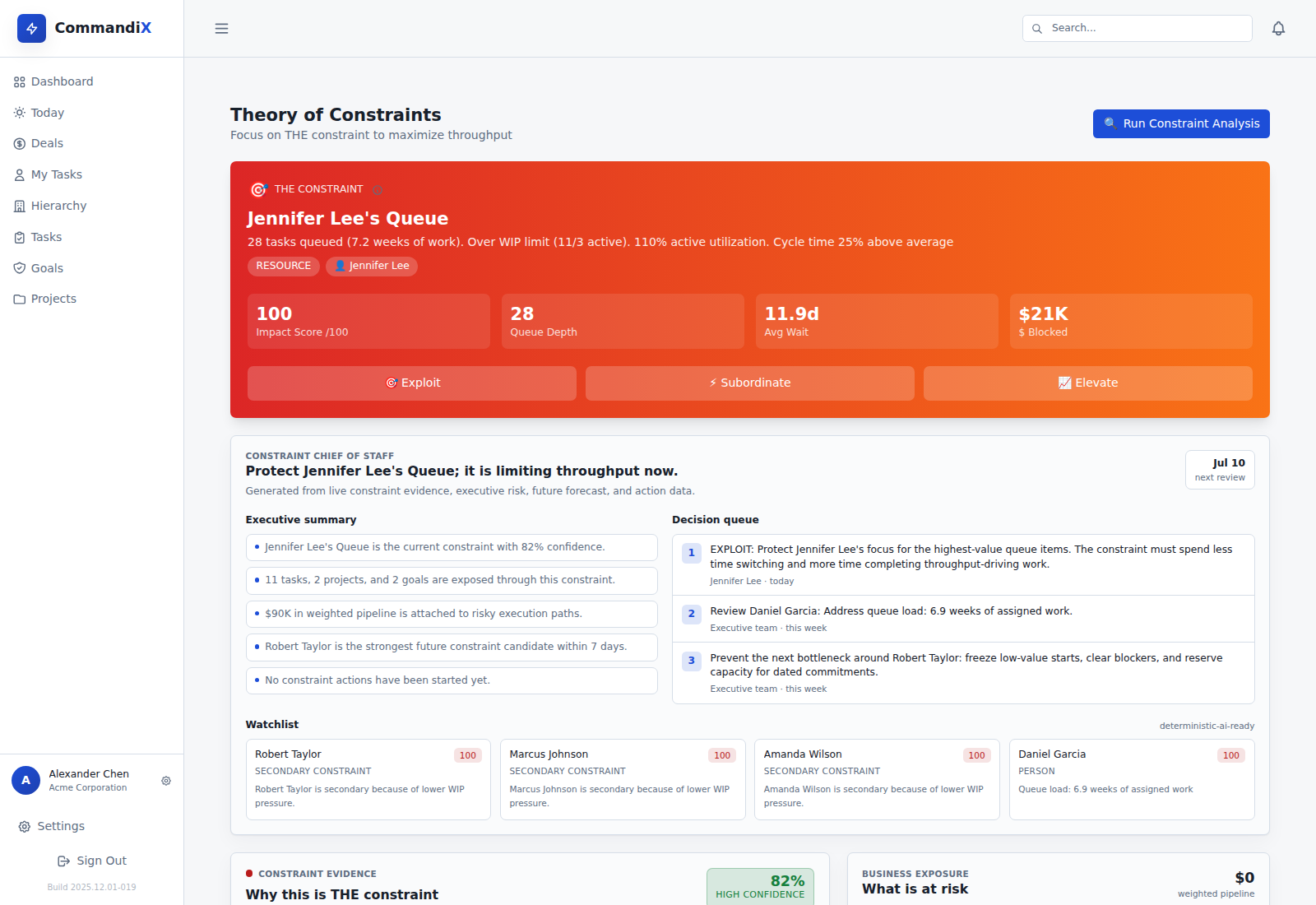
Local execution signals in Commandix for AI executive analyst software, showing Even without live AI chat, Commandix surfaces grounded signals from operating data.
Local execution signalsEven without live AI chat, Commandix surfaces grounded signals from operating data.

Commandix AI Analyst: the right question engine#

The Commandix AI Analyst is built around executive questions. What is limiting execution right now? Which goal is most at risk and why? Who is overloaded or underperforming, and what evidence supports that? Which seller drives the most weighted pipeline, and where is revenue execution stuck? What are the next three leadership actions for this week?

These are not cute prompts. They are the questions executives already ask when the room gets serious. The difference is that Commandix can ground the conversation in the system: goals, constraints, owners, tasks, projects, teams, revenue, and throughput. The AI does not need to invent the company. The company is already in the operating graph.

Generic AI

Gives broad advice that may apply to any company.

BI dashboard

Shows data, then leaves interpretation to the meeting.

Commandix AI

Connects operating evidence to a leadership question and next action.

The local signal layer matters#

One smart design choice is that AI should not be all-or-nothing. Commandix can surface local execution signals even before a live provider key is connected. That matters for trust. Leaders should see the raw operating signals the AI will reason over. If the system says "current constraint," "goal risk," "revenue execution," or "team performance," the leader should understand where that signal comes from.

Without that layer, AI becomes a black box. It may produce a convincing answer, but nobody knows whether it saw the right evidence. Commandix keeps the evidence close: active work, blocked work, weighted pipeline, throughput, owner context, and constraint details. The AI is an analyst on top of the operating system, not a substitute for the operating system.

Executive chat questions in Commandix for AI executive analyst software, showing Leaders can ask direct questions about constraints, goal risk, sales execution, and next best.
Executive chat questionsLeaders can ask direct questions about constraints, goal risk, sales execution, and next best actions.

Bring your provider: OpenAI, Claude, or DeepSeek#

Enterprise teams care about control. Some teams prefer OpenAI. Some prefer Claude. Some want DeepSeek for cost-efficient analysis. Some will run procurement and security reviews before any production key is saved. Commandix supports provider settings so owners can configure the AI layer in a way that matches their policy and trust requirements.

The settings page exposes the practical controls leaders expect: model, base URL, API key, enabled state, default provider, test, remove, and save. That may sound administrative, but it is part of enterprise credibility. A serious company does not want mystery AI. It wants explicit provider configuration and accountable owner control.

Procurement lens

AI features are easier to approve when provider choice, key ownership, and configuration are visible instead of hidden inside the product.

What the CEO can ask#

The CEO should ask questions that create management movement. "What is the current constraint?" is good. "What should we stop doing this week?" is better. "Which goal is at risk because of this constraint?" is better still. The power is not that AI answers instantly. The power is that it can compress a messy operating review into a sharper first draft.

High-value executive prompts

  • What is limiting execution right now, and what evidence supports it?
  • Which strategic goal is most exposed to blocked work?
  • Which owner needs protected capacity this week?
  • Which seller has the most weighted pipeline and the most risk?
  • What should the leadership team stop doing to improve throughput?
  • What should we measure next week to prove the action worked?
AI provider settings in Commandix for AI executive analyst software, showing Owners can connect OpenAI, Claude, or DeepSeek providers from Settings.
AI provider settingsOwners can connect OpenAI, Claude, or DeepSeek providers from Settings.

What the AI should never do#

The AI should not become a toy for endless analysis. The company does not need infinite conversation. It needs better decisions. If leaders use AI to generate more options, more meetings, and more commentary, they have missed the point. The AI analyst should collapse complexity into action, not expand complexity into beautiful language.

It should also avoid pretending certainty when the data is weak. If flow data is thin, say so. If a person appears overloaded but the goal impact is low, explain the difference. If a sales number is weak but task evidence is missing, call out the data gap. Trust rises when the AI can say, "I do not have enough evidence for that conclusion."

How AI changes the weekly operating review#

Before the review, the AI can summarize the current execution signals: goal risk, constraint, team performance, revenue execution, and data quality. During the review, leaders can ask follow-up questions. After the review, the AI can help draft the operating brief: goal, constraint, owner, next action, stop-doing list, and throughput check.

Review stageAI contributionHuman decision
BeforeSurface weak signals and likely constraint.Choose what deserves discussion.
DuringAnswer evidence questions from operating data.Decide exploit, subordinate, or elevate.
AfterDraft next actions and weekly brief.Commit owner and measure.
Provider configuration card in Commandix for AI executive analyst software, showing Model, base URL, API key, enablement, default provider, testing, and removal controls are.
Provider configuration cardModel, base URL, API key, enablement, default provider, testing, and removal controls are visible.

The emotional value: no more flying blind#

The emotional trigger for a CEO is not "AI." Everyone has AI now. The trigger is relief mixed with control. Relief because the system can find the signal faster. Control because the answer is grounded in the work, people, revenue, and constraints that actually decide the quarter. That feeling is powerful. It turns the AI from a novelty into an executive advantage.

Imagine opening the AI Analyst and asking, "What should I fix first?" Then instead of generic advice, it points to the current constraint, the owner, the business impact, the evidence, and the throughput check. That is the kind of answer a leader can act on before the quarter slips.

How to evaluate AI executive analyst software#

Do not evaluate it by the smoothness of the prose. Evaluate it by the quality of the decision it helps produce. Can it access the operating data? Can it distinguish activity from throughput? Can it connect revenue to work? Can it explain evidence? Can it handle uncertainty? Can it produce a next action? Can leadership verify whether the action worked?

If the answer is no, the product may still be useful for drafting. It is not yet an executive analyst. The executive analyst must operate inside the system of record for execution, not outside it.

Commandix is built for that role. The AI sits on top of the command center, constraint analysis, task flow, goals, projects, teams, and revenue execution. It gives leaders a faster way to interrogate the system and a cleaner way to move from insight to action.

That is the promise: not AI for show, but AI for operating leverage. Ask the system what is limiting execution. See the evidence. Choose the next action. Check throughput. Repeat until the business moves.

Ask the operating system.

Open Commandix AI Analyst and inspect how goals, constraints, owners, tasks, revenue, and throughput become executive questions.

Open live demo
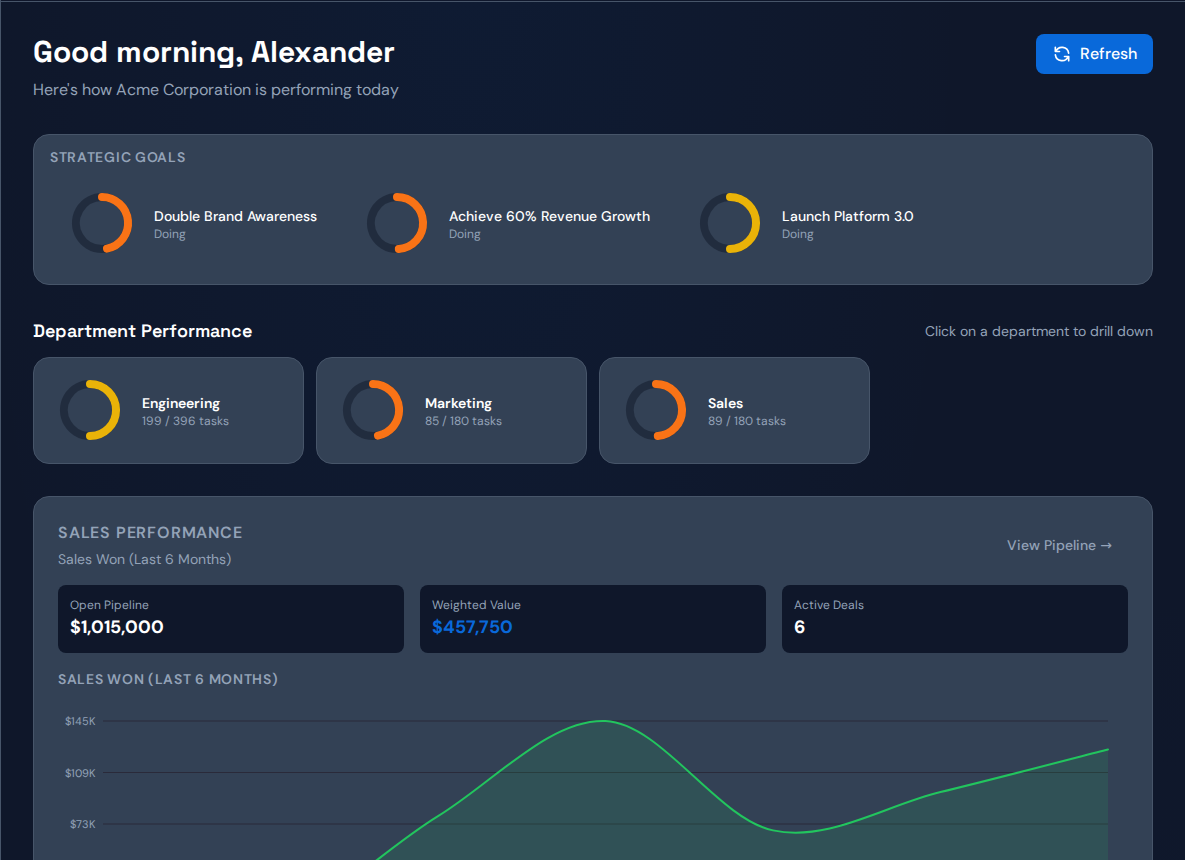
Command center context for AI in Commandix for AI executive analyst software, showing The AI is most useful when grounded in the same command center facts leadership uses.
Command center context for AIThe AI is most useful when grounded in the same command center facts leadership uses.

Frequently asked questions#

What is AI executive analyst software?#

It is AI that analyzes operating data such as goals, constraints, owners, tasks, projects, teams, revenue, and throughput to help leaders ask better questions and choose next actions.

Why should executive AI be grounded in company data?#

Generic AI advice is easy to produce and hard to trust. Grounded AI can reference the current constraint, business impact, owner, evidence, and throughput check.

Which AI providers can Commandix connect to?#

Commandix includes provider settings for OpenAI, Claude, and DeepSeek so owners can choose the reasoning engine they trust.

See it in Commandix

Ask the operating system what leadership should inspect first.

Explore the AI Analyst with goals, work, revenue, teams, and constraint evidence in context.
Open live demo
Back to all Commandix articles