Team performance
Team Performance Dashboard: Find High Performers, Low Performers, and System Bottlenecks Fairly
A practical executive guide to team performance dashboards that compare people fairly using goals, tasks, workload, blockers, revenue, and system constraints.
Key takeaways
- A team performance dashboard should help leaders coach and unblock people, not create surveillance theater.
- High and low performance must be judged with context: workload, blockers, goal contribution, role, and system constraints.
- Commandix connects team performance to tasks, goals, projects, sales, and workload so decisions are more fair and more useful.
A team performance dashboard should help executives see who is moving the business, who needs help, and where the system is making good people look slow. That last part is critical. Performance dashboards can easily become dangerous if they reduce people to task counts without context. A fair dashboard must show output, workload, blockers, priority, goals, and the constraints around the person.
Leaders need the truth, but they need the useful truth. A low completion rate might mean underperformance. It might also mean the person owns harder work, depends on slow approvals, is overloaded by other teams, or is stuck behind unclear priorities. A high task count might mean excellence. It might also mean low-value work. Commandix helps leaders inspect the operating evidence before turning data into people decisions.
What team performance should include
The strongest view starts at the unit or department level. Is the team completing important work? Are goals moving? Are tasks blocked? Are owners overloaded? Are projects slipping? Then leaders can drill into people. This order matters because individual performance only makes sense inside the system that creates or prevents throughput.
| Signal | What it can mean | What to inspect next |
|---|---|---|
| Low completed tasks | Low output or hard work mix. | Priority, complexity, blockers, dependencies. |
| Many overdue tasks | Poor follow-through or overload. | Workload, due-date quality, role expectations. |
| High completed tasks | Strong execution or easy work mix. | Goal contribution and business value. |
| Many blocked tasks | Dependency or policy constraint. | Who or what is causing the wait? |
| High workload | Capacity risk or leadership overassignment. | Whether the person is the constraint. |
How to identify high performers
High performers are not merely the people who complete the most tasks. In an executive operating system, a high performer moves important work, contributes to active goals, helps unblock others, and creates reliable throughput. They may also protect focus, make dependencies visible, and reduce chaos around them.
Look for the person whose work repeatedly moves goals, projects, or revenue forward without creating hidden queues for everyone else.
Commandix lets leaders inspect this by moving from organization performance into the unit, people, tasks, and goals. If one seller consistently moves high-value deals and closes follow-up tasks, that is different from someone logging low-value activity. If one engineer completes fewer tasks but those tasks unblock the launch goal, the dashboard should make that visible.
How to identify low performers fairly
Low performance should never be concluded from one metric. Before coaching or escalation, leaders should ask whether the person has clear priorities, reasonable workload, unblocked inputs, and work that matches their role. If a person is slow because the system keeps feeding them conflicting priorities, the fix is leadership discipline. If a person is slow despite clean inputs, clear priorities, and reasonable workload, the conversation becomes more direct.
Separate people problems from system problems before you coach, reassign, promote, or hire. A dashboard that cannot do that will damage trust.
Dashboard examples leaders should use
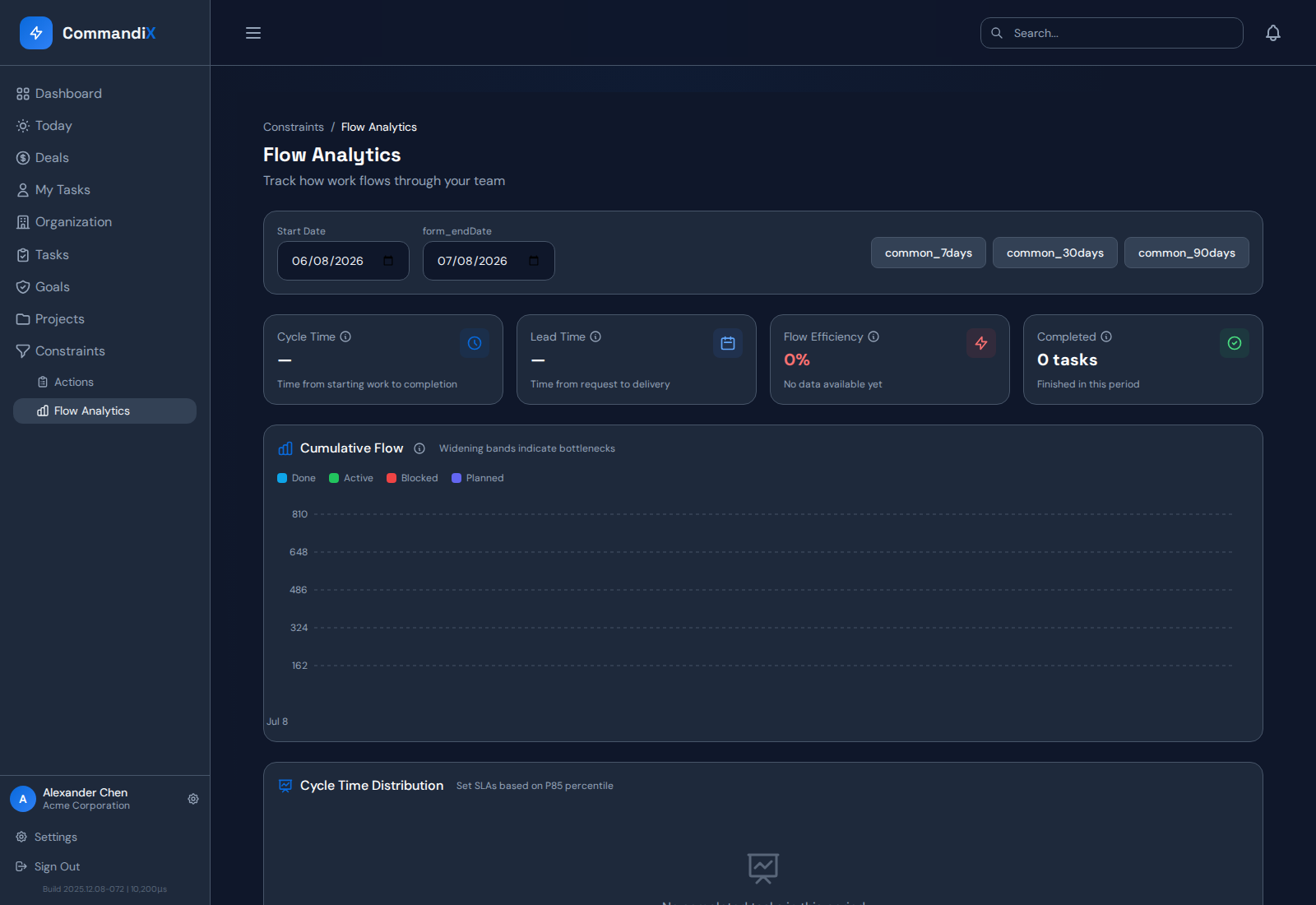
Shows whether the team is healthy before judging individuals.
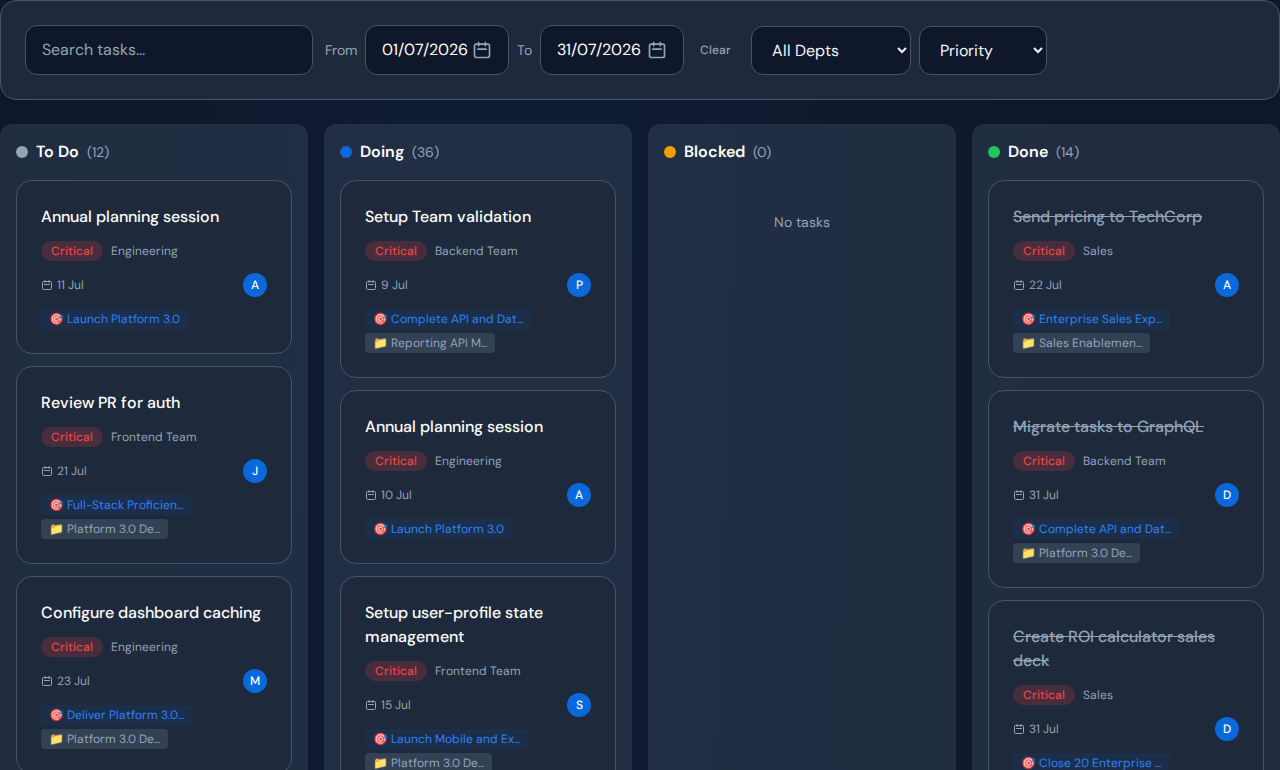
Compares output, task load, and contribution with context.
Shows whether performance is limited by overloaded capacity.
The best performance dashboard supports better conversations. A manager can say, "Your high-priority work is consistently late and there are no visible blockers." That is clear. Another manager can say, "Your work is late because three teams keep routing urgent requests through you. We are going to protect your focus." That is leadership. Both conversations require evidence.
Performance dashboard vs HR performance management
| Need | HR performance system | Commandix team dashboard |
|---|---|---|
| Annual reviews | Strong. | Not the core purpose. |
| Weekly execution evidence | Usually weak. | Strong through tasks, goals, projects, and teams. |
| Goal contribution | Often qualitative. | Visible through linked work. |
| Workload fairness | Often missing. | Visible through workload and constraint views. |
| Coaching trigger | Review cycle. | Operating signal while there is still time to act. |
The executive coaching workflow
Before labeling performance, check:
- Is the person assigned work that matters to active goals?
- Are their overdue tasks high value or low value?
- Are blockers visible and owned by someone else?
- Is the person overloaded compared with peers?
- Is this an individual issue or a system constraint?
- What one action would improve performance next week?
Where performance dashboards go wrong
The first failure mode is surveillance. If people believe the dashboard exists to catch them, they will optimize for visible activity instead of valuable work. They will close easy tasks, avoid hard problems, and spend energy managing perception. That is the opposite of execution intelligence. A useful dashboard must make better work easier, not make people feel hunted.
The second failure mode is context collapse. A team member with many overdue tasks may be underperforming, or they may be carrying the messy work nobody else wants. A person with fewer completed tasks may be slow, or they may be handling complex work with high goal contribution. Leaders need context before judgment. Commandix provides that context by connecting people to work, goals, projects, and workload.
The third failure mode is ignoring system constraints. Sometimes an entire team appears weak because the company has designed a bad system around them. They get unclear priorities, late inputs, changing requirements, or too much work in progress. A good performance dashboard helps leaders see when the fix is coaching and when the fix is system design.
How to use performance data without damaging trust
Start by sharing the operating purpose. The dashboard exists to help the team win: recognize strong contribution, remove blockers, protect overloaded people, and make coaching specific. Then use the same evidence standard for everyone. If leaders use data only when they are already frustrated with someone, the dashboard becomes a weapon. If they use it consistently, it becomes a shared language.
Finally, connect every performance conversation to a next action. High performers should get leverage, not only praise. Struggling performers should get clarity, not vague disappointment. Overloaded performers should get protection. Teams constrained by the system should get leadership intervention. Data without action becomes judgment. Data with action becomes management.
Example: high performer, low performer, or constrained performer?
Consider three people. One completes many small tasks and keeps the board clean. One completes fewer tasks, but those tasks unlock strategic goals. One misses deadlines repeatedly because every urgent cross-functional request lands on their desk. A weak dashboard may rank them by completion count. A useful dashboard asks what kind of work they own, whether it matters, and whether the system is creating the result.
This is where Commandix is different from a generic employee performance dashboard. It does not treat people data as separate from work data. It shows the unit, tasks, goals, project context, sales context, and workload. That gives executives a better chance of making the right call: recognize, coach, reassign, protect, or redesign the process.
Search intent: why executives look for this
Searches like "team performance dashboard," "employee performance dashboard examples," and "how to identify underperforming employees" often come from leaders who feel they do not have clean visibility. They are not always looking for HR software. Many are trying to answer an operating question: who is contributing, who is stuck, and what should management do next?
A Commandix article should meet that intent directly. It should show examples, explain fairness, provide a checklist, and demonstrate how the platform separates human performance from system constraints. That is a more credible sales argument than promising a prettier scorecard.
The article should also earn trust by refusing lazy answers. It should say clearly that low performers, high performers, and constrained performers are different categories. That nuance helps the page rank as a useful guide and helps the product feel executive-grade rather than punitive.
The reader should leave with a better management standard. Do not judge a person before checking the work, the goal, the blocker, and the load. Do not reward volume before checking value. Do not call someone a problem when the dashboard shows they are carrying the system's constraint.
When this workflow is used well, the team gets stronger without becoming colder. High performers get recognized for the right reasons. Struggling performers get clearer coaching. Overloaded contributors get protected. Leaders stop managing from vibes and start managing from evidence that everyone can inspect and trust together.
That is the real promise of a team performance dashboard. Not control for its own sake. Clarity. Fairness. Speed. A better way to see the people doing the work and the system shaping their results.
Open Commandix and drill from organization performance into teams, people, tasks, goals, and workload evidence.
Open live demoFrequently asked questions
What should a team performance dashboard show?
It should show department performance, people, tasks completed, overdue work, blocked work, workload, goals, projects, and business contribution.
How do you identify low performers fairly?
Compare output with context: workload, blockers, role, task priority, goal contribution, and whether the system is constraining the person.
Can Commandix identify high performers?
Commandix helps leaders see who moves important work, contributes to goals, follows through on tasks, and creates throughput without ignoring context.