CommandiX Open demo

OKR execution

OKR Dashboard vs. Execution Command Center: What Leaders Actually Need

An OKR dashboard shows targets. An execution command center connects targets to teams, projects, tasks, constraints, and revenue so leaders can act.

Executive command center
Executive command centerGoals, departments, revenue, throughput, and operating signals in one leadership view.

An OKR dashboard is useful. It can show objectives, key results, progress bars, confidence, owners, and status. But a dashboard is not a command center. A dashboard tells you where the target is. A command center tells you what is happening in the system that is supposed to hit it.

That difference matters when the quarter starts slipping. A leadership team staring at an OKR dashboard may know that a key result is behind. What they often do not know is why. Is the linked project under-resourced? Are tasks blocked? Is one team overloaded? Is the sales pipeline healthy but execution weak? Is the constraint a person, a policy, a dependency, or a handoff? Without that answer, the dashboard becomes a beautiful scoreboard for a game the company cannot influence fast enough.

What OKR dashboards do well

OKR dashboards are good at alignment. They make priorities visible. They remind teams what matters. They create language around objectives and measurable outcomes. For companies that have been running on scattered tasks and vague goals, that alone can feel like oxygen.

They also help executives see progress without asking every manager for a custom update. A clean OKR dashboard can reduce meeting noise and create a shared view of strategy. That is valuable. The problem begins when leaders assume visibility equals control. Seeing a goal at 42 percent progress does not reveal the operating constraint behind that number.

Where OKR dashboards fail

OKRs fail in the space between the target and the work. A key result may say "increase enterprise revenue by 20 percent," but the real execution lives in deals, follow-ups, proposal work, sales tasks, product readiness, implementation capacity, and cross-functional handoffs. A key result may say "launch platform 3.0," but the real execution lives in projects, dependencies, technical reviews, QA, blockers, and constrained specialists.

If those objects are disconnected, leaders get a status layer instead of an execution layer. The OKR dashboard becomes a mirror. It reflects delay. It does not diagnose it. That is why teams can hold disciplined OKR reviews and still miss the quarter. They are measuring the target without managing the system that produces the result.

OKR command center layers
OKR command center layersHow objectives become operational when goals connect to projects, tasks, owners, constraints, and revenue.

What an execution command center adds

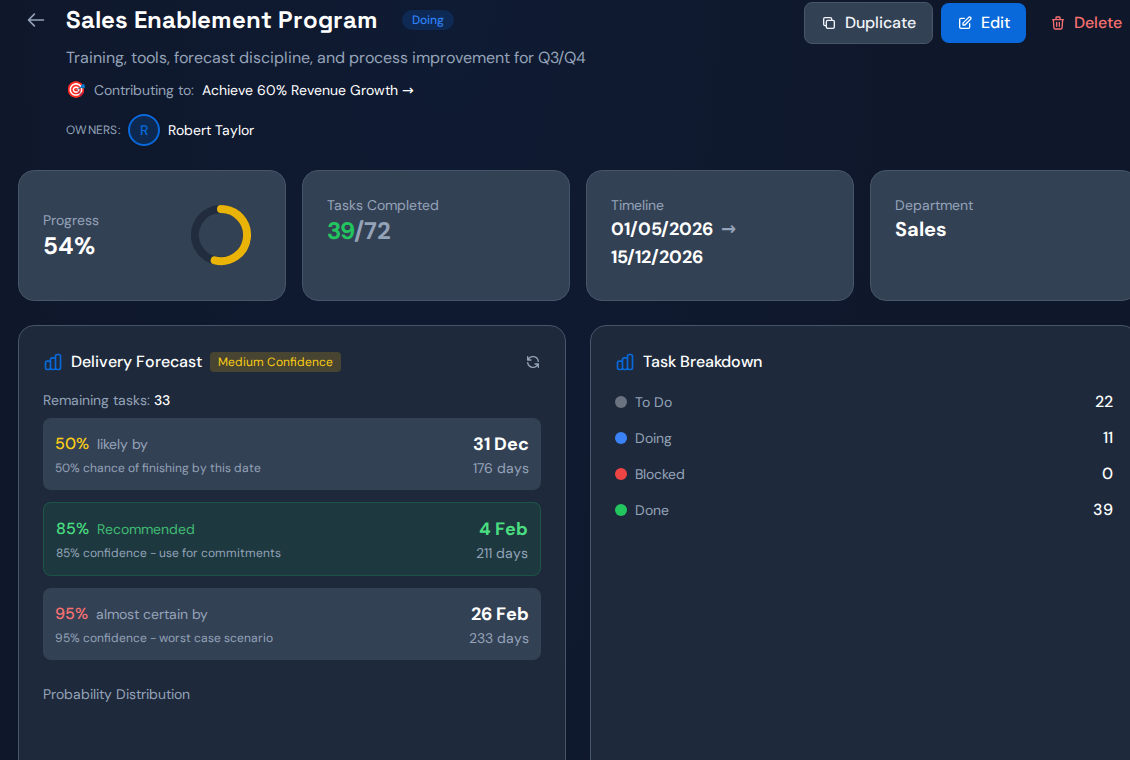
An execution command center connects objectives to the machine underneath. In Commandix, a strategic goal can be traced into projects, weighted tasks, departments, and owners. A department signal can be opened into unit performance and team workload. A constraint can be identified and linked to action. Revenue can sit beside execution work instead of living in a separate CRM universe.

The command center does not replace OKRs. It makes them operational. It gives leaders the answer to the question that matters most: what action should we take this week to improve the probability of hitting the objective?

The review meeting changes

A normal OKR review asks: what moved, what did not, and what is the confidence level? A stronger execution review asks: what is the goal, what work is attached, where is flow slowing down, who owns the constraint, and what action will improve throughput? The first meeting produces awareness. The second produces motion.

This is where the energy returns to the room. Instead of debating whether a progress number is accurate, the team opens the work behind it. Instead of asking for another update, the CEO asks which queue is limiting movement. Instead of assigning vague follow-ups, the COO assigns a constraint action. Everyone leaves knowing what has to change in the system.

Goal traceability
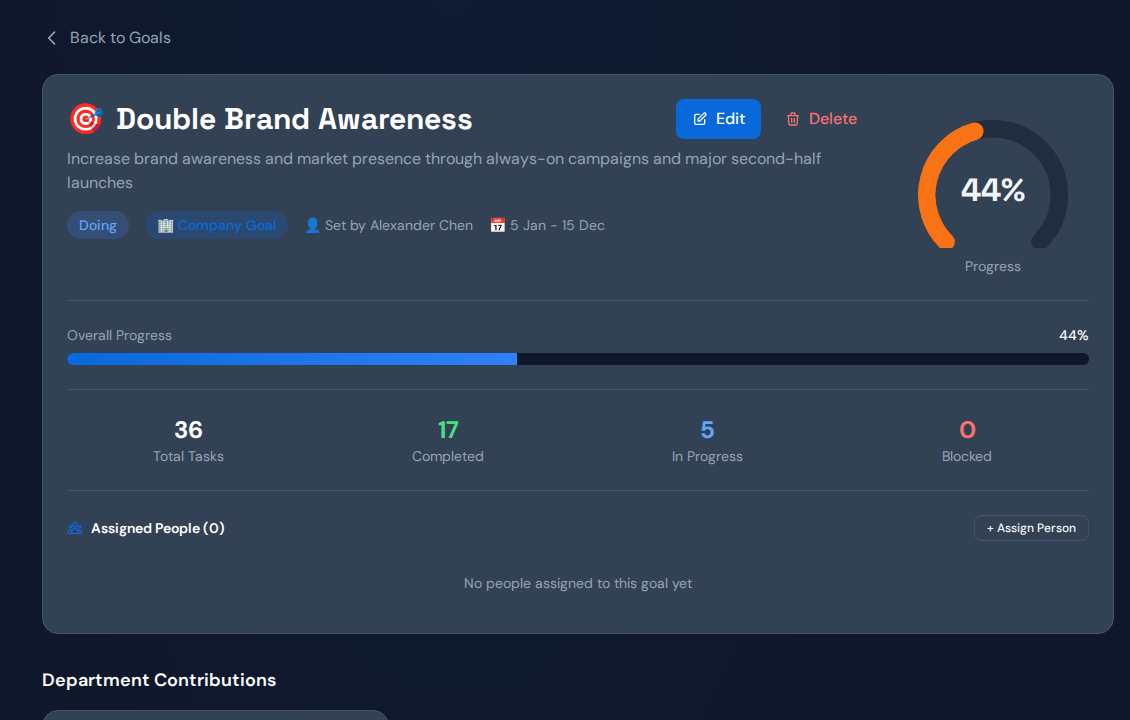
Goal traceabilityFollow a strategic goal into projects, weighted tasks, owners, and real execution movement.

Commandix in practice

The Commandix executive dashboard shows strategic goals beside department and sales performance. That layout is intentional. It prevents strategy from floating above operations. A goal like "Achieve 60 percent revenue growth" is not isolated from Sales, projects, pipeline, and task execution. It is part of one operating graph.

When a goal is weak, leaders can open the goal detail and see the work connected to it. They can inspect the projects contributing to progress. They can open the task flow and see planned, active, blocked, and done work. If the issue is constraint-related, the TOC pages show the candidate bottleneck and the action path. That is the difference between a dashboard and a command center: the command center keeps going until it reaches ownership.

When to use each

If your company needs simple alignment and visibility, an OKR dashboard may be enough. If the real problem is execution drift, cross-functional delays, overloaded teams, and revenue work disconnected from goals, you need a command center. The more complex the organization becomes, the less useful standalone status becomes.

Leaders do not need another place to admire ambition. They need a place to turn ambition into movement. That is what Commandix is built to do. Keep the OKRs. Make them sharper. Then connect them to the work, people, constraints, and revenue that decide whether the business actually gets there.

Task flow
Task flowPlanned, active, blocked, and done work with owner, goal, project, and priority context.

A practical upgrade

At your next OKR review, pick one objective that is behind. Do not ask for a slide. Open the work. Find the projects, tasks, owners, and blocked items. Identify the constraint. Assign one exploit or subordinate action. Review the result next week. That one change can transform the OKR process from a quarterly reporting ritual into a weekly execution engine.

The missed opportunity inside most OKR programs

Most OKR programs already have the raw ambition. The company knows what it wants. The missed opportunity is the operating conversion: turning that ambition into visible work, capacity choices, constraint actions, and revenue movement. Without that conversion, OKRs become a performance ritual. The organization talks about strategic outcomes while the actual system keeps running on local priorities.

A command center creates the conversion layer. It lets leaders inspect not just whether the objective is behind, but why the operating system is failing to produce enough movement. That is the difference between awareness and control. Awareness says, "We are late." Control says, "This project is waiting on review capacity, and we are going to subordinate lower-value work for two weeks."

Constraint identified
Constraint identifiedImpact score, queue depth, wait time, blocked value, and exploit/subordinate/elevate actions.

Why this wins executive trust

Executives trust systems that help them make decisions. A dashboard that stops at status eventually becomes background noise. A command center that reveals the next best action becomes part of the leadership cadence. It earns its place because it saves time, prevents drift, and makes weak signals visible sooner.

That is why Commandix positions goals beside work, teams, constraints, and revenue. The company does not need strategy in one room and execution in another. It needs one view that can carry the conversation all the way from "what did we promise?" to "what do we do next?"

The executive upgrade path

If your OKR dashboard is already in place, the upgrade is not to throw it away. The upgrade is to demand more from it. Choose one objective that is behind and ask whether the dashboard can answer the next five questions: what projects support this objective, which tasks are blocked, who owns the most important work, which team is overloaded, and what constraint action will improve the odds this week?

If the answer requires five separate tools and a manager to prepare a slide, you do not have a command center yet. You have an alignment layer. Alignment matters, but enterprise execution needs a decision layer. Leaders should be able to move from goal to work to owner to constraint without losing the thread.

Commandix is designed around that upgrade path. It keeps the OKR valuable while adding the operating context leaders need to act. The business benefit is immediate: less time explaining lagging progress, more time changing the system that caused it. That is why a command center feels more alive than a dashboard. It does not just report the score. It tells the leadership team where to put the next ounce of force.

Pipeline execution
Pipeline executionOpen pipeline, weighted revenue, deal stages, owners, and sales execution context.

What the best leaders do next

The best leaders do not abandon OKRs. They make OKRs tougher. They ask every objective to prove its execution path. What project will move it? What tasks prove it is alive? Which owner carries the critical work? Which constraint can stop it? What action will increase the probability of success this week?

Those questions create a different kind of urgency. The company is not waiting for the quarter to judge performance. It is operating the goal while there is still time to change the result. That is the emotional difference between a dashboard and a command center: one reports the miss, the other helps prevent it.

Commandix is built for that leadership move. It gives the objective a working body: projects, tasks, people, revenue signals, flow, and constraints. The result is a review that feels sharper, faster, and more useful to the business.

Frequently asked questions

What is an OKR dashboard?

An OKR dashboard visualizes objectives, key results, progress, and status for teams or the company.

Why is a command center different?

A command center connects OKRs to the operating system behind them: projects, tasks, owners, constraints, and revenue signals.

Should teams stop using OKRs?

No. OKRs are useful for alignment. The problem is stopping at alignment instead of connecting goals to execution.

See the operating system behind the article.Open Commandix demo