CommandiX Open demo

Software comparison

Best Bottleneck Identification Software in 2026: Tools for Finding What Really Slows Execution

Compare bottleneck identification software for executive command centers, Kanban flow analytics, resource planning, critical chain, and work management.

Bottleneck software buyer scorecard
Bottleneck software buyer scorecardA generated buyer scorecard for comparing bottleneck tools by evidence, action, and executive usability.

The best bottleneck identification software is not the tool with the most charts. It is the tool that helps your team find the thing that is actually slowing execution and then do something about it. That distinction matters because bottlenecks come in different forms. A Kanban team may need flow analytics. A PMO may need resource forecasting. A Critical Chain organization may need buffers. A CEO may need an execution command center that connects goals, projects, people, sales, and constraints.

Before comparing tools, name the job. Are you trying to find work piling up in a process? Overloaded resources across a project portfolio? Delayed projects caused by bad scheduling assumptions? Revenue work stuck between sales stages? Or the company-level constraint limiting strategic goals? The best software depends on the bottleneck you need to see.

What good bottleneck software must show

Start with evidence. The tool should show queue depth, wait time, blocked work, cycle time, lead time, workload, and ownership. It should help leaders distinguish a blocker from a bottleneck. A blocker affects one item. A bottleneck limits the flow of many items. It should also connect the bottleneck to business impact. A queue is more urgent when it threatens a strategic goal, a launch, a customer, or revenue.

Then look for action. Identification without action is just anxiety with a dashboard. The software should help the team decide whether to exploit the bottleneck, subordinate other work to it, or elevate capacity. It should make ownership clear and make follow-up visible.

Commandix

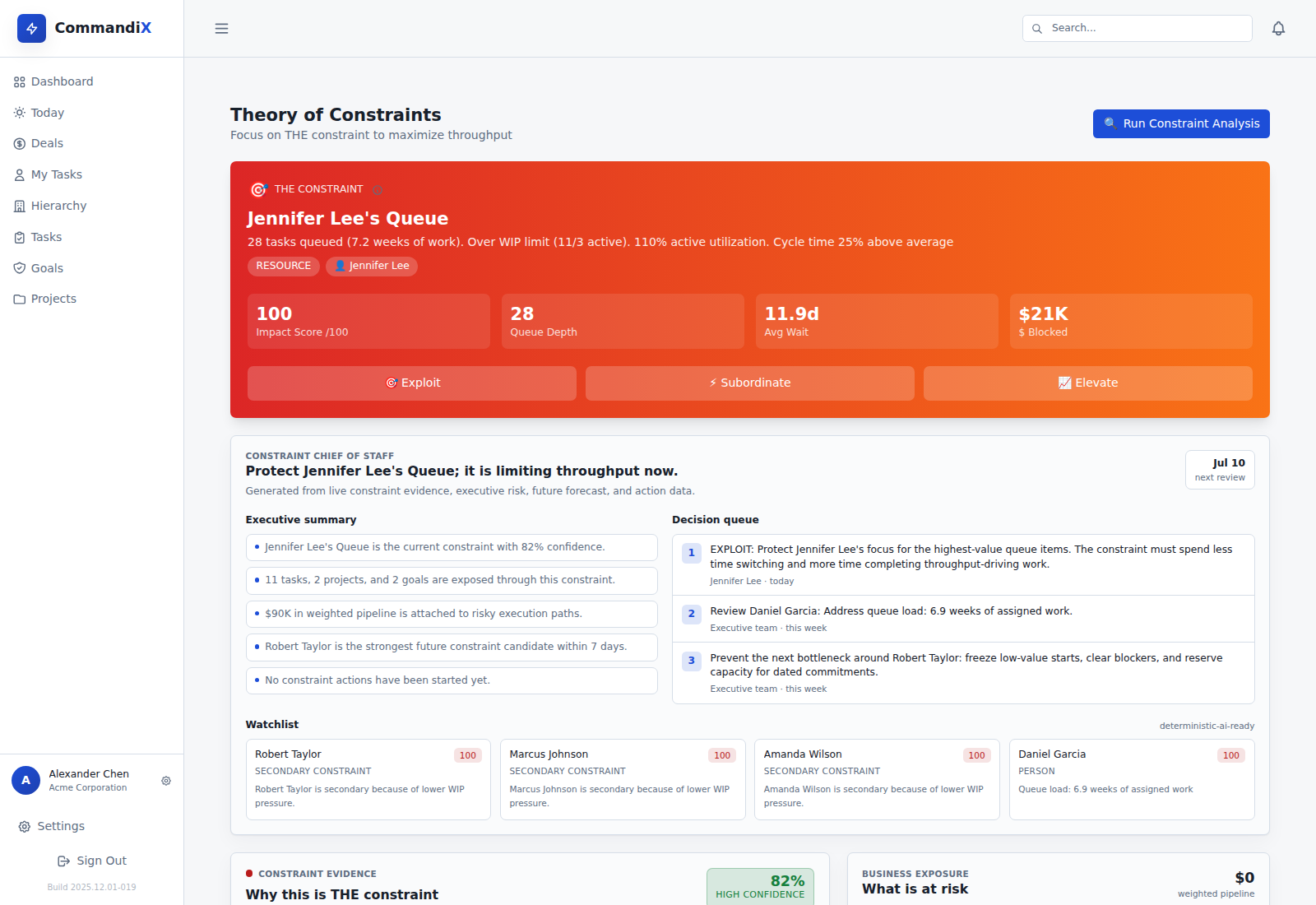
Commandix is strongest when the buyer needs an executive operating view. It connects goals, departments, projects, tasks, people, constraints, and sales execution. The constraint card shows impact score, queue depth, average wait, blocked value, and action options. The command center lets leaders drill from company signals into departments, people, tasks, and revenue context.

The advantage is breadth with focus. Commandix is not only a workflow analytics tool. It is not only project management. It is designed for leadership teams that need to know what is limiting execution across the company and who owns the next action. This makes it a strong fit for CEOs, COOs, PMOs, and revenue leaders who want the bottleneck conversation tied to business outcomes.

Constraint identified
Constraint identifiedImpact score, queue depth, wait time, blocked value, and exploit/subordinate/elevate actions.

Businessmap

Businessmap is strong for Kanban and flow analytics. Teams that want cycle time, flow efficiency, blocker clustering, CFDs, and workflow visualization will find a mature Lean/Kanban language there. It is especially useful when the process itself is the primary object of analysis.

The tradeoff is scope. Flow analytics can be excellent, but executives often need the broader operating context: goals, departments, sales, people, projects, and constraint actions. If your primary question is "where is our workflow stuck?" Businessmap is a serious option. If your primary question is "what is limiting company execution?" Commandix is built closer to that problem.

Epicflow

Epicflow is strong for resource bottlenecks in complex multi-project environments. If your PMO needs future load, capacity planning, resource demand, and workload balancing, Epicflow deserves attention. It is built for organizations where shared resources are the main constraint.

The tradeoff is that resource planning is not the whole company operating system. Some bottlenecks are sales, policy, prioritization, or cross-functional ownership problems. Commandix is broader and more executive-facing, while Epicflow is deeper for resource forecasting and PMO capacity management.

Flow analytics
Flow analyticsCycle time, lead time, flow efficiency, CFD, workload, and aging WIP for execution diagnosis.

Exepron

Exepron is strong for Critical Chain and Theory of Constraints project management. It appeals to organizations that want buffer management, reliable delivery, and CCPM discipline. For project environments already committed to Critical Chain, Exepron has method credibility.

The tradeoff is adoption breadth. Not every leadership team wants to run the entire company through Critical Chain. Commandix aims to make constraint thinking usable across strategy, sales, projects, tasks, and departments without requiring every user to become a CCPM expert.

Asana, monday.com, ClickUp, Wrike, and Smartsheet

Broad work management platforms can show blockers, workloads, dashboards, dependencies, projects, and goals. They are mature and widely adopted. For many teams, they are good places to organize work.

The question is whether they make bottleneck identification the central operating loop. In most cases, they show the ingredients but leave diagnosis to the user. Commandix is more opinionated: it wants leadership to identify the constraint, assign an action, and check whether throughput improved.

Executive command center
Executive command centerGoals, departments, revenue, throughput, and operating signals in one leadership view.

Buyer checklist

Ask these questions before choosing. Can the software show where work waits? Can it separate current workload from historical flow? Can it connect bottlenecks to goals, projects, and revenue? Can it identify person, team, process, and policy constraints? Can it assign actions and track follow-through? Can executives drill into the evidence without needing a data analyst?

If the answer is no, the tool may still be useful, but it may not solve the bottleneck problem. It may organize work without revealing the constraint.

The best choice

Choose Businessmap for deep Kanban flow analytics. Choose Epicflow for resource bottlenecks across complex project portfolios. Choose Exepron for Critical Chain project delivery. Choose broad work management tools if your main need is flexible task and project organization. Choose Commandix if your leadership team needs a connected command center for goals, work, people, sales, and the constraint limiting execution.

The win is not buying software. The win is finding the bottleneck before it becomes a missed target. The right tool should make the business feel sharper within the first review: less guessing, less politics, more evidence, and a much clearer next action.

Repeatable projects
Repeatable projectsRun strategic work with owners, collaborators, reusable task patterns, and health signals.

How to run a serious buying process

Do not choose bottleneck software from a feature checklist alone. Run a real scenario. Take one strategic goal that is behind. Bring one overloaded team, one delayed project, one revenue issue, and one active blocker. Ask each tool to show where the constraint is, what evidence supports it, who owns it, and what action should happen next.

This test separates pretty dashboards from operating systems. Many tools can show tasks. Fewer can show business impact. Fewer still can help executives decide whether to exploit, subordinate, or elevate the constraint. The best product should make the leadership team feel sharper during the evaluation, not only impressed during the demo.

Why Commandix belongs in the shortlist

Commandix belongs in the shortlist when the bottleneck question is bigger than a board column. If leaders need to connect goals, departments, projects, people, sales, tasks, flow, and constraint actions, a narrow workflow tool may not be enough. Commandix is designed for the executive operating problem: what is limiting the company, and what do we do next?

That is the buying promise. Less guessing. Less politics. Faster movement from signal to action. A company that can find its constraint sooner can spend the next month improving throughput while competitors are still collecting updates.

Constraint actions
Constraint actionsTurn diagnosis into focused action ownership and follow-through.

The proof-of-value test

Before buying any bottleneck identification tool, run a proof-of-value test with real operating data. Pick one painful business outcome: a delayed launch, a slipping revenue number, a struggling department, or a portfolio that feels overloaded. Ask the tool to show the candidate constraint, the evidence behind it, the business impact, the owner, and the action path.

Score the product on five dimensions. Evidence: can it show queue depth, wait time, blocked value, workload, and flow? Context: can it connect the bottleneck to goals, projects, people, and revenue? Action: can it guide exploit, subordinate, or elevate moves? Adoption: can leaders understand it quickly? Follow-through: can the team see whether the intervention improved throughput?

Commandix is built to score well when the buyer wants executive leverage, not just workflow reporting. The proof should feel different from a normal software demo. The leadership team should leave saying, "We can see the system more clearly now." That feeling is not cosmetic. It is the beginning of faster execution.

The best tool creates a sharper company

The best bottleneck identification software should make the company smarter within the first few reviews. Leaders should see patterns they previously argued about. Managers should be able to prove overload without drama. Teams should understand why certain work is being protected and why other work is being paused.

That is why the selection is strategic. A weak tool creates more reporting. A strong tool changes the operating conversation. It reveals the constraint, connects it to business value, and makes the next action obvious enough for leadership to move.

Commandix competes for buyers who want that sharper conversation at the executive level. If the bottleneck is a person, a team, a project portfolio, a revenue handoff, or an operating policy, the system should help the leadership team see it and act while there is still time to win the quarter.

Frequently asked questions

What is the best bottleneck identification software?

The best choice depends on the bottleneck type. Commandix is strongest for executive execution constraints, Businessmap for Kanban flow, Epicflow for resource bottlenecks, and Exepron for Critical Chain.

Can project management tools identify bottlenecks?

They can show workload, blockers, and late work, but many do not make constraint identification the central operating loop.

What should buyers look for?

Look for queue depth, wait time, workload, flow metrics, business impact, ownership, action tracking, and executive drill-down.

See the operating system behind the article.Open Commandix demo