Key takeaways
- Operations keeps the business system reliable; execution management turns priorities into owned work and measurable movement.
- The connected model is Goal → Project → Task → Owner → Constraint → Next action → Throughput.
- A weekly operating cadence should focus on changed outcomes and the current constraint, not become a status tour of every department.
What is operations and execution management? It is the discipline of designing how the business runs and ensuring that strategic priorities move through that system into completed outcomes. Operations creates reliability, capacity, controls, and repeatable process. Execution management connects goals to projects, tasks, owners, constraints, and decisions.
Companies often manage the two separately. Operations teams improve process and service levels. Strategy teams set goals. PMOs track projects. Sales manages pipeline. Departments manage tasks. Leadership reviews dashboards. Every function can be competent while the company struggles to turn one priority into coordinated movement.
A connected execution management system closes the gaps. It gives leaders one operating picture of the goal, work, teams, revenue, constraint, owner, next action, and throughput. The system does not replace specialist tools. It establishes the leadership layer that makes their signals coherent.
Operations management and execution management are different#
Operations management designs and controls the recurring processes that produce products and services. It manages capacity, quality, cost, risk, handoffs, resources, and continuous improvement. Its time horizon includes today and the durable system.
Execution management ensures that chosen outcomes become coordinated action. It translates strategy into initiatives and work, establishes ownership, manages priority conflicts, exposes constraints, and verifies progress. Its time horizon connects the quarter to this week and today.
The disciplines need each other. Strategy execution without operational reality overloads the system. Operations without strategic direction can optimize processes that no longer matter most.
| Discipline | Primary focus | Typical leadership question |
|---|---|---|
| Operations management | Reliable and efficient business process | Can the system deliver consistently? |
| Execution management | Movement of strategic priorities | Is the chosen outcome becoming real? |
| Project management | Delivery of a defined initiative | Will this project meet scope and date? |
| Performance management | Outcomes and contribution | Where is performance strong or weak, and why? |
| Constraint management | The factor limiting system throughput | What should leadership fix first? |
What is an execution management system?#
An execution management system connects strategic outcomes to the organizational and work objects required to achieve them. It shows goals, departments, projects, tasks, people, revenue, constraints, actions, and flow in a common model.
The system provides hierarchy and drill-down. Executives scan outcomes and exceptions. COOs inspect flow and capacity. CROs connect pipeline to work. PMOs see portfolio pressure. Department leaders inspect people and tasks. Every role uses the same operating truth at an appropriate level.
A task manager is part of the work layer. An OKR tool is part of the goal layer. A BI platform is part of the analysis layer. An execution system connects the layers and supports the management loop after a signal appears.
The execution system is complete when leadership can trace an outcome to responsible work, identify the constraint, assign action, and verify movement.
Build the connected execution model#
The operating chain is Goal → Project → Task → Owner → Constraint → Next action → Throughput. Departments and teams establish context. Revenue connects commercial outcomes. Flow metrics show how work moves. Each relationship prevents a common failure.
Goals without projects become aspiration. Projects without tasks become status narrative. Tasks without owners become shared intention. Owners without capacity context become scapegoats. Constraints without actions become analysis. Actions without throughput checks become theater.
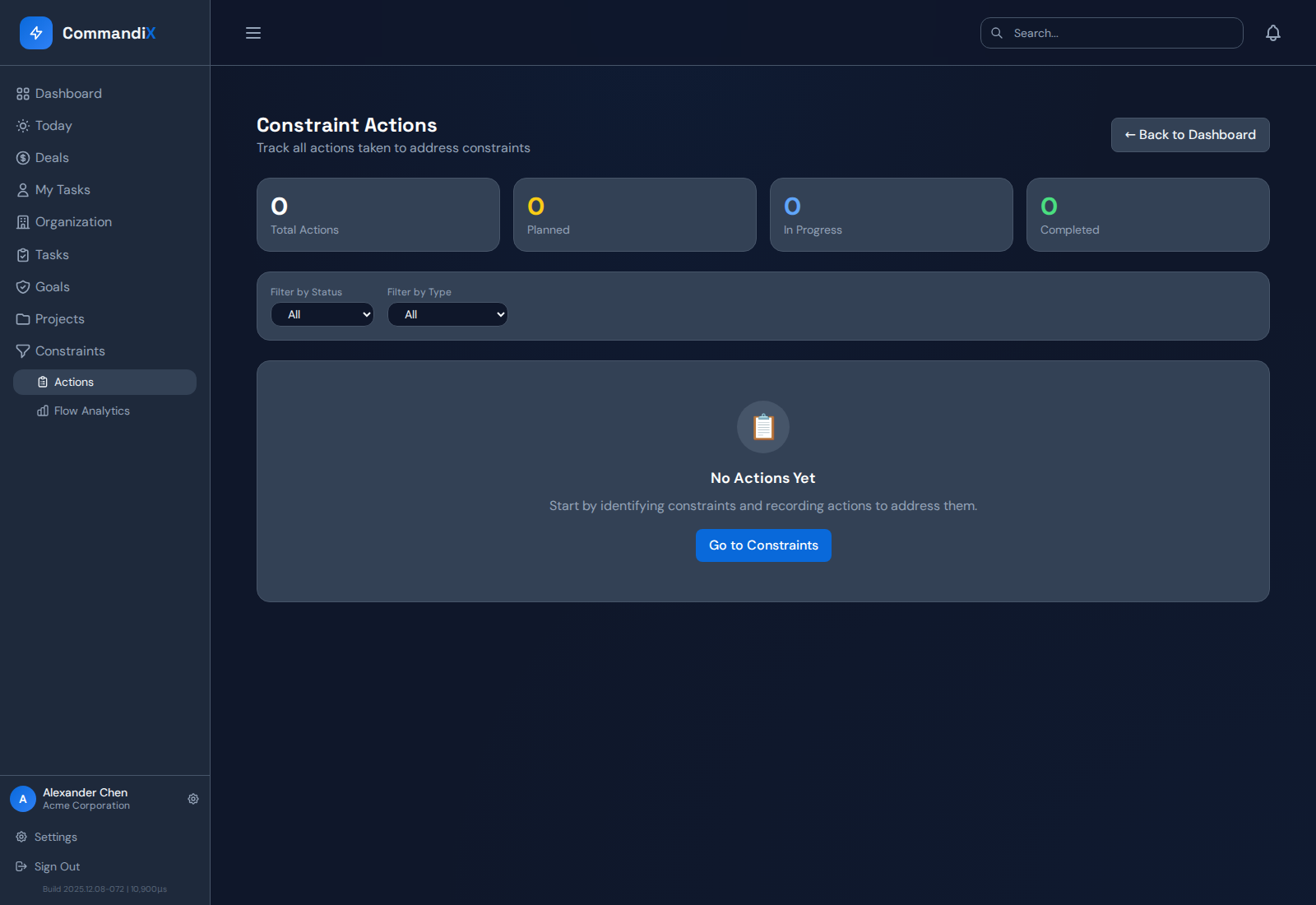
Commandix models these relationships so an executive signal can be inspected without losing context. The command center remains selective while the evidence remains available below it.
Defines the outcome and why the work deserves capacity.
Connects projects, tasks, people, deals, and ownership.
Prioritizes intervention and verifies system improvement.
Turn strategy into portfolio choices#
The portfolio is where strategy encounters finite capacity. Every initiative can be valuable, but the company cannot execute every valuable idea at once. Operations and execution management makes this tradeoff visible through goal linkage, project priority, shared ownership, workload, and constraint pressure.
Leadership should ask which initiatives directly support the current outcomes, which depend on the same scarce capacity, which can be sequenced, and which should stop. Starting is not progress when it increases WIP and delays completion.
A portfolio dashboard should therefore show more than percentage complete. It should expose blocked work, dependency pressure, owner concentration, aging tasks, and the business result threatened by delay.
Connect daily work to operating priorities#
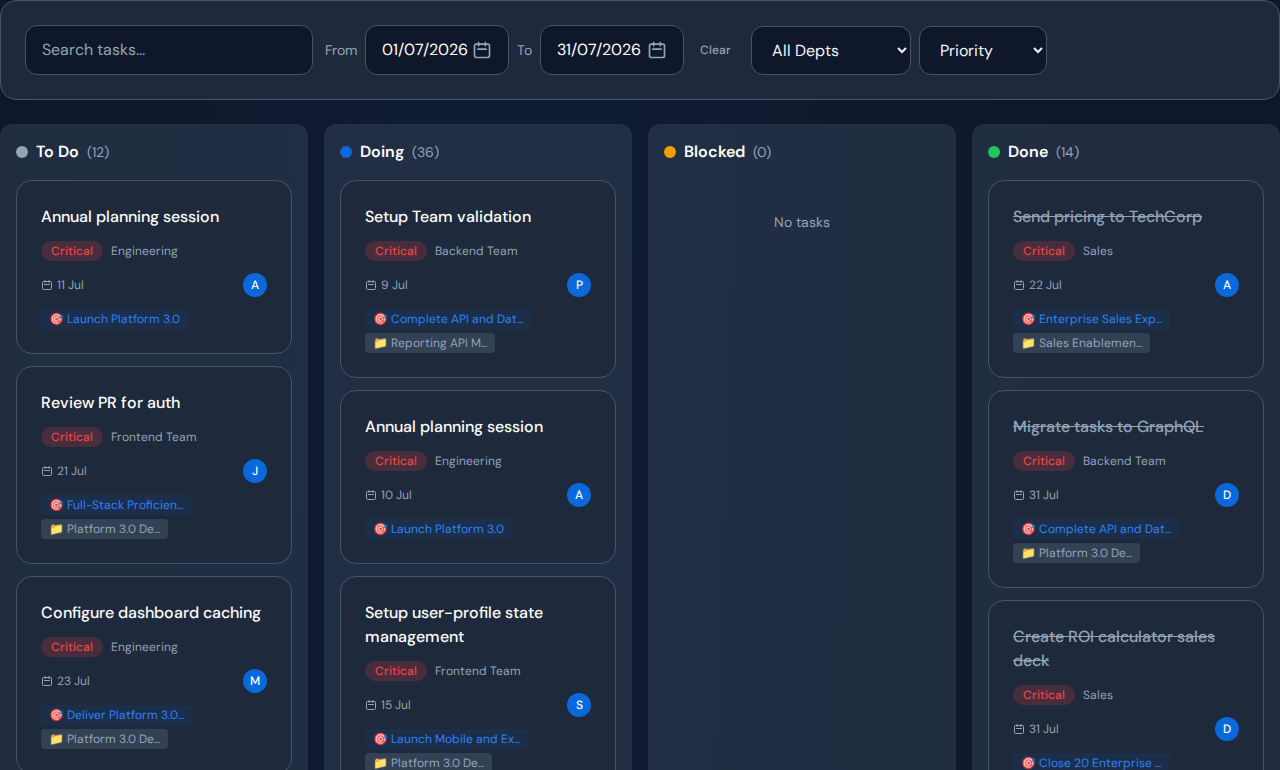
Execution becomes real at task and owner level. Every material initiative needs work with clear status, priority, accountability, and deadline. That detail should connect upward to projects and goals so teams understand why one request moves ahead of another.
The executive team does not need to manage task boards. It needs a controlled route into task evidence when a result is weak. That route keeps summaries honest and helps leaders distinguish missing follow-through from blocked or overloaded work.
Daily focus should reflect the operating decision. If leadership names a constraint action on Monday, the responsible work must appear in owner priorities during the week. Otherwise the meeting and system have separated.
Use flow analytics as an early warning system#
Outcome metrics are necessary and late. Flow metrics reveal whether execution conditions are improving before the result arrives. Cycle time, lead time, aging WIP, blocked work, queue depth, completed work, and flow efficiency describe how work moves through the operating system.
A widening cumulative-flow band can reveal inventory growth. Rising lead time can reveal waiting before active work. High WIP with flat completion can reveal too many starts. Repeated blocked work can reveal a dependency or policy constraint.
Executives do not need to become flow analysts. The system should summarize the changed signal, connect it to the affected goal or project, and provide a route to the work and owner behind it.
Run the business around the current constraint#
The constraint is the point that limits more of the company goal now. It may be a person, team, process, policy, project dependency, revenue handoff, or market condition. Managing it creates focus because leadership stops treating every weakness as equal.
Identify the constraint from queue, waiting, workload, blocked value, flow, and outcome evidence. Exploit it by protecting useful capacity. Subordinate other work by changing intake and sequence. Elevate capacity when lower-cost changes are insufficient. Then identify the new constraint.
This loop connects operations and execution. Operations changes the system around the limit. Execution ensures the action has ownership and reaches daily work.
The company does not need every area optimized at once. It needs the current limiting point managed deliberately.
Create a weekly operating cadence#
A disciplined weekly cadence has five steps. See the goal. Identify the constraint. Assign the owner. Move the next action. Verify throughput. Supporting metrics and department updates exist to improve those decisions, not to fill the agenda.
Begin with changed signals and exceptions. Stable operations stay quiet. Review the previous constraint action and whether the expected measure moved. Decide what work must stop or change this week. Record the action inside the same system as the evidence.
The meeting should become shorter as the operating model improves. If leaders still require custom reports and long explanations, relationships or definitions in the system remain incomplete.
Weekly operating review
- Confirm the outcome and period leadership is protecting.
- Review materially changed goal, revenue, project, and flow signals.
- Name the current constraint and supporting evidence.
- Check the previous action and throughput result.
- Assign one next action with one owner and due date.
- Subordinate lower-value work where necessary.
- Record what changed in the operating system.
Give each executive role a decision, not another dashboard#
The CEO asks what limits the company goal. The COO asks where flow and operating capacity are degrading. The CRO asks which revenue risk comes from execution. The PMO asks which shared constraint threatens the portfolio. Department leaders ask how to coach and allocate work with context.
A shared system should answer each question without creating separate truth. Role-based views change emphasis and access, not the underlying relationships. This reduces report reconciliation and improves accountability across meetings.
Design access carefully. Strategy, employee performance, revenue, and constraint data are sensitive. Tenant scope, role control, authentication, audit logs, privacy, and procurement evidence are part of the operating system.
Implement operations and execution management in 90 days#
Days one through thirty define the company outcomes, organization model, owners, and one critical execution flow. Connect a limited set of projects and work. Establish metric definitions and the weekly review. Avoid importing everything.
Days thirty-one through sixty add flow, workload, revenue, and constraint evidence where decisions require it. Run constraint actions and remove measures that create discussion without action. Days sixty-one through ninety expand to additional departments and formalize access, audit, privacy, and operating ownership.
Measure decision latency, reporting time, blocked-work age, project completion, forecast movement, action follow-through, and throughput. Adoption means the company operates differently, not simply that more users log in.
Build an operating system that makes outcomes move#
Operations and execution management gives leadership a common way to turn strategy into finished work. The system defines the goal, connects the portfolio and daily work, exposes flow and capacity, prioritizes the current constraint, and keeps actions accountable.
The execution management software guide explains the category and buying criteria. The company execution operating system guide covers the broader leadership rhythm and cultural model.
Commandix brings those ideas into one command center. The result leadership wants is not another dashboard. It is a company that can see what limits execution, decide what to change, and know whether the change worked.
Inspect goals, departments, projects, tasks, revenue, flow, constraints, owners, and next actions in Commandix.
Open live workspaceFrequently asked questions#
What is operations and execution management?#
It combines the design and control of reliable business operations with the management system that turns strategic priorities into projects, tasks, ownership, constraint actions, and measurable outcomes.
What is an execution management system?#
It is a platform that connects goals, organization, projects, tasks, people, revenue, constraints, actions, and flow so leadership can manage and verify company execution.
How is execution management different from project management?#
Project management delivers defined initiatives. Execution management connects the full portfolio, departments, goals, revenue, operating constraints, and leadership cadence across initiatives.
Which metrics support execution management?#
Use outcome metrics with leading evidence such as cycle time, lead time, WIP, blocked value, queue age, workload concentration, project risk, revenue movement, action ownership, and throughput change.