Execution management
Execution Management Software: Turn Strategy Into a Living Operating Rhythm
Execution management software connects goals, projects, tasks, owners, constraints, and revenue so leaders can move from strategic intent to operating action.
Execution management software exists because strategy has a habit of disappearing after the kickoff. The leadership team agrees on the quarter. The deck looks sharp. The goals feel important. Then real life arrives: overloaded teams, shifting priorities, unclear owners, dependency waits, stalled revenue work, and meetings where everyone tries to reconstruct truth from memory.
A serious execution management system turns strategy into a living operating rhythm. It does not merely store tasks. It keeps the line connected from objective to project, from project to task, from task to owner, from owner to constraint, and from constraint to leadership action. That line is where execution becomes manageable.
Why strategy execution breaks
Most execution failures do not happen because people forgot the strategy. They happen because the strategy was never wired into the operating system. Goals sit in one tool. Projects live in another. Sales work lives in a CRM. Tasks live in boards. People performance lives in manager notes. The leadership meeting becomes the place where everyone manually stitches the business together.
That stitching is slow and political. One leader brings a clean slide. Another brings a spreadsheet. A third brings a story. The organization may be full of effort, but the system does not show which effort is creating movement and which effort is creating noise.
What the software must connect
The first connection is goals to work. Every meaningful objective should have the projects and tasks that move it. The second connection is work to ownership. A task without a responsible person is a wish with a due date. The third connection is ownership to capacity. If the same people carry the most important work across every project, leadership needs to know that before overload becomes failure.
The fourth connection is work to revenue. Commercial outcomes are not separate from operations. Deals create work. Proposal support creates work. Implementation readiness creates work. A revenue target that cannot be opened into operating tasks is a forecast, not a controllable execution plan.
Where Commandix is different
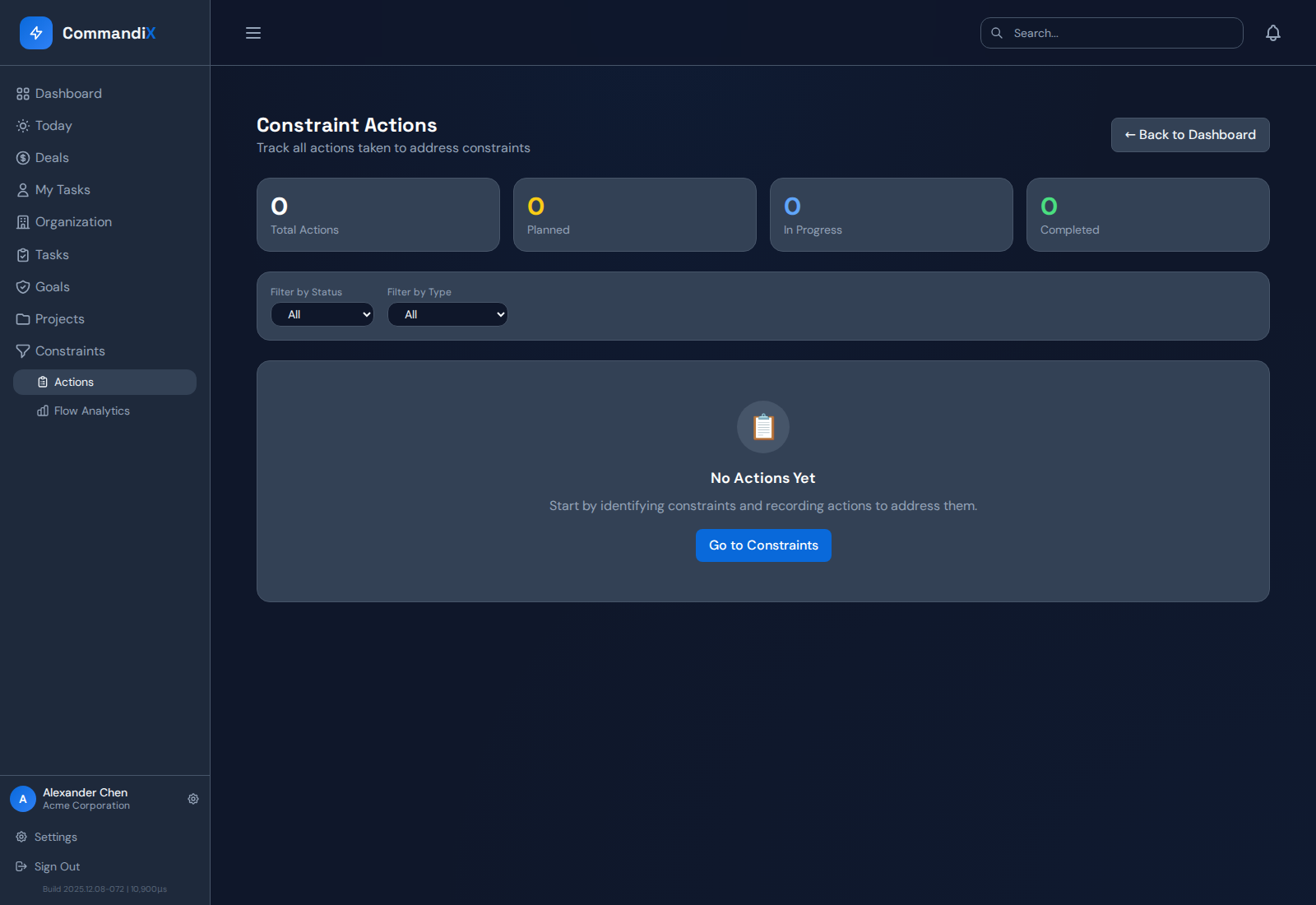
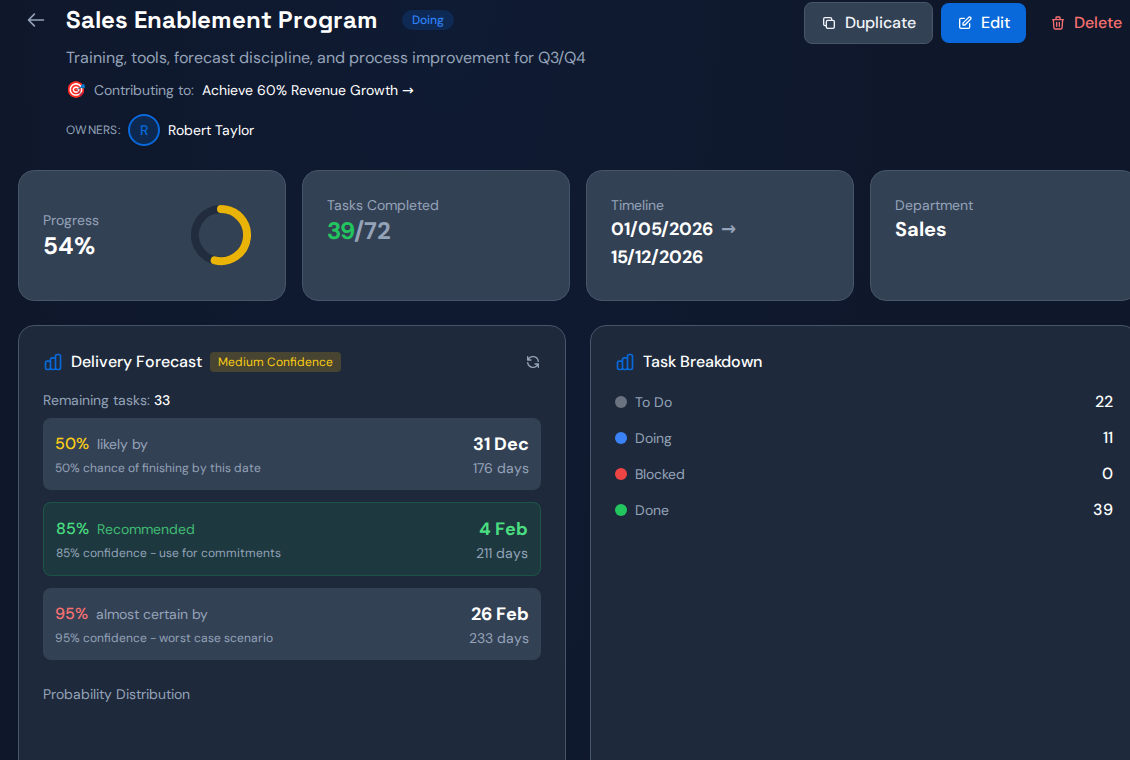
Commandix treats execution as a system. The dashboard shows goals, departments, throughput, work type mix, and sales performance in the same leadership surface. Project pages show strategic initiatives as owned operating objects. Team views show the work behind the numbers. The constraints layer asks what is limiting throughput and what action should happen next.
That matters because execution management without constraint management becomes prettier reporting. Leaders do not just need to know what is red. They need to know why the system is not producing more and where attention will create the highest return.
The benefit to the business
The benefit is not just visibility. Visibility is the beginning. The real benefit is faster management response. When a key project stalls, the leader can open the work and find the owner, task state, and dependency. When a goal slips, the team can inspect the project portfolio behind it. When sales underperforms, executives can open the sales unit and see tasks, people, and pipeline context.
This changes the tone of the company. Reviews become less theatrical. Managers spend less time preparing defensive updates. Teams see why their work matters. Executives stop distributing attention evenly and start focusing on the constraint that can move the business now.
A practical first review
Start with the three goals the company cannot afford to miss. Attach the projects and tasks that prove those goals are alive. Open the owners and departments carrying the work. Identify overdue, blocked, and waiting items. Then ask which person, team, process, or policy appears most often as the limiting factor.
The output should be one action, not a longer meeting. Protect constrained capacity. Reassign low-value work. Clarify ownership. Pause a project. Escalate a decision. Then return next week and ask what improved. That weekly rhythm is where execution management becomes a competitive advantage.
What great execution feels like
Great execution feels calmer and sharper at the same time. Calmer because truth is visible. Sharper because the company knows where to apply force. Instead of pushing every team equally, leaders push the system at the place where leverage is highest. That is the difference between a company that is busy and a company that is dangerous.
The mistake to avoid
The common mistake is buying execution software and then using it like a prettier task archive. That wastes the opportunity. The real power comes when leadership changes the review. Every important conversation should start from the live operating system: goals, projects, tasks, owners, constraints, and revenue signals. The software becomes the room where decisions happen.
That does not mean every leader needs to stare at every task. It means the path from strategic concern to execution evidence must be fast. The CEO should not need three days of reporting to understand why a target is at risk. The answer should be close enough to inspect while the decision still matters.
Why teams feel the difference
Teams feel the difference because good execution management reduces randomization. People are less likely to be pulled into surprise priorities when the system shows what matters and why. Managers can defend focus. Executives can see the cost of adding work. The organization becomes more honest about capacity.
That honesty creates drive. A focused team can build momentum. A scattered team can only survive. Commandix is built for the focused version: the company that wants strategy to move through real work, visible owners, and deliberate constraint action.
The enterprise rollout checklist
For an enterprise team, execution management must roll out with discipline. Define the company goals first. Map the departments and accountable leaders. Add active strategic projects. Connect tasks to projects and goals. Bring revenue execution into the same review. Establish one weekly operating cadence where leaders inspect movement, constraints, and actions from the system.
Security and governance matter too. Execution data can expose strategy, people performance, sales pressure, and operational risk. The system should support roles, permissions, auditability, sane session controls, and a security posture that enterprise buyers can defend. A leadership operating system cannot behave like a casual team notebook.
Adoption also needs a clear owner. The COO, chief of staff, PMO lead, or operating partner should decide which reviews happen inside the system and which old reports can disappear. That owner protects the rollout from becoming another optional workspace. When the leadership team treats the system as the official place for execution truth, everyone else learns quickly that the operating rhythm has changed.
Commandix is valuable because it combines the management rhythm with the operating surface. Leaders get the dashboard, the drill-down, the project portfolio, the task flow, the revenue context, and the constraint actions in one system. That is the structure a scaling business needs when execution is too important to run through memory and too dynamic to freeze inside slides.
The results that prove it is working
After 60 days, execution management software should show visible changes. Strategic projects should have clearer ownership. Goal reviews should rely less on slide updates and more on live work. Overloaded teams should be easier to spot. Constraints should generate action instead of debate. Revenue work should have better follow-through.
If those changes are not happening, the company may have implemented a database instead of an operating rhythm. Commandix is meant to support the rhythm: see the system, drill into the work, identify the constraint, assign the action, and measure movement.
That is what gives leaders confidence. The business can still be hard. The quarter can still be intense. But the company is no longer flying blind. It has an execution surface that turns pressure into better decisions.
The adoption signal to watch is meeting quality. If execution reviews become shorter, clearer, and more action-oriented, the system is working. If leaders leave with named owners, fewer open questions, and a visible constraint action, the operating rhythm is getting stronger. If every review still turns into a custom reporting exercise, the company needs to tighten how it uses the tool.
Commandix gives leaders the structure to make that shift. The work is visible, the context is connected, and the constraint has a place in the conversation. That combination is what turns strategy execution from a reporting burden into a management advantage.
The final test is whether the business can make a better decision faster than it could before. If the answer is yes, execution management has moved from software purchase to operating leverage.
Frequently asked questions
What is execution management software?
It is software that connects strategic goals to projects, tasks, owners, constraints, and operating reviews so leaders can manage execution with evidence.
How is it different from task management?
Task management organizes work items. Execution management connects work to business goals, capacity, constraints, and leadership decisions.
Who buys execution management software?
CEOs, COOs, PMOs, department leaders, and revenue leaders who need more than status reporting.