AI Execution System: Turn Operating Data Into Decisions and Owned Actions

An AI execution system grounds analysis in goals, projects, tasks, revenue, owners, constraints, and flow so leadership gets evidence-backed next actions.

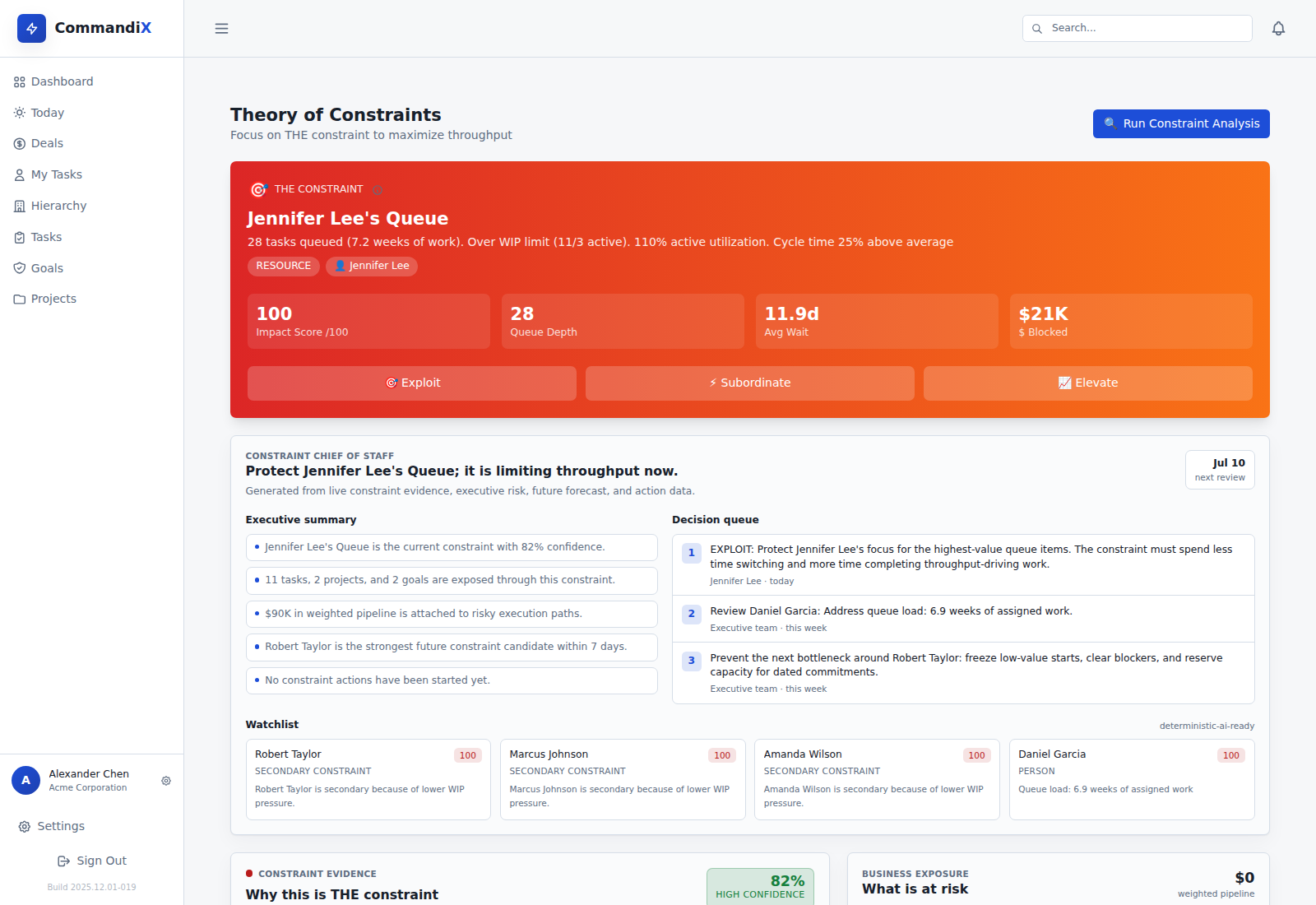
AI execution system dashboard showing the current constraint, execution signals, executive questions, and grounded next actions in Commandix
AI execution system analyst dashboardThe AI analyst begins with live operating context instead of a generic prompt and disconnected documents.
On this page

Key takeaways

  • An AI execution system is valuable when it grounds answers in current operating objects and turns analysis into an accountable action.
  • The model should explain its evidence, preserve tenant and role boundaries, and require human approval before changing company work.
  • The highest-value questions concern the current constraint, goal risk, revenue execution, overloaded capacity, and whether throughput improved.

An AI execution system should do more than summarize dashboards. Leadership does not need a faster way to restate what is already visible. It needs a way to ask a hard operating question, inspect the evidence behind the answer, choose an owner, and move the next action while the result can still change.

Generic AI cannot provide that reliably from a prompt alone. It needs structured company context: goals, projects, tasks, departments, people, revenue, workload, flow, constraints, and history. It also needs access boundaries, freshness rules, citations to source objects, and a clear separation between recommendation and action.

Commandix combines that operating graph with configurable AI providers. The system can answer executive questions from live execution signals while the organization retains control over provider choice and API credentials. AI becomes an analyst inside the operating system, not an oracle floating above it.

What is an AI execution system?#

An AI execution system uses a language model or analytical model to interpret current operating data, explain risks and constraints, recommend practical next actions, and support follow-through inside an execution management platform. Its purpose is to improve decision speed and quality, not merely generate text.

The system combines three layers. The operating layer contains trusted business objects and metrics. The reasoning layer interprets those signals for a specific question. The action layer presents recommendations, owners, and verification steps to a human decision-maker.

Remove any one layer and value falls. Reasoning without trusted context hallucinates. Context without reasoning leaves leaders to interpret every signal. Recommendations without an action and feedback loop become another report.

AI execution rule

A useful answer names the evidence, the business impact, the responsible owner, the next action, and the measure that should change.

How an AI execution platform differs from a chatbot#

A chatbot accepts a prompt and produces a response. An AI execution platform understands the company objects the question refers to and can retrieve current, permission-scoped evidence. It knows that a goal has owners and linked work, a deal has value and tasks, a project competes for capacity, and a constraint should have an action.

The platform also supports an operating rhythm. Answers can become reviewed recommendations. Approved recommendations can become actions. Actions can be checked against later throughput. The conversation remains connected to the system of record rather than disappearing into chat history.

This distinction protects leadership from impressive but unusable prose. The standard is not whether the answer sounds intelligent. The standard is whether it helps the company make and verify a better decision.

CapabilityGeneric chatbotAI execution system
ContextPrompt and attached contentCurrent goals, work, people, revenue, constraints, and flow
AccessOften broad or manually suppliedTenant- and role-scoped retrieval
EvidenceMay summarize without traceabilityReferences source objects and current signals
ActionProduces adviceProposes owner, action, due date, and verification
FeedbackConversation endsLater throughput tests the recommendation
AI execution signals showing goals, workload, throughput, revenue, blocked work, owners, and constraint evidence in Commandix for AI execution system
Grounded AI execution signalsGrounding connects the model to the company objects and metrics required for an explainable answer.

Ground AI in the execution graph#

The execution graph connects Goal → Project → Task → Owner → Constraint → Next action → Throughput. Revenue, departments, workload, and flow add business and system context. This structure is more useful than an unorganized document dump because relationships are explicit.

When a CEO asks which goal is most at risk, the system can inspect goal progress, linked projects, blocked tasks, responsible teams, and current constraints. When a CRO asks where revenue is stuck, it can connect pipeline value to seller work and internal dependencies. When a COO asks who is overloaded, it can compare workload with flow and outcome impact.

Freshness matters. The answer should identify the snapshot time and avoid presenting stale data as current truth. Missing evidence should be reported rather than invented.

Ask decision-grade executive questions#

The strongest questions have a decision behind them. What is limiting execution right now? Which goal is most at risk and why? Which owner or team has a queue affecting the most business value? Where is revenue waiting on company work? Which three actions deserve leadership attention this week?

Weak questions ask AI to create an executive update with no defined outcome or timeframe. The result may read well but cannot prioritize. Add the goal, period, system boundary, and expected decision whenever possible.

Commandix provides suggested questions that match its available operating context. Leaders can still ask naturally, but the interface teaches the standard for an answer that can lead to action.

Executive AI question checklist

  • Name the outcome or operating area being protected.
  • Specify the relevant time period.
  • Ask for evidence and alternative explanations.
  • Request the responsible owner or system point.
  • Ask for one to three practical next actions.
  • Define how leadership should verify improvement.
Executive AI execution chat with suggested questions about constraints, goal risk, team workload, sales, and next actions in Commandix for AI execution system, showing Executive.
Executive AI execution chatExecutive questions are framed around decisions the operating system can support with evidence.

Use AI for constraint analysis, not automatic blame#

AI can rank candidate constraints by combining queue depth, waiting, workload, blocked value, repeated ownership, goal risk, and flow trend. It can explain why one candidate deserves attention and compare alternatives. This is valuable analytical compression.

The system should not automatically label a person as the problem. A person appearing in a queue may be carrying the most important work, waiting on dependencies, or absorbing demand created by leadership. The model should separate observation, inference, confidence, and missing context.

Human review is essential for people decisions. Use the recommendation to choose where to inspect. Open the work and operating history. Confirm the diagnosis with the responsible manager before changing role, capacity, or performance conclusions.

Human oversight

AI may prioritize the investigation. Leadership remains accountable for interpreting context and approving action.

Connect recommendations to owned actions#

An AI recommendation becomes operational only when it can be accepted, rejected, refined, or assigned. The system should preserve the prompt, evidence snapshot, answer, reviewer, decision, owner, due date, and expected measure. That record supports learning and auditability.

Actions should be narrow. Protect a constrained owner from low-value work. Reassign a specific stale deal task. Pause a lower-priority project. Clarify ownership on a blocked goal. Review queue age in seven days. Broad advice such as improve collaboration cannot be verified.

Keep execution changes human-approved by default. A read-only analyst can deliver substantial value with less risk. Automation can expand later for low-risk workflows with clear permissions and rollback behavior.

Recommendation

AI explains what it believes should change and why.

Approval

An accountable human reviews evidence and authorizes the change.

Verification

The system checks whether the expected operating measure moved.

AI execution platform settings for configuring approved AI providers and organization-controlled API keys in Commandix for AI execution system, showing Provider controls keep.
AI execution provider settingsProvider controls keep model choice and credentials under explicit organization ownership.

Control providers, models, and API keys#

Organizations need explicit provider control. Different providers offer different models, terms, data handling, regional options, price, and performance. The CEO or authorized administrator should configure the approved provider and model rather than embedding credentials in client code.

API keys should be encrypted at rest, masked in the interface, restricted by role, excluded from logs, and transmitted only to the selected provider endpoint. Key rotation and removal should be straightforward. Demo users should never inherit organization secrets.

Provider configuration does not replace data governance. The application must still enforce tenant and role access before constructing model context. The model should receive only the minimum information required for the question.

Design for explainability and failure#

Every answer should show its evidence basis in a form the leader can inspect. Distinguish direct facts from model inference. Include confidence when ranking constraints. State when data is incomplete, old, or contradictory. Do not fabricate a precise answer to an under-specified question.

Plan for provider outage, rate limits, malformed responses, and model refusal. The local execution signals should remain available even when AI is unavailable. A failed AI call must not block ordinary dashboard use or corrupt company data.

Log security and operational events without logging secrets or unnecessary prompt content. Establish retention appropriate to the data and procurement commitments.

AI execution system model configuration showing provider status, model selection, and protected API key controls in Commandix
AI model and API key controlModel configuration should be separate from business data access and governed by role.

Implement AI execution management in phases#

Phase one is read-only analysis over a narrow, trusted dataset. Choose five executive questions and verify answers manually. Phase two adds source links, confidence, alternative explanations, and saved recommendations. Phase three adds approved action creation. Later phases can automate low-risk follow-through.

Measure answer usefulness, evidence accuracy, time to decision, recommendation acceptance, action completion, and throughput change. Do not optimize for chat volume. A few high-value questions that change leadership action are more valuable than constant low-value conversation.

Create an evaluation set from real operating questions and expected evidence. Re-test when the model, prompt, retrieval, or data model changes.

Make AI part of a disciplined operating cadence#

Use the analyst before the weekly review to surface changed signals and candidate constraints. During the review, inspect evidence and approve the action. After the review, track ownership. At the next meeting, ask whether throughput improved and what the new constraint may be.

The AI executive analyst software guide explores the product use cases and provider controls. The weekly operating brief guide shows how evidence becomes a focused CEO review.

Commandix treats AI as one layer of the execution system. The model helps leadership understand complexity, but the operating graph, human judgment, owned action, and measured result remain the source of control.

Ask the operating system what leadership should fix first.

Explore grounded AI analysis across goals, teams, projects, tasks, revenue, constraints, owners, and throughput in Commandix.

Open live workspace
AI execution command center connecting strategic goals, department performance, revenue, constraints, and throughput in Commandix for AI execution system, showing The command.
AI execution command center contextThe command center provides the structured operating context that makes AI analysis relevant to leadership.

Frequently asked questions#

What is an AI execution system?#

An AI execution system grounds model analysis in current company goals, work, owners, revenue, constraints, and flow, then helps leadership create and verify accountable next actions.

How is an AI execution platform different from a chatbot?#

It has structured operating context, tenant- and role-scoped data access, evidence traceability, action workflow, and a feedback loop that tests whether recommendations improved throughput.

Can AI automatically identify company bottlenecks?#

AI can rank candidate constraints and explain evidence, but human leaders should inspect context and approve changes, especially when people or strategic decisions are involved.

How should AI provider API keys be stored?#

Keys should be encrypted at rest, masked in the UI, restricted by role, excluded from logs, rotatable, and sent only to the explicitly selected provider.

See it in Commandix

Ask the operating system what leadership should inspect first.

Explore the AI Analyst with goals, work, revenue, teams, and constraint evidence in context.
Review one delayed result
Back to all Commandix articles