Key takeaways
- Scarce capacity turns project selection into a sequencing decision.
- Compare value and readiness, then make the work that will not proceed explicit.
- Review the sequence when the dependency, cost of delay, or available capacity changes.
Three important projects need the same security architect, data engineer, legal reviewer, or implementation specialist. Each sponsor can explain why their date matters. The common compromise is to divide the person across all three. It feels fair and often produces three slow projects, constant switching, and no clear explanation for the next missed milestone.
The portfolio decision is not whether the projects are good. It is which sequence makes the best use of the capacity the organization actually has.
Map the shared dependency#
List the exact work each project needs from the specialist. Include readiness, estimated effort, earliest useful start, downstream work unlocked, and the date after which delay becomes costly. Separate work that is truly ready from work whose sponsor merely wants to reserve a place in the queue.
Then show the specialist’s current active work. A person with ten assignments does not have ten parallel units of capacity. Identify interruptions, recurring duties, review obligations, and work that only this person is currently authorized or qualified to perform.
Choose with an explicit comparison#
Use a small set of decision factors: business result at risk, cost of delay, readiness, dependency leverage, effort at the shared resource, and reversibility. Avoid a giant scoring model that creates a false sense of precision. The purpose is to expose the tradeoff, not bury it in arithmetic.
| Question | Why it matters |
|---|---|
| Which project unlocks the most downstream work? | A short specialist task may release several teams. |
| Which input is genuinely ready? | Scarce capacity should not be consumed by preventable clarification. |
| What becomes irreversible if delayed? | Contractual, regulatory, or customer dates may dominate. |
| What should stop? | A priority is credible only when lower work loses capacity. |
Protect the chosen sequence#
Once the order is chosen, limit work in progress around the specialist. Prepare inputs before the slot begins. Give one person authority to protect the sequence. If an executive override occurs, record which project moves and what consequence is accepted. That turns an interruption into a visible portfolio tradeoff.
Do not measure the specialist by how many projects they touch. Measure whether scarce work completes and unlocks the intended result. Queue age, handoff wait, milestone movement, and downstream release are more useful than activity counts.
Review when the facts change#
The sequence is a current decision, not a permanent ranking. Review it when a project becomes unready, a customer date changes, a dependency clears, or more qualified capacity becomes available. Preserve the original decision record so leadership can learn whether the expected result occurred.
This approach is less comfortable than promising everyone progress. It is also more honest. A portfolio cannot escape a shared constraint by distributing it across more status reports. It improves when leadership chooses, protects, and revisits a sequence using evidence everyone can inspect.
Calculate delay in business terms#
Project status colors are a weak way to compare demand on scarce capacity. Translate each delay into the consequence leadership actually cares about: revenue deferred, contractual exposure, customer commitment, regulatory obligation, strategic option lost, or downstream teams left idle. Use ranges when the amount is uncertain. A visible assumption is safer than a precise but unsupported score.
Cost of delay also changes with time. A two-week movement may be harmless today and critical close to a market event. Record the decision date separately from the project finish date so the portfolio can change sequence before the cost becomes irreversible.
Prepare work before it reaches the specialist#
Scarce expert time should not be spent discovering that inputs are missing. Define a ready rule for each kind of review. A security assessment might require architecture, data flow, threat assumptions, and an accountable engineer. A legal review might require the agreed commercial position, customer redlines, and a named business decision-maker.
Return incomplete work before it occupies the specialist’s active queue. Track the reason for return. If one project repeatedly arrives unready, its apparent resource shortage may actually be an intake-quality problem. Improving readiness can create effective capacity without changing the number of specialists.
Use a sequence record everyone can inspect#
| Field | Decision recorded |
|---|---|
| Shared capacity | Role or team, available capacity, and non-project duties |
| Candidate work | Ready package, effort range, and downstream work unlocked |
| Order | First, second, and third with the reason for the sequence |
| Not now | Work explicitly paused or prevented from starting |
| Override | Who may change the order and which consequence is accepted |
| Review | Signal, owner, and date for reconsidering the sequence |
Avoid false precision in resource plans#
Knowledge work rarely consumes a specialist in perfectly predictable blocks. Use effort ranges and protect slack for urgent failures or review feedback. Do not plan every available hour and then treat normal variation as poor performance. The schedule should show uncertainty and the conditions that would require a new decision.
At the same time, uncertainty is not an excuse to start everything. A rough sequence with protected focus is more useful than a detailed plan that assumes unlimited parallelism. Watch starts, finishes, interruptions, and queue age to learn how the shared capacity behaves.
What to say to project sponsors#
Explain the shared constraint, the chosen business result, the order, and the next review date. Give paused projects useful preparation work that does not consume the constrained resource. Do not label everything “in progress” to avoid a difficult conversation. Clear waiting states make the portfolio more predictable and protect teams from hidden commitments.
When the specialist finishes the first package, verify that the expected downstream work actually moved. If it did not, the portfolio may have optimized the wrong dependency. Preserve that evidence and adjust the sequence. The goal is faster business outcomes, not maximum utilization of one person.
Questions for the weekly portfolio review#
- Is the first item still ready and still the highest-cost delay?
- Has an external deadline or customer consequence changed?
- Is any active work waiting on input that could be returned?
- What new demand tried to enter the constrained queue?
- Did completed specialist work unlock the expected downstream movement?
These questions make priority a continuing operating decision. They also create an evidence trail for a later capacity case. If valuable ready work persistently waits after sequencing and readiness improve, leadership can evaluate added capacity with much stronger evidence.
Model the portfolio sequence in Commandix#
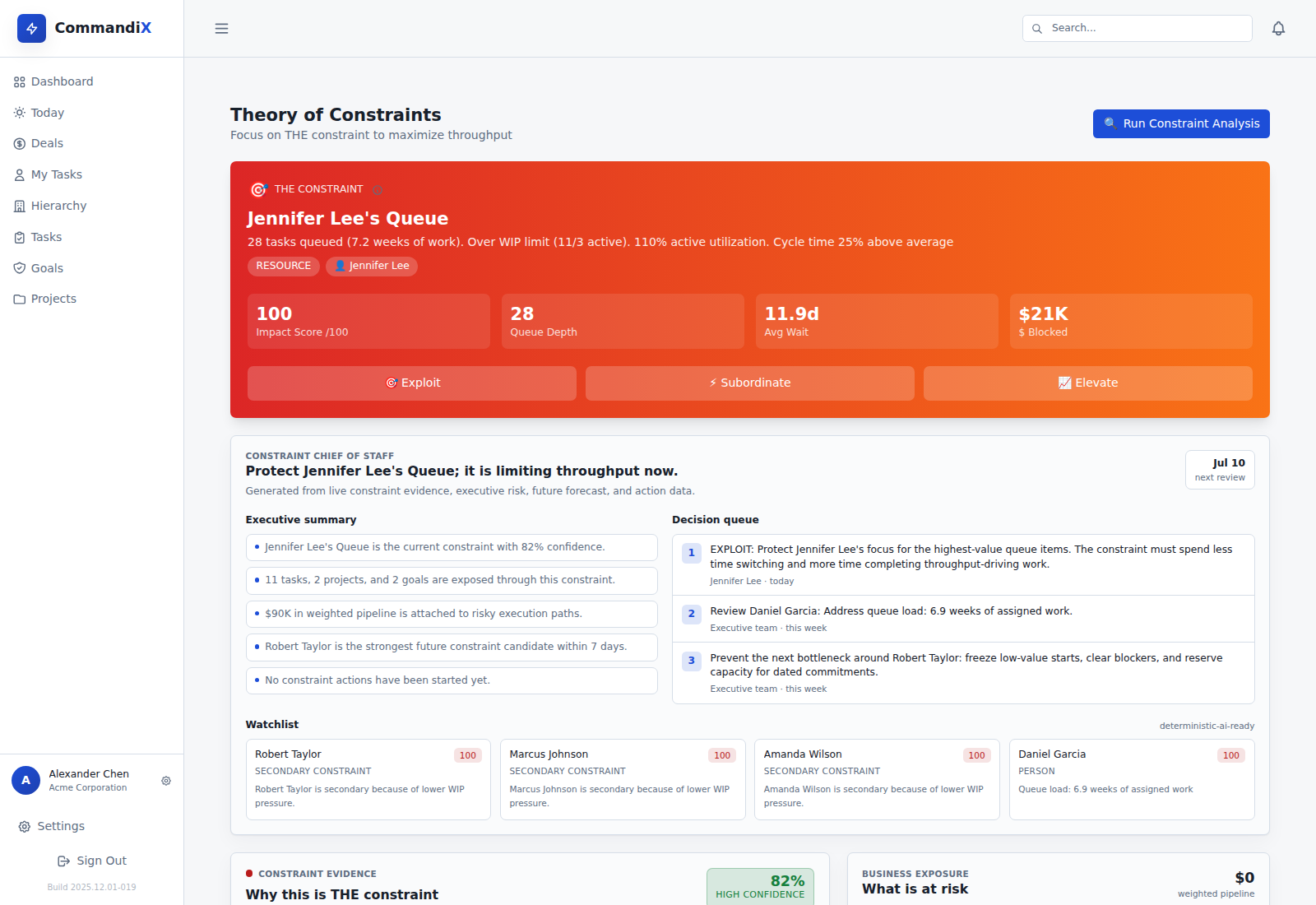
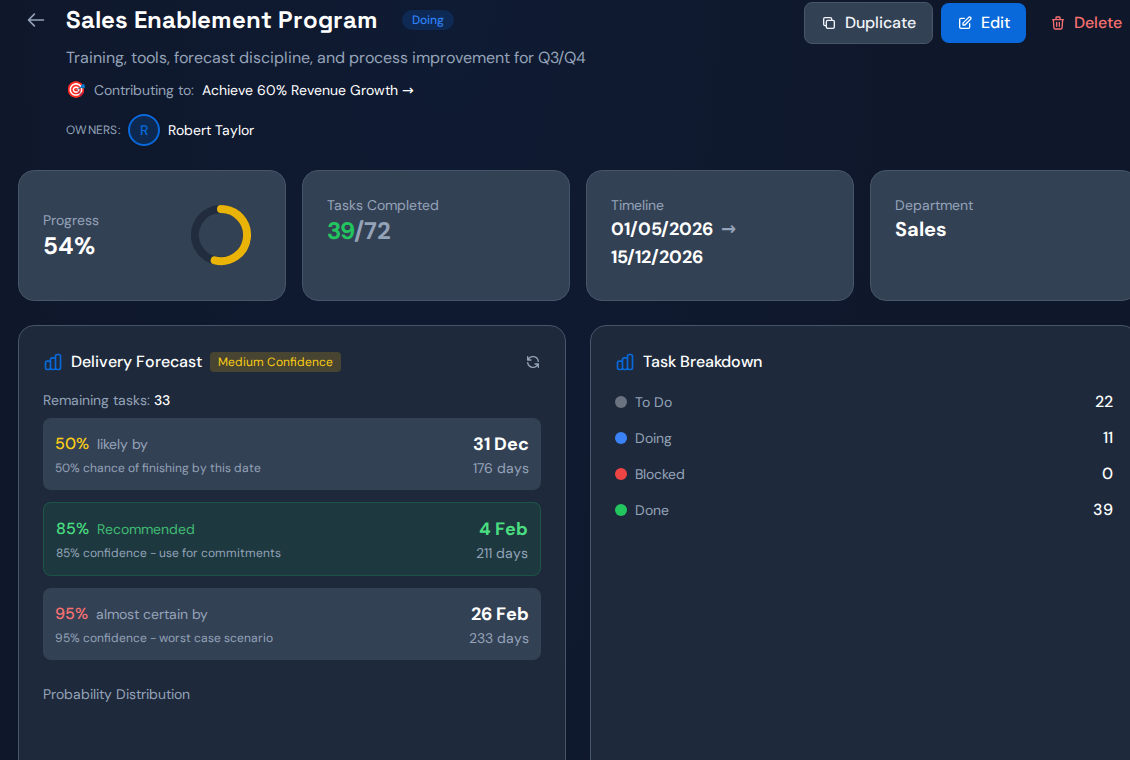
Connect each candidate project to its strategic result, milestones, tasks, owners, dates, dependencies, and blocked work. Identify the exact tasks needing the shared specialist rather than assuming the entire project consumes that capacity. Review their readiness and the specialist’s current active and queued work. This produces a sequence based on work that can actually proceed.
Record the priority choice as an action with one owner authorized to protect the order. Note which work is paused and link the evidence used: customer or regulatory date, downstream work unlocked, effort range, and current capacity. Use comments or the decision record to retain overrides so the organization can see why the original order changed.
Project templates and repeated structures can help create consistent work packages, but duplicate project records do not prove recurrence or priority. The operating team still chooses when a project begins and which capacity it may consume. The public sample workspace illustrates the relationships with sample data; it is not a forecast for a buyer’s portfolio.
At the next review, inspect starts, finishes, queue age, interruptions, and the downstream milestone expected to move. If specialist work completed without unlocking the result, revisit the assumed dependency. If valuable ready work continues to wait after sequencing and intake improve, the same record becomes useful evidence for training, contracting, or adding durable capacity.
How to use this guide responsibly#
Treat the guide as a decision structure, not as proof that one cause applies in every company. Begin with a named result and current records. Separate observations from explanations, keep plausible alternatives visible, and scale the response to the confidence of the evidence. A short reversible test is often more informative than a broad rollout based on an attractive story.
Commandix organizes operating evidence and the action history; it does not guarantee a root cause or business outcome. Source data may be incomplete, stale, or shaped by different workflow definitions. Validate important records with the people doing the work. Keep personal, customer, commercial, and security information within the access and retention rules appropriate to the organization.
Use sample screenshots and the public sample workspace to inspect the interface only. They contain illustrative data. A live review should state its evidence period, included systems, gaps, baseline, action owner, expected signal, and next decision date. If the records cannot support the decision, stop with a data-readiness action. That is a useful management outcome, not a failed analysis.
Frequently asked questions#
Should the most urgent project always go first?#
No. Compare business impact, dependency timing, readiness, cost of delay, and the amount of scarce capacity each option requires.
What is wrong with splitting the specialist evenly?#
Equal allocation can create context switching and leave all three projects late. A deliberate sequence often finishes valuable work sooner.
What should a portfolio priority record contain?#
The projects considered, shared resource, evidence, chosen sequence, paused work, owner, review date, and expected signal.