Portfolio execution
Project Portfolio Bottleneck Management: Stop Letting Good Projects Strangle Each Other
Project portfolio bottleneck management helps leaders find shared constraints across projects, protect scarce capacity, and improve delivery throughput.
Project portfolios do not fail because every project is bad. They fail because too many good projects compete for the same constrained system. The company approves seven strategic initiatives, each one sensible on its own. Then all seven need the same architect, the same sales operations analyst, the same approval group, the same executive decision, or the same implementation capacity. Suddenly the portfolio is not a collection of opportunities. It is a traffic jam with a strategy deck.
Project portfolio bottleneck management is the discipline of finding the shared constraint across projects and managing the portfolio around it. It is where leadership stops asking, "Is this project important?" and starts asking, "Can our system actually move this portfolio at the same time?"
The portfolio lie
The lie is that projects can be judged independently. In reality, projects share people, skills, attention, systems, and decision capacity. A platform launch, mobile app, sales enablement initiative, brand campaign, and internal process change may all look feasible when planned separately. Together, they may overload the same few roles.
This is why local project plans often look cleaner than portfolio reality. Each project manager can produce a plan. Each team can explain its milestones. But no one sees the combined demand on the constrained resource until delays begin. By then the organization has already created too much work in progress.
How portfolio bottlenecks appear
The first sign is queue growth. Work waits for the same person or team across multiple projects. The second sign is priority churn. Leaders keep reshuffling work because everything is important and nothing is truly sequenced. The third sign is half-completion. Many projects move a little, but few finish decisively. The fourth sign is morale damage. Teams feel like they are failing even though the real problem is that the system accepted more simultaneous work than it could finish.
Those signs are expensive. They create delay, rework, context switching, and hidden cost. Worse, they create cynicism. People stop believing strategic priorities because the company keeps starting new work before finishing the old work that was also strategic.
What Commandix makes visible
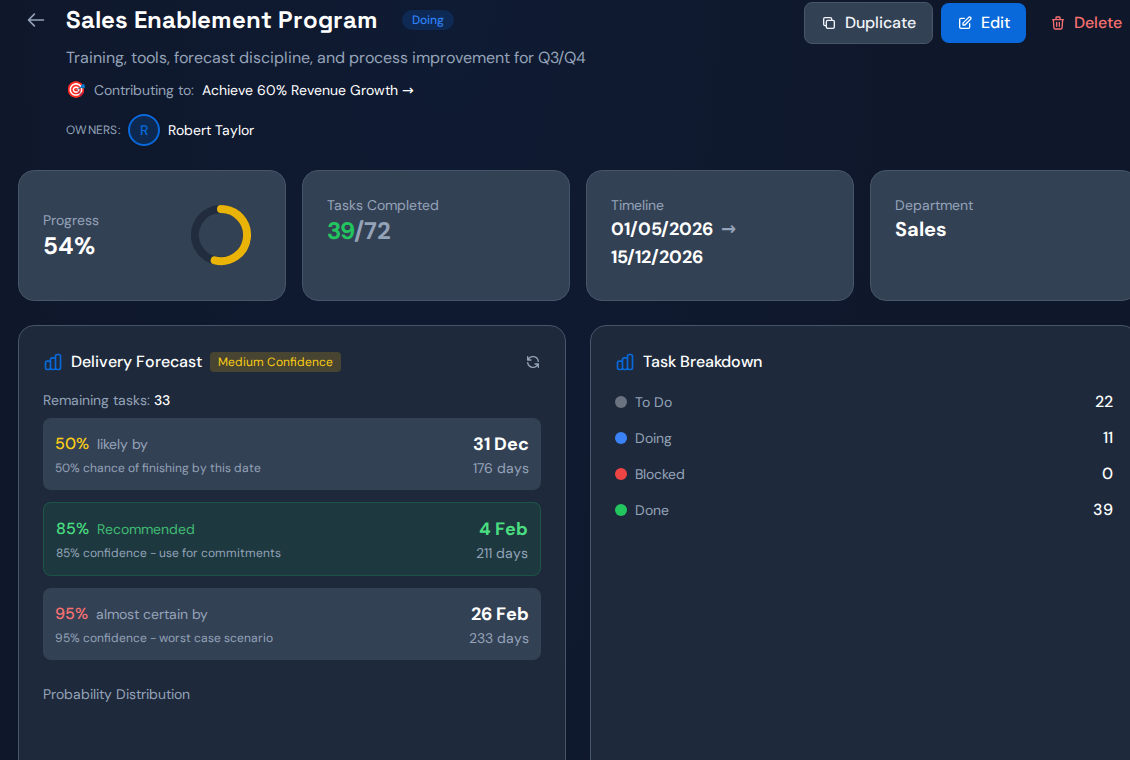
Commandix connects projects to goals, tasks, teams, and owners. That means portfolio pressure can be inspected instead of guessed. A project is not just a card with a status. It is a set of work, people, collaborators, task patterns, and goal contribution. When leaders open the portfolio, they can see not only what exists but what the portfolio is asking the organization to absorb.
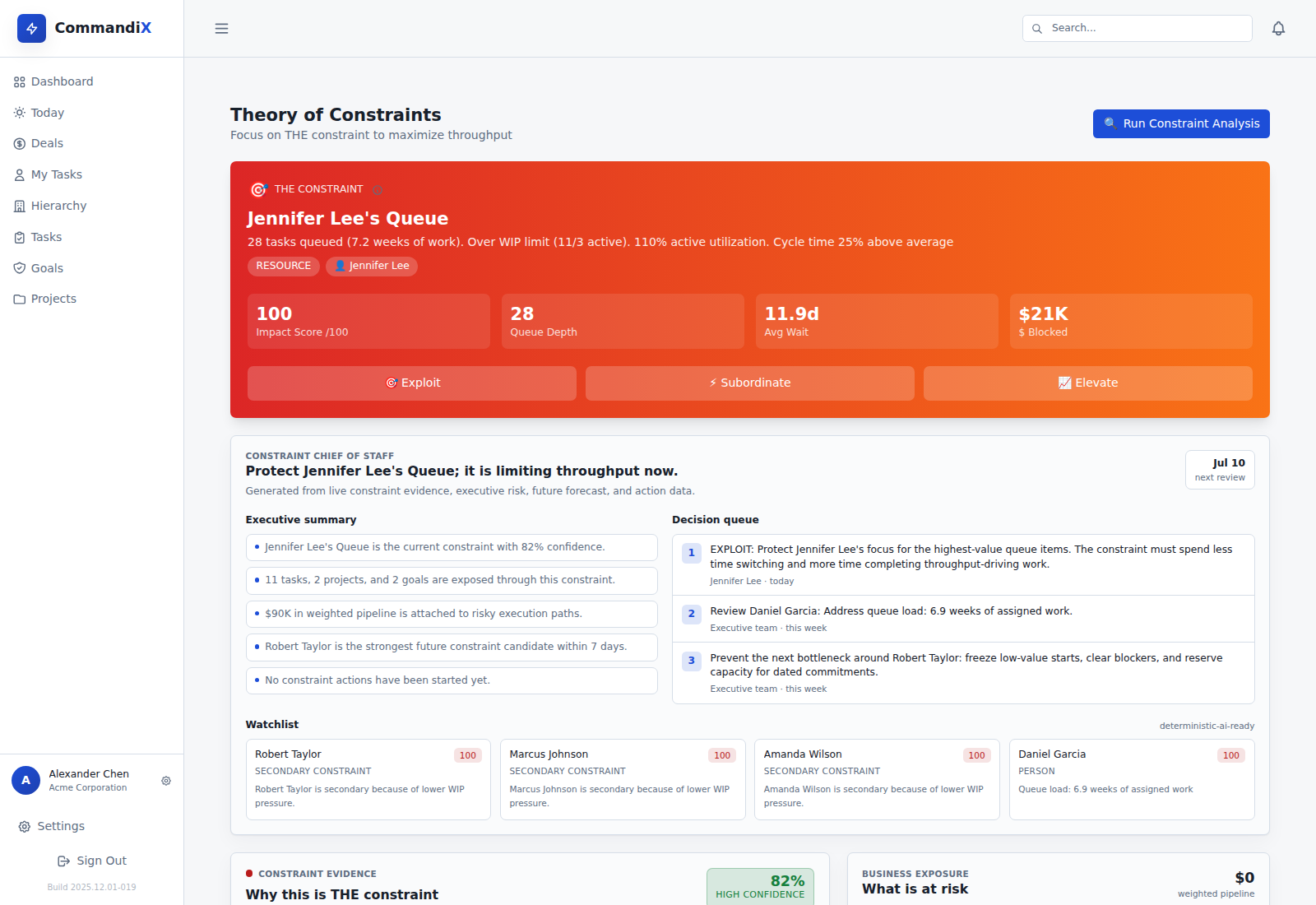
Constraint analysis adds the next layer. If several projects are waiting on the same team or person, that pattern can be treated as a candidate constraint. Flow analytics can then show whether completed work is keeping pace. Department and person views show whether workload is becoming unhealthy. Together, these views turn portfolio management from opinion into operating evidence.
The discipline of saying not yet
The hardest portfolio move is not cancellation. It is sequencing. Leaders love to say yes because yes feels strategic. But if the constraint cannot process the work, yes becomes delay in disguise. A disciplined portfolio review asks which projects deserve constrained capacity now and which must wait.
This is not pessimism. It is respect for throughput. A company that finishes three critical projects cleanly may create more value than a company that starts ten and drags all ten through a swamp. The point is not to do less forever. The point is to stop choking the system so finished work can create value sooner.
Portfolio exploit, subordinate, elevate
To exploit the portfolio constraint, protect the constrained role or team. Make sure it works only on the highest-value project tasks. Clear inputs before they arrive. Remove meeting noise. To subordinate, adjust other projects to the pace of the constraint. Do not keep launching dependent work that will only wait. To elevate, add capacity through training, delegation, hiring, automation, or external support when the evidence shows the constraint remains binding.
This framework calms the chaos because it gives leaders a sequence. They do not have to argue abstractly about who deserves resources. They can inspect the constraint and decide what increases portfolio throughput.
A portfolio review that works
Start with the strategic goals. List the active projects supporting them. Identify shared resources and dependencies. Open blocked and overdue work. Look for repeated queues. Rank projects by business value and constraint demand. Then decide what gets protected, what gets paused, and what gets elevated.
The review should produce action, not commentary. If the backend lead is the constraint, the action might be to pause lower-value engineering requests for two weeks. If sales enablement is the constraint, the action might be to protect proposal support capacity. If executive approval is the constraint, the action might be a fixed decision window with prepared packets.
The value for the business
Portfolio bottleneck management gives the business finishing power. It reduces strategic thrash. It helps leaders stop pretending that capacity is infinite. It protects the work that matters most and gives teams the psychological relief of a system that finally makes sense.
When the portfolio is managed around the constraint, projects stop strangling each other. The company gets momentum back. People see work finish. Goals move. Leadership conversations become more honest. That is not just better project management. It is better company execution.
The CFO should care about portfolio WIP
Portfolio overload is not just an execution problem. It is a capital problem. Every active project consumes money, attention, leadership bandwidth, and scarce specialist capacity. When too many projects run at once, the company does not simply become busier. It increases the amount of investment trapped in unfinished work.
That trapped investment is invisible unless the portfolio is connected to the operating system. Leaders need to know which projects are consuming constrained capacity, which goals they support, and which work is waiting. Without that view, the company can spend aggressively and still feel slow.
How the strongest teams use the portfolio view
The strongest teams use portfolio review as a sequencing weapon. They do not ask whether every project is worthy. They ask what the constraint can actually process now. They protect the highest-value work, pause attractive distractions, and make capacity elevation a deliberate decision rather than a panic response.
Commandix supports that move because projects are connected to goals, tasks, teams, and constraint evidence. The review can stop being a tour of project statuses and become a leadership decision about throughput. That is where portfolio management becomes strategic instead of administrative.
The portfolio decision rule
Use a simple rule: the portfolio is healthy only when the constrained capacity can finish the highest-value work without being buried by lower-value demand. That rule sounds strict because it is. It forces leadership to stop approving work as if every initiative lives in a vacuum. The system has limits, and ignoring them is how good projects slowly suffocate each other.
In a portfolio review, rank projects by strategic value and constraint demand. A high-value project that needs a constrained specialist may deserve protection. A medium-value project that consumes the same capacity may need to wait. A low-value project with heavy dependency load may need to be killed, paused, or redesigned. These are not administrative calls. They are strategy calls.
Commandix makes that strategy visible. Projects carry owners, collaborators, tasks, goals, and status. Constraint analysis reveals whether the same capacity is being hit repeatedly. Flow analytics shows whether work is actually finishing. Leaders get a portfolio that can be operated, not just admired. That is how a company turns strategic ambition into finished outcomes instead of a shelf of half-complete promises.
The portfolio question that changes the room
Ask one question in the next portfolio review: which active projects are competing for the same constrained capacity? The room will usually get sharper immediately. People may discover that the highest-priority launch, the executive reporting initiative, and the sales enablement project all need the same analyst, architect, reviewer, or decision group.
Once that truth is visible, leadership gets choices. Protect the highest-value project. Pause the lower-value project. Train another person. Reduce scope. Change the approval policy. The portfolio stops being a list of commitments and becomes a system that can be operated.
That is the value Commandix is designed to create: not just project visibility, but portfolio decisions that improve throughput. The company finishes more of what matters because it finally respects the constraint shared across the work.
Frequently asked questions
What is a project portfolio bottleneck?
It is a shared resource, team, dependency, decision, or policy that limits delivery across multiple projects.
Why do portfolios create bottlenecks?
Because leaders often approve more projects than the constrained resources can actually process.
How do you fix a portfolio bottleneck?
Identify the shared constraint, protect its capacity, reduce WIP, subordinate lower-value projects, and elevate capacity only when necessary.