CommandiX Open demo

Theory of Constraints

Theory of Constraints Software: The Executive Guide to Constraint Management Systems

How modern Theory of Constraints software helps executives identify, exploit, subordinate, elevate, and repeat around the constraint limiting company throughput.

Command center constraint signals
Command center constraint signalsTOC starts with the system goal, not with local productivity metrics.

Key takeaways

  • Theory of Constraints software should make the Five Focusing Steps operational, not just explain TOC concepts.
  • The executive version of TOC must connect goals, people, projects, tasks, sales, and flow data.
  • Commandix is built around the weekly question that matters: what is the constraint and what action will improve throughput?

Theory of Constraints software should help leaders find THE constraint, not drown them in dashboards. Goldratt's insight is simple and uncomfortable: every system has a limiting factor, and improving anything else produces little leverage until the constraint moves. For executives, that idea is electric. It means the company does not need equal attention on everything. It needs disciplined attention on the point limiting the goal.

Modern companies need this more than ever. Knowledge work is full of invisible queues. Deals wait for security answers. Projects wait for senior review. Product launches wait for cross-functional decisions. Goals wait for tasks that are not connected to the people who can move them. Without software that exposes the constraint, leadership meetings turn into storytelling.

What TOC software must do

A serious constraint management system should support the Five Focusing Steps: identify the constraint, exploit it, subordinate everything else to it, elevate it, and repeat. The software should not treat these as a poster on the wall. It should make them visible in the weekly operating cadence.

TOC stepExecutive questionCommandix workflow
IdentifyWhat is limiting the most important goal?Constraint analysis, queue depth, wait, blocked value.
ExploitHow do we protect the constraint now?Exploit action with owner and follow-up.
SubordinateWhat should the rest of the system stop or change?Subordinate lower-value work and align teams.
ElevateDo we need more capacity, automation, or redesign?Elevation action when evidence justifies investment.
RepeatDid throughput improve and where did the constraint move?Flow analytics, workload, goals, and action review.

Why ordinary dashboards hide constraints

Ordinary dashboards are often too democratic. They give every metric a tile. They show every department, every project, every task count, and every trend as if each one deserves equal attention. That can be comforting, but TOC is not democratic. It asks leaders to decide which part of the system has the highest leverage right now.

A team may have low completion, but it may not be the constraint. A person may be overloaded, but completed work may still flow. A cumulative flow chart may look thin because the historical data is sparse, while current workload already shows a dangerous queue. A good TOC tool explains these differences instead of flattening them into red and green status.

TOC warning

Do not confuse local utilization with system throughput. A company can keep everyone busy and still starve the constraint of clean, high-value work.

Identified constraint
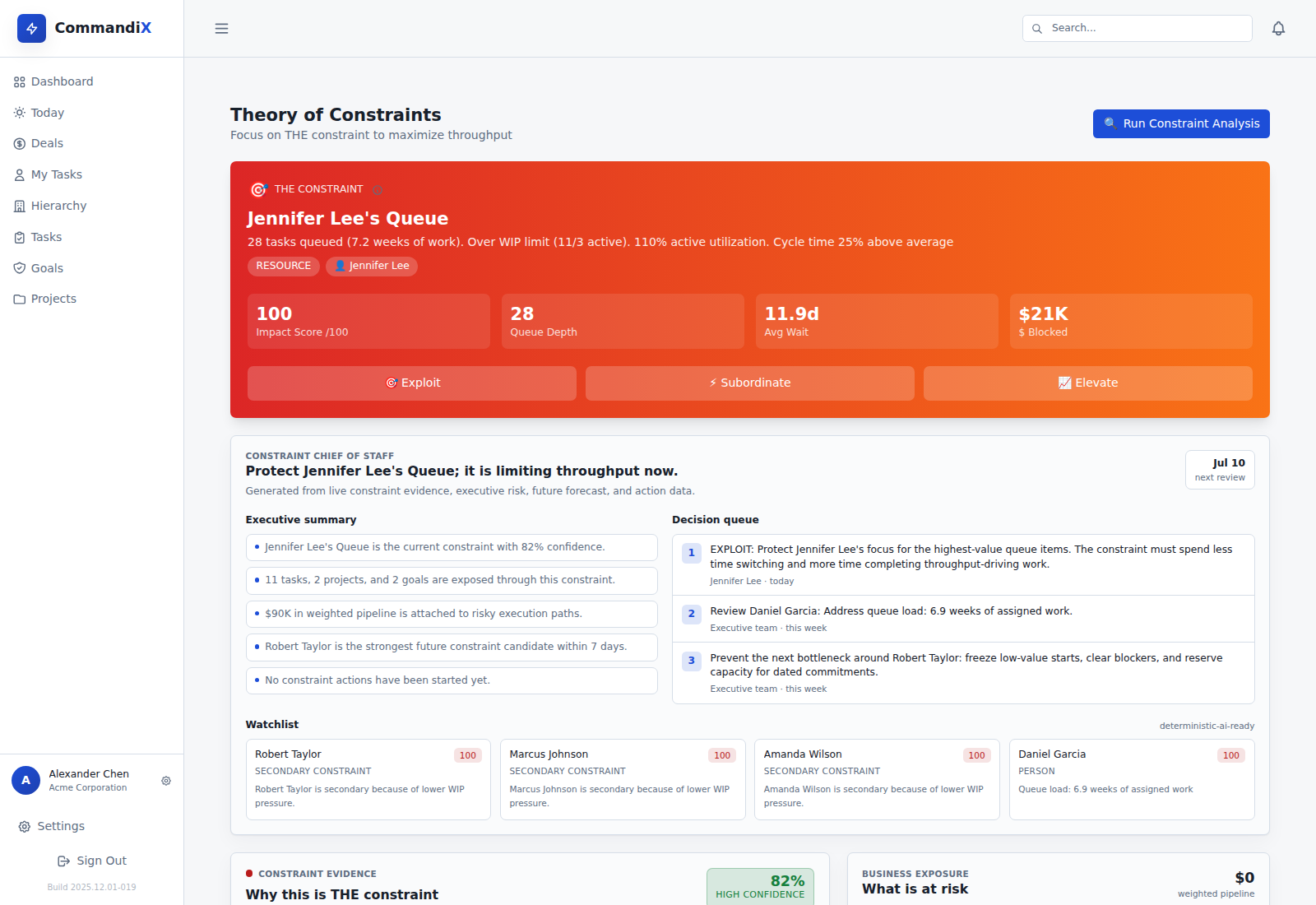
Identified constraintCommandix names the constraint and shows why it is limiting throughput now.

Constraint types in modern companies

Manufacturing has physical work centers. Knowledge work has human and decision work centers. The constraint may be a senior architect, implementation specialist, sales engineer, executive approver, legal review path, product manager, customer-success handoff, or overloaded operations queue. It may also be policy: too many approvals, too many active projects, or an intake process that lets demand exceed capacity.

Commandix gives these constraints a shared operating home. The dashboard shows the system. Goals show what matters. Tasks and projects show the work. Sales shows revenue movement. Flow analytics shows wait and movement. Constraint analysis names the bottleneck. Actions make the management response explicit.

Exploit, subordinate, elevate actions
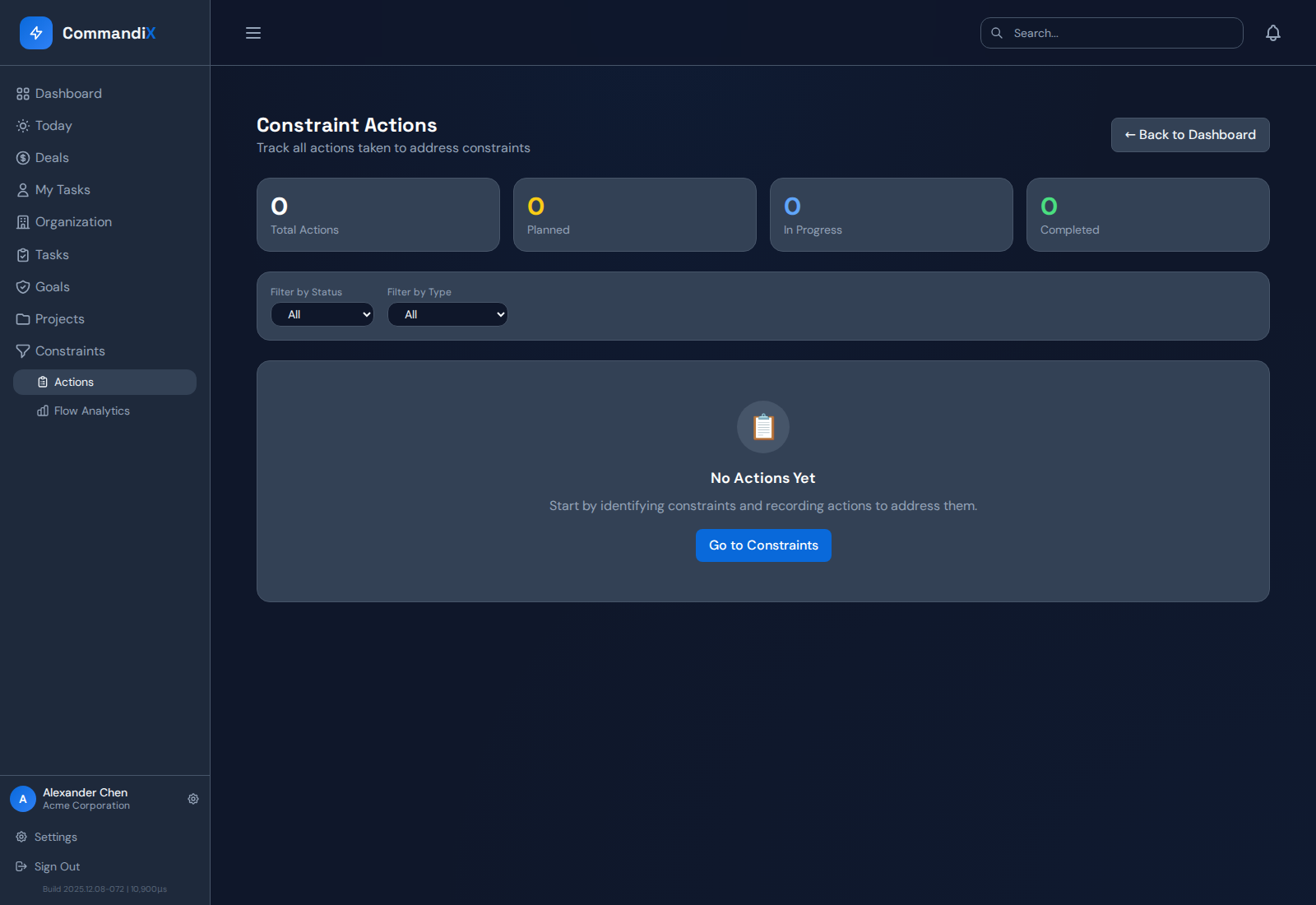
Exploit, subordinate, elevate actionsThe Five Focusing Steps become a practical leadership action list.

The executive TOC cadence

Run TOC as a weekly cadence, not an annual consulting exercise. Monday: pick the goal that matters most. Tuesday: inspect the work connected to that goal. Wednesday: run constraint analysis and review the evidence. Thursday: decide the exploit, subordinate, or elevate action. Friday: confirm ownership and decide what will be measured next week.

The cadence matters because constraints move. Once a team protects Jennifer Lee's queue, the constraint may shift to sales follow-up, project intake, or legal review. That is success, not failure. TOC is a continuous hunt for leverage. The software should make the hunt repeatable.

Project tools

Great for tasks and owners, weaker at naming the system limit.

CCPM tools

Strong for project buffers, often narrower than company execution.

Commandix

Built for goals, work, teams, sales, flow, constraints, and actions.

What to look for in a constraint management system

Buying checklist

  • Does it identify one active constraint with evidence?
  • Does it show business impact, not only task count?
  • Can leaders drill into people, teams, projects, and revenue?
  • Does it turn the constraint into exploit, subordinate, or elevate actions?
  • Does it review whether throughput improved after the action?
  • Can executives understand it without becoming flow-metric specialists?

The best TOC software should make a leadership team calmer and more intense at the same time. Calmer because the problem is visible. More intense because the next action is hard to ignore. When the constraint is named, excuses become less useful. The company knows where to aim.

Flow analytics for TOC
Flow analytics for TOCFlow metrics help confirm whether the constraint is affecting real throughput.

How Commandix operationalizes TOC

Commandix starts from the command center and moves toward action. The dashboard shows strategy, departments, sales, throughput, and work mix. The constraint page identifies the active constraint and why it matters. The actions page turns that diagnosis into the language of TOC: exploit, subordinate, elevate. Flow analytics and workload give the next review evidence.

This is the difference between TOC as an idea and TOC as an operating system. An idea can inspire a room. An operating system changes what the room does next. Commandix is designed for the second outcome.

Goals affected by constraints
Goals affected by constraintsGoals give the constraint business meaning and prevent local optimization.

Where TOC software creates executive leverage

The first source of leverage is attention. Executives have more possible problems than useful hours. TOC gives them a principled way to choose what deserves attention. If the active constraint is the sales proposal queue, then debating engineering velocity may be interesting but not decisive. If the active constraint is a senior reviewer, then launching more projects only increases inventory. Software makes this visible before the leadership team spreads effort across too many fronts.

The second source of leverage is language. A leadership team that uses TOC can stop saying vague things like "we need better execution" and start saying specific things like "we need to exploit the current sales engineering constraint by protecting demo-prep capacity and subordinating lower-value internal requests." Specific language produces specific action. Specific action produces measurable learning.

The third source of leverage is courage. TOC often reveals that the company must stop doing something. That is politically harder than starting something. A system full of evidence helps leaders defend the pause. When the dashboard shows queue depth, wait time, blocked value, and exposed goals, the decision to pause lower-value work stops feeling arbitrary. It becomes the responsible move.

Implementation plan for the first month

Week one is mapping. Choose one company goal and confirm the projects, tasks, units, and revenue work connected to it. Week two is diagnosis. Run constraint analysis and inspect workload and flow. Week three is intervention. Pick one exploit or subordinate action, assign one owner, and protect the constraint. Week four is proof. Compare flow, wait, blocked value, and goal movement. Then repeat with the next constraint.

This is intentionally narrow. A company that tries to implement TOC everywhere on day one usually turns a sharp method into a broad initiative. Start with one important goal. Prove that focused constraint action improves throughput. Then expand the cadence. Momentum beats ceremony.

Sales constraint impact
Sales constraint impactRevenue work can be constrained by sales execution, handoffs, or internal dependencies.

What executives should ignore at first

Ignore the urge to build a perfect model. TOC does not require a perfect map of the company before action starts. It requires a useful enough diagnosis of the current constraint. Leaders should also ignore local efficiency theater. A team that improves its own utilization while starving the constraint is not helping the system. The question is always throughput against the goal.

Also ignore vanity adoption metrics during the first month. The point is not how many users logged in. The point is whether the leadership team used the system to make one better decision. Did they protect constrained capacity? Did they pause lower-value work? Did they clear a recurring queue? If yes, adoption will have a business reason to grow.

That is the practical promise of TOC software: fewer opinions, faster learning, and a clearer path from constraint to measurable improvement.

That promise is exactly what a search visitor needs to see. They may arrive looking for "TOC software" or "constraint management system," but the real buying question is whether the product can change the next leadership meeting. Commandix should make the answer visible on the page: here is the constraint, here is the evidence, here is the action, and here is how the next review proves whether throughput improved.

That clarity is the difference between content that ranks and content that sells.

Run TOC in a live command center.

Open Commandix and inspect the identified constraint, action loop, and flow evidence in the demo workspace.

Open live demo

Frequently asked questions

What is Theory of Constraints software?

Theory of Constraints software helps organizations identify the constraint limiting throughput, decide how to exploit and subordinate around it, elevate capacity when needed, and repeat the process.

Is TOC only for manufacturing?

No. TOC applies anywhere a system has a goal and a limiting factor, including SaaS, sales, engineering, services, operations, and project portfolios.

What makes Commandix different from project management software?

Project management organizes work. Commandix connects goals, work, people, revenue, flow, constraints, and actions so executives can manage the system limit.

See the operating system behind the article.Open Commandix demo