Theory of Constraints in Software Development: Find Engineering Flow Bottlenecks

Theory of Constraints in software development helps engineering leaders find the workflow, review, dependency, or decision queue limiting delivery throughput.

Engineering execution dashboard showing department performance, active work, goals, and current delivery constraints in Commandix for theory of constraints software development
Engineering execution constraint dashboardEngineering constraint analysis begins with the delivery outcome and the work system supporting it.
On this page

Key takeaways

  • Theory of Constraints applies to the flow of software delivery, not to runtime code profiling or infrastructure diagnostics.
  • The engineering constraint is the stage, skill, policy, dependency, or decision queue that limits valuable software completion relative to the goal.
  • Protecting constrained capacity and limiting upstream WIP usually deserves attention before hiring or pushing developers to start more work.

Theory of Constraints in software development begins with an uncomfortable observation: the engineering organization can become busier while delivering less. More tickets start. More branches open. More projects report progress. Work accumulates before review, testing, approval, release, or a scarce technical decision. The system celebrates activity while the customer waits.

Engineering leaders often know where pressure feels highest, but feeling is not enough for a portfolio or staffing decision. They need to see where work queues, how long it waits, which projects depend on the same capacity, what business value is blocked, and whether the suspected bottleneck actually controls delivery throughput.

Commandix addresses the management layer of that problem. It connects engineering goals, projects, tasks, owners, workload, flow analytics, and constraint actions. It does not profile application code, inspect CPU traces, or replace observability platforms. Its purpose is to identify execution bottlenecks in the human and project system that turns strategy into shipped work.

Define the engineering system and its goal#

Constraint analysis fails when the system boundary is vague. A product engineering system might begin when work is selected and end when a reliable capability reaches users. Its goal might be valuable software delivered with an acceptable balance of speed, quality, security, and sustainability.

That definition prevents local optimization. Coding speed is not the system goal if work then waits in review. Test automation volume is not the goal if release decisions remain slow. High utilization is not the goal if queues and defects increase. The output is valuable, completed software and the learning it creates.

Connect the goal to projects and tasks so the work can be inspected. If engineering activity cannot be traced to an outcome, leadership cannot tell whether capacity is being spent on the result the company promised.

Engineering rule

Optimize the rate of valuable software completion, not the local speed or utilization of every stage.

Separate delivery bottlenecks from code bottlenecks#

The phrase engineering bottleneck can describe two different problems. Runtime bottlenecks occur inside software or infrastructure: CPU, memory, database, network, or code-path limitations. Delivery bottlenecks occur in the operating process: design decisions, review, testing, security approval, environments, dependencies, release authority, and portfolio overload.

The tools are different. Profilers, APM, tracing, and infrastructure observability diagnose runtime behavior. Execution management, work tracking, flow analytics, and constraint methods diagnose how engineering work moves. Commandix belongs to the second category.

Problem typeTypical evidenceAppropriate tools
Runtime code bottleneckLatency, CPU, memory, traces, query timingProfiler, APM, tracing, database diagnostics
Build or CI bottleneckQueue time, build duration, failure and retry rateCI analytics plus delivery-flow context
Review bottleneckPull requests waiting, repeated reviewer concentrationRepository analytics plus workload and project context
Delivery workflow bottleneckAging work, blocked dependencies, long lead timeFlow analytics and execution management
Portfolio bottleneckSeveral initiatives need the same specialist or decisionProject portfolio and constraint management software
Engineering team performance dashboard showing people, workload, contribution, and execution context in Commandix for theory of constraints software development
Engineering team performance and workloadTeam evidence helps leaders distinguish individual performance from a workflow or dependency constraint.

Map the software delivery flow#

Map the states that matter from commitment to delivery. A simple flow may include selected, ready, active, review, validation, blocked, and done. The exact labels matter less than consistent movement and clear entry and exit rules.

Record when work enters and exits each state. That creates lead time, cycle time, waiting, and aging evidence. Connect work to owner, project, goal, priority, and dependency. The map should be detailed enough to reveal a queue but simple enough that teams maintain it during normal work.

Do not force every engineering activity into one generic path. Product changes, security work, infrastructure changes, and incident follow-up may have different flows. Analyze each relative to its goal, then inspect shared resources across them.

Find the constraint using flow evidence#

Start with queue age and wait time. Where does work spend elapsed time without progressing? Add WIP and arrival rate. Is upstream work entering faster than the stage can complete it? Add ownership concentration. Does one person or skill appear repeatedly? Add business impact. Which goals, releases, customers, or revenue commitments wait behind the queue?

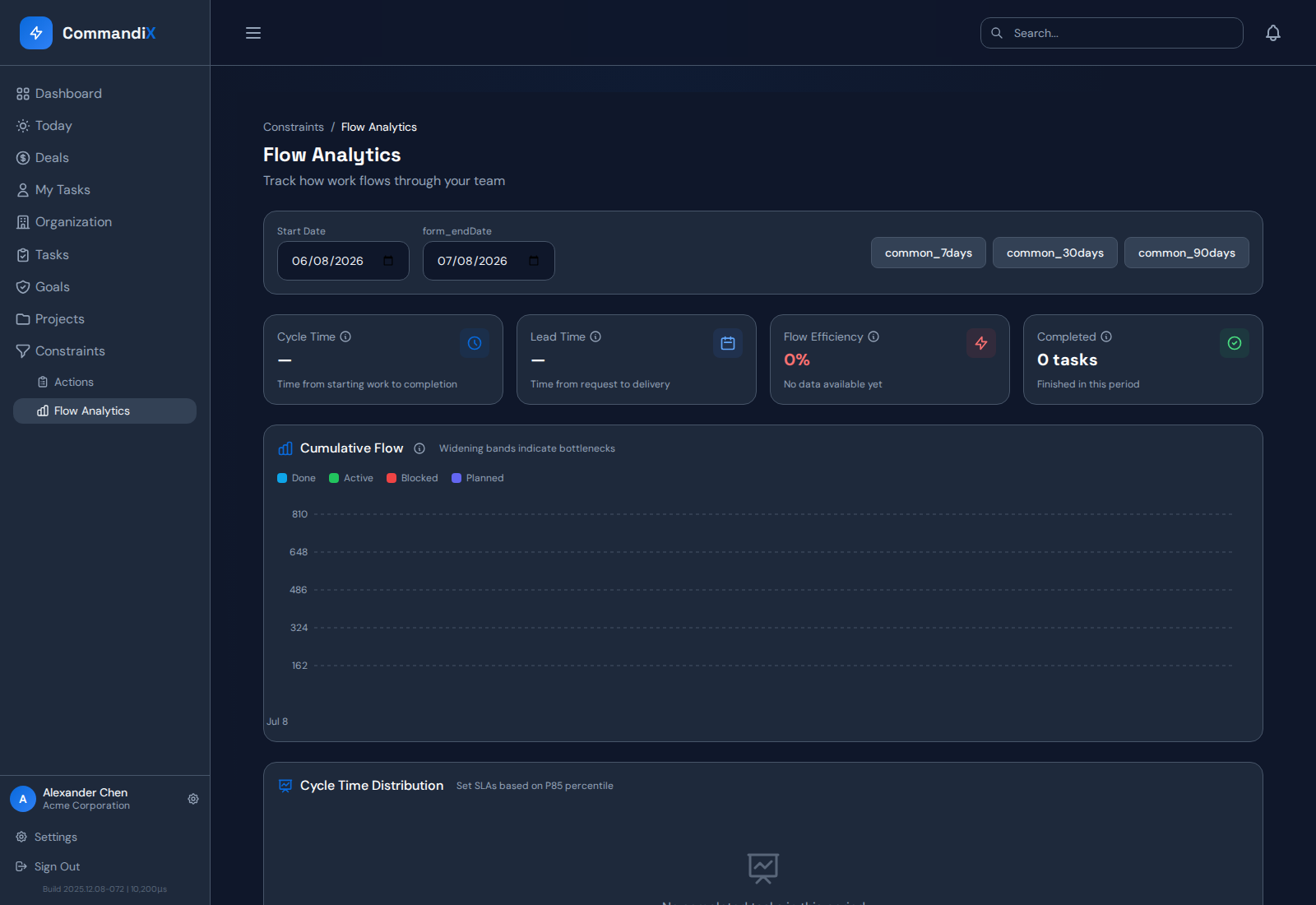
Cumulative flow can reveal a widening band between states, which signals accumulating inventory. Cycle-time distributions show whether delay is broad or driven by a few extreme items. Blocked-work history shows repeated dependencies. Workload shows whether the suspected stage is capacity constrained or poorly sequenced.

Use several signals because one can mislead. A review queue may look large but clear quickly. A small architecture decision queue may block several high-value projects. The constraint is the point limiting the system goal, not the biggest visual element.

Engineering constraint evidence

  • Waiting time is material relative to active engineering time.
  • The same stage, skill, reviewer, dependency, or decision appears repeatedly.
  • The queue affects committed goals, projects, customers, or revenue.
  • Upstream WIP continues to feed the constrained point.
  • Cycle time or lead time changes with pressure at the candidate constraint.
  • Removing isolated blockers does not remove the repeated pattern.
Software development task flow dashboard showing planned, active, blocked, overdue, and completed engineering work in Commandix for theory of constraints software development
Software development task flow dashboardTask states and age reveal where engineering work waits between commitment and completion.

Recognize common software development constraints#

Architecture and product decisions become constraints when teams wait for a small number of people to resolve ambiguity. Code review becomes a constraint when critical changes route through specialists whose attention is fragmented. Testing becomes a constraint when environments, data, or manual validation cannot absorb development output.

Security and compliance can constrain delivery when evidence arrives late or approval is centralized without clear readiness rules. Cross-team dependencies create queues when one platform or data team serves many roadmaps. Portfolio policy becomes the constraint when leadership starts more initiatives than engineering can finish.

These conditions are not proof that the owner or function is failing. They often indicate that the company has placed too much unprepared demand on scarce capability. Constraint management changes how the system uses and protects that capability.

Skill constraint

Critical work depends on scarce expertise or review authority.

Policy constraint

Rules, approvals, or intake behavior create avoidable waiting.

Portfolio constraint

Too many active initiatives compete for shared engineering capacity.

Exploit the engineering constraint#

Exploit means use existing constraint capacity for the work only it can do. Prepare inputs before handoff. Reduce meetings and context switching. Route routine decisions elsewhere. Pair constrained experts with others to transfer knowledge. Prevent defects and incomplete requests from consuming the queue.

For code review, teams can improve change size, automated checks, review readiness, and routing. For architecture, define decision templates and office hours. For testing, stabilize environments and move repeatable checks earlier. For security, agree on evidence and threat-model requirements before late-stage approval.

The goal is not permanent heroics. It is a reliable operating rule that protects scarce attention while reducing dependency on individual heroics over time.

Engineering project portfolio dashboard showing initiative priority, ownership, progress, and shared capacity pressure in Commandix for theory of constraints software development
Engineering project portfolio constraintsPortfolio demand can overload a shared engineering skill even when individual project plans appear realistic.

Subordinate intake and portfolio work#

Subordination is where leadership behavior changes. Stop feeding more work than the constraint can absorb. Limit WIP. Sequence projects by business value. Delay lower-priority starts. Make upstream teams accountable for complete inputs. Keep a ready buffer before the constraint without allowing an uncontrolled queue.

This can feel slower because fewer initiatives appear active. Completion should increase. The company trades the comfort of visible motion for the economics of finished value.

Commandix links project priority, task state, owners, goals, and constraints so subordination decisions remain visible. Teams can see why work paused and which outcome the protected capacity supports.

Portfolio warning

Starting more engineering work does not create more capacity. It creates more inventory unless the constraint can complete it.

Elevate capacity with evidence#

Elevate when exploitation and subordination are working but the constraint still limits valuable demand. Add training, automation, authority, tooling, environments, supplier support, or people. Choose the intervention that changes effective capacity at the constrained point.

Measure the cost against blocked value and expected throughput. Hiring a specialist may be justified when a sustained queue delays strategic outcomes. Hiring broadly because every team feels busy is not the same decision.

After elevation, check where the constraint moved. A faster review stage may expose testing or release authority as the next limit. Continuous constraint management expects that movement.

Engineering flow analytics showing cycle time, lead time, flow efficiency, WIP, blocked work, and cumulative flow in Commandix for theory of constraints software development
Engineering flow analytics and cumulative flowFlow evidence identifies widening queues and verifies whether engineering throughput improved.

Run an engineering constraint review#

Keep the weekly review narrow. Confirm the engineering outcome. Inspect changed flow and portfolio signals. Name the candidate constraint and supporting evidence. Review the previous action. Decide what to exploit, what work to subordinate, and whether elevation is justified. Assign one owner and throughput check.

Do not turn the review into individual performance theater. A person appearing in the queue may be carrying a system dependency leadership created. Inspect assignments, authority, inputs, and interruption before interpreting the signal.

At the next review, compare queue age, cycle time, completed work, blocked value, and goal movement. The feedback closes the management loop.

Use software to connect engineering evidence and action#

Repository and delivery tools contain important local data. An execution command center adds company context: which goal, project, department, owner, and business commitment is affected. That prevents engineering flow from becoming an isolated efficiency exercise.

The cumulative flow diagram guide for executives explains how widening bands and WIP patterns signal risk. The Theory of Constraints software executive guide covers the broader selection and operating model.

Commandix gives engineering leaders a place to connect the work system to leadership decisions. It helps the company identify the delivery constraint, protect it, change portfolio behavior, and verify whether valuable software moves faster.

See the engineering work system behind delivery risk.

Inspect projects, tasks, people, workload, flow, constraints, and next actions in a connected Commandix workspace.

Open live workspace
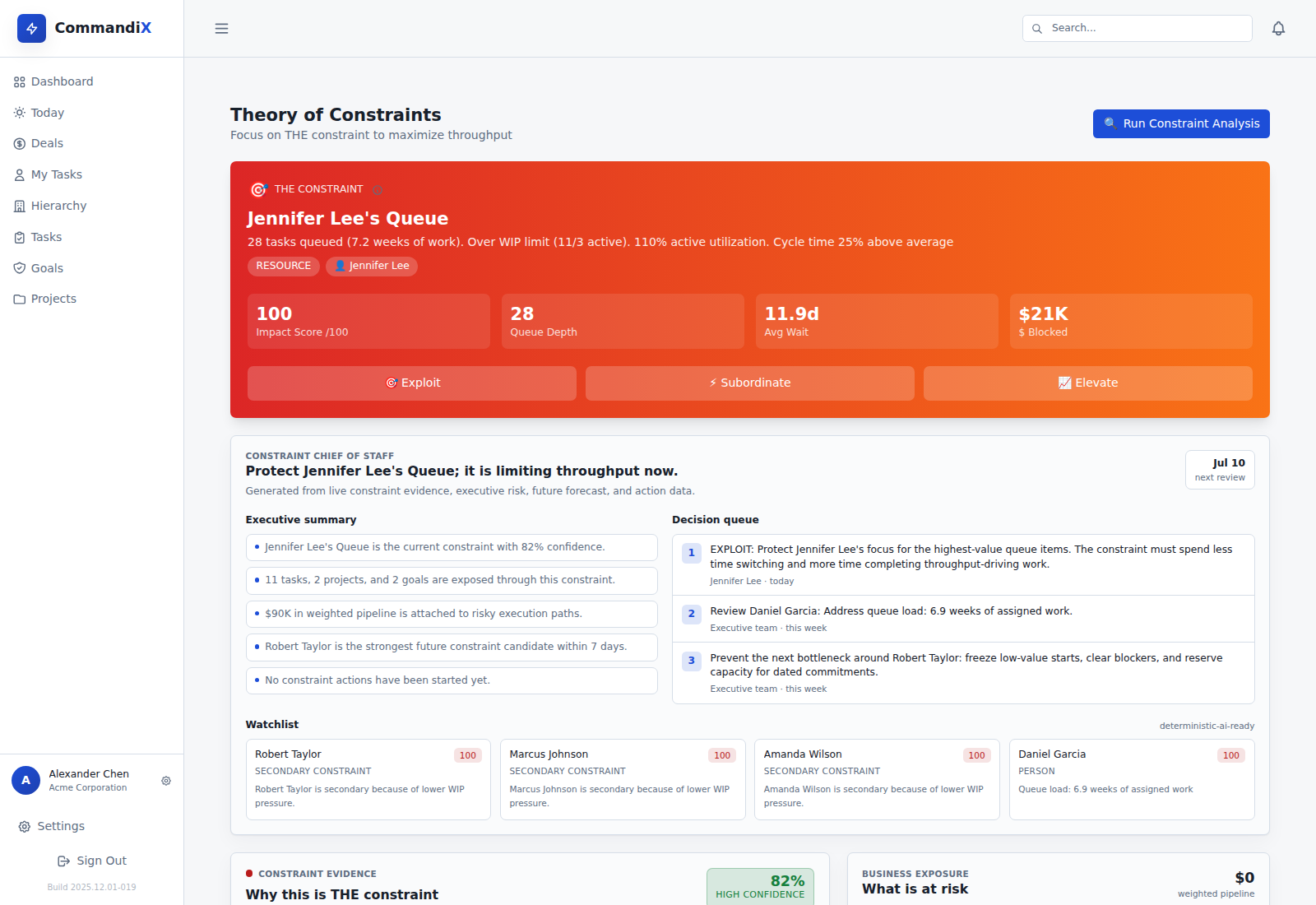
Software delivery constraint analysis showing the limiting queue, owner, impact, evidence, and next action in Commandix for theory of constraints software development
Software delivery constraint actionThe constraint action turns engineering analytics into a change in focus, intake, sequence, or capacity.

Frequently asked questions#

How does Theory of Constraints apply to software development?#

It treats software delivery as a flow system and identifies the stage, skill, dependency, policy, or decision queue that limits the rate of valuable software completion.

Is engineering bottleneck software the same as application performance monitoring?#

No. APM and profiling diagnose runtime code and infrastructure. Engineering execution software diagnoses workflow, project, capacity, dependency, and decision bottlenecks in software delivery.

Which metrics reveal software delivery bottlenecks?#

Useful evidence includes wait time, queue age, cycle time, lead time, WIP, flow efficiency, blocked work, ownership concentration, dependency pressure, and affected business value.

What should engineering leaders do after finding the constraint?#

Protect the constraint from avoidable waste, subordinate intake and portfolio work to its capacity, elevate capacity when justified, and verify whether throughput improved.

See it in Commandix

Ask the operating system what leadership should inspect first.

Explore the AI Analyst with goals, work, revenue, teams, and constraint evidence in context.
Review one delayed result
Back to all Commandix articles