CommandiX Open demo

OKR examples

75 OKR Examples That Include the Execution Constraint

Most OKR examples stop at ambition. These OKR examples include the execution constraint, owner, and operating signal needed to move the business.

OKR command center layers
OKR command center layersHow objectives become operational when goals connect to projects, tasks, owners, constraints, and revenue.

Most OKR examples are too polite. They describe ambition, attach a few key results, and walk away before the hard part begins. But the hard part is where the business lives. What will stop this objective from moving? Which team is overloaded? Which project is dependent on one person? Which sales process is leaking momentum? Which approval path will quietly eat three weeks?

A better OKR example includes the execution constraint. Not because leaders should be pessimistic, but because they should be awake. The constraint is the thing that can make a beautiful objective fail. When teams name it early, the OKR becomes more than a statement of intent. It becomes a plan for focus.

How to write a constraint-aware OKR

Start with the objective. Make it directional, valuable, and memorable. Then write key results that prove progress. After that, add the constraint hypothesis: the person, team, process, dependency, resource, or market condition most likely to limit throughput. Finally, define the operating signal that will tell you whether the constraint is improving.

The format is simple: Objective, Key Results, Current Constraint, Operating Signal, Next Action. This extra layer keeps OKRs grounded. It prevents teams from pretending that setting the target is the same as creating the capacity to hit it.

Company OKR examples

Objective: Increase enterprise execution speed. Key results: complete 85 percent of strategic initiatives on time, reduce blocked work by 30 percent, and cut average leadership decision wait time to under three days. Current constraint: too many projects depend on the same executive review group. Operating signal: approval queue age. Next action: subordinate low-priority reviews and create a weekly constraint review.

Objective: Improve company-wide goal delivery. Key results: move strategic goal completion from 50 to 75 percent, reduce overdue goal-linked tasks by 25 percent, and ensure every goal has an active project owner. Current constraint: goal work is not consistently connected to projects and tasks. Operating signal: percentage of goals with linked execution work. Next action: audit goals and attach owners, projects, and task weights.

Objective: Build a calmer, faster operating rhythm. Key results: reduce recurring status meetings by 40 percent, publish one weekly execution brief, and close 90 percent of constraint actions within two weeks. Current constraint: managers spend too much time collecting updates manually. Operating signal: number of manual update requests. Next action: move review to the command center and require evidence from live work.

Goal traceability
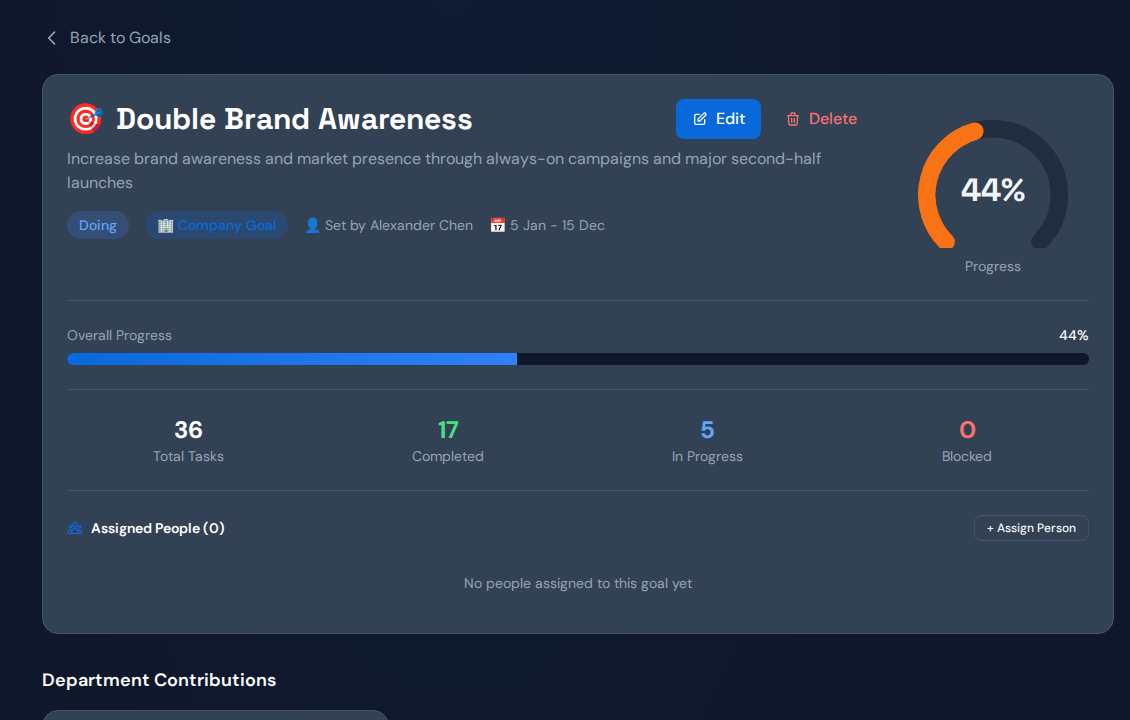
Goal traceabilityFollow a strategic goal into projects, weighted tasks, owners, and real execution movement.

Sales OKR examples

Objective: Convert pipeline into predictable revenue. Key results: increase weighted pipeline to $600,000, close six enterprise deals, and reduce proposal follow-up delay to under 48 hours. Current constraint: account executives have too many open follow-up tasks after proposal. Operating signal: overdue sales tasks by owner. Next action: protect seller follow-up time and reassign non-selling work.

Objective: Improve sales team throughput. Key results: increase sales task completion to 80 percent, reduce overdue deal work by 35 percent, and identify top three stall reasons every week. Current constraint: handoff from discovery to proposal is slow. Operating signal: average wait between qualified stage and proposal stage. Next action: create a proposal support queue and review it twice weekly.

Objective: Raise enterprise win quality. Key results: improve average deal size, reduce low-fit opportunities, and increase close rate on qualified deals. Current constraint: pipeline volume is hiding weak qualification. Operating signal: qualified-to-proposal conversion rate. Next action: subordinate low-value outreach and focus senior selling capacity on qualified enterprise accounts.

Operations OKR examples

Objective: Reduce execution drag across departments. Key results: reduce blocked tasks by 30 percent, reduce average wait time in review queues by 25 percent, and publish constraint actions weekly. Current constraint: cross-functional approvals move slower than task execution. Operating signal: approval wait time. Next action: elevate approval ownership and remove unnecessary sign-offs.

Objective: Make work visible before it becomes urgent. Key results: every department reviews active, blocked, and overdue work weekly; every strategic project has a named owner; and every high-priority blocker has a next action. Current constraint: work enters the system faster than managers can inspect it. Operating signal: active WIP per department. Next action: create WIP thresholds and escalate breaches.

Constraint identified
Constraint identifiedImpact score, queue depth, wait time, blocked value, and exploit/subordinate/elevate actions.

Engineering OKR examples

Objective: Ship Platform 3.0 with less heroics. Key results: complete launch-critical tasks, reduce blocked engineering work by 40 percent, and keep review wait under two business days. Current constraint: backend architecture review depends on one lead. Operating signal: queue depth behind backend review. Next action: exploit the lead's time, prepare cleaner review packets, and train a second reviewer.

Objective: Improve delivery predictability. Key results: reduce cycle time variance, increase completed work per week, and cut rework from unclear requirements. Current constraint: too many tasks enter development before acceptance criteria are ready. Operating signal: tasks returned from Doing to To Do. Next action: subordinate intake to readiness criteria.

Repeatable projects
Repeatable projectsRun strategic work with owners, collaborators, reusable task patterns, and health signals.

Marketing and customer success examples

Objective: Turn brand awareness into qualified demand. Key results: publish ten high-intent SEO assets, increase demo requests, and improve conversion from blog to product walkthrough. Current constraint: content production is not connected to product proof. Operating signal: percentage of posts with screenshots and CTA. Next action: require every article to show a Commandix workflow.

Objective: Improve onboarding confidence. Key results: reduce first-value time, close onboarding tasks faster, and identify at-risk accounts before week two. Current constraint: implementation questions wait too long for internal answers. Operating signal: customer onboarding blocker age. Next action: create a priority queue for onboarding blockers and assign daily ownership.

Why this works

Constraint-aware OKRs feel different. They carry more urgency because they do not hide the risk. They carry more purpose because they connect ambition to the work that will make or break it. They also make teams braver. Instead of waiting until the end of the quarter to explain what went wrong, leaders name the likely constraint at the start and organize around it.

That is the benefit for the business: fewer surprise misses, fewer vague updates, more focused intervention, and a stronger line between strategy and execution. In Commandix, that line is visible. Goals connect to projects and tasks. Constraints connect to actions. Sales connects to operating work. The OKR stops being a slide and becomes part of the company machine.

Task flow
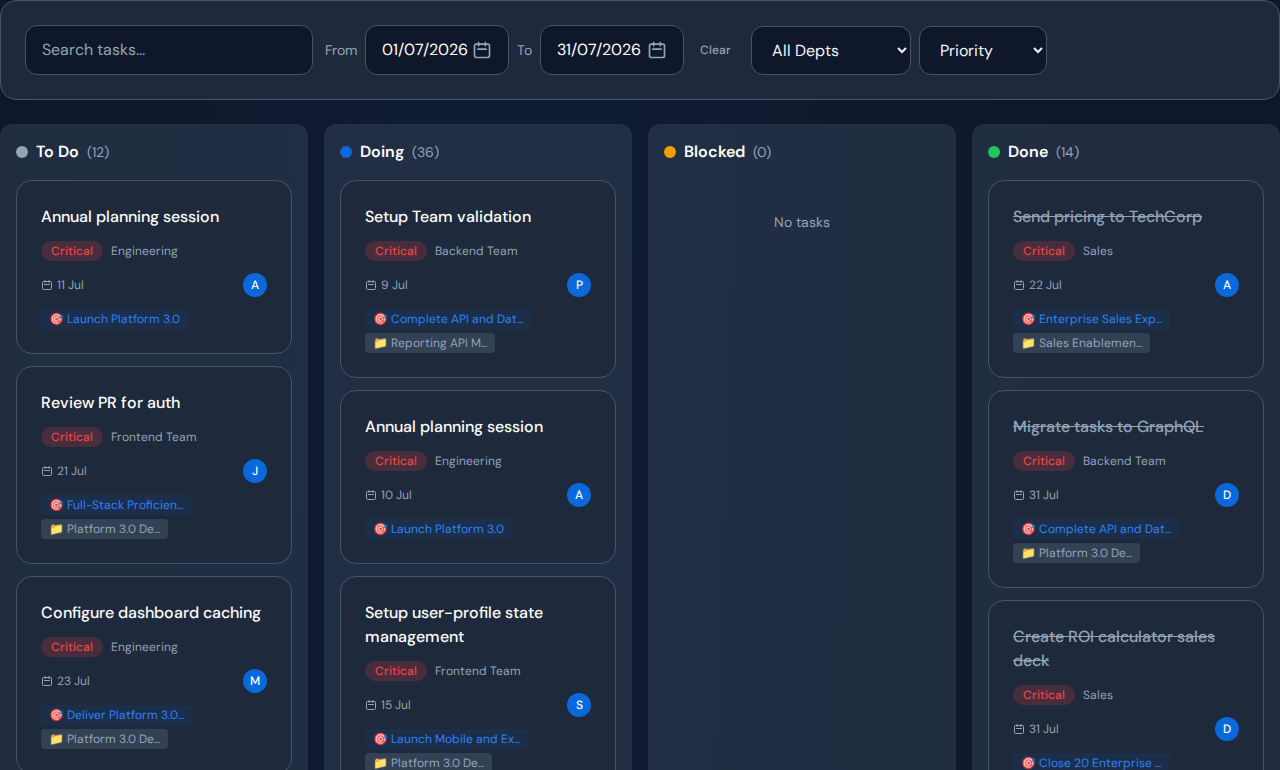
Task flowPlanned, active, blocked, and done work with owner, goal, project, and priority context.

How to use these examples without turning them into theater

Do not copy an OKR example and stop there. Use it as a starting gun. The value appears when the team names the constraint and commits to an operating signal. If the objective is revenue growth, the constraint might be seller follow-up capacity. If the objective is delivery speed, the constraint might be review wait. If the objective is customer onboarding, the constraint might be implementation answers from product or operations.

This makes the OKR more alive because it admits the battle up front. The company is no longer pretending that ambition creates capacity. It is choosing the fight that will decide whether the ambition survives the quarter.

What Commandix adds after the OKR is written

Commandix gives the example somewhere to live. The goal can be connected to projects, tasks, owners, teams, sales work, and constraints. Leaders can review progress without relying entirely on self-reported confidence. They can see whether the work exists, whether it is blocked, whether the owner is overloaded, and whether the constraint action is actually happening.

That is the leap from OKR writing to OKR execution. The examples create language. The operating system creates movement. When both work together, the company gets a goal process with muscle: inspiring enough to matter, grounded enough to survive, and focused enough to win.

Sales team performance
Sales team performanceSee who is winning, who is overloaded, and where execution work needs attention.

The constraint-aware OKR workshop

Bring the leadership team together for ninety minutes and run every proposed OKR through a constraint filter. First, ask what business outcome the objective protects or creates. Second, ask what work must exist for the objective to move. Third, ask which person, team, process, dependency, or market condition is most likely to limit that work. Fourth, choose the operating signal that will prove the constraint is improving.

This workshop changes the quality of the OKR set. Weak objectives become obvious because nobody can explain the work behind them. Overloaded objectives become obvious because the same constrained team appears again and again. Attractive but low-leverage goals become obvious because they do not connect to current business pressure.

The result is more exciting than a normal OKR planning session because the team leaves with an executable battle plan. Every goal has ambition, proof, risk, and action. Commandix then gives those goals an operating home, so the workshop does not die in a document. Goals become visible, tasks become weighted, constraints become named, and leaders can review progress from evidence instead of memory.

Frequently asked questions

Why add constraints to OKR examples?

Because an OKR without an execution constraint can look inspiring but fail in the operating system.

What departments can use constraint-aware OKRs?

Company leadership, sales, operations, engineering, marketing, customer success, and PMO teams can all use them.

Should every OKR have a constraint?

Every important OKR should have at least a current risk or constraint hypothesis so the team knows what could limit progress.

See the operating system behind the article.Open Commandix demo